Rufus Woods Lake
Fly fishing in Washington · Intermediate · Best seasons: Spring, Summer, Fall
Target Species
Rainbow Trout
About This Water
Columbia River reservoir with trophy triploid rainbow trout. World-record potential fishery.
Fishing Recommendations
Welcome to the high desert of Central Washington. As your guide, I’m excited to break down Rufus Woods Lake. This isn’t your typical mountain stream; it is a world-class tailwater fishery known for producing some of the largest Rainbow Trout in the United States.
🎣 Location Overview
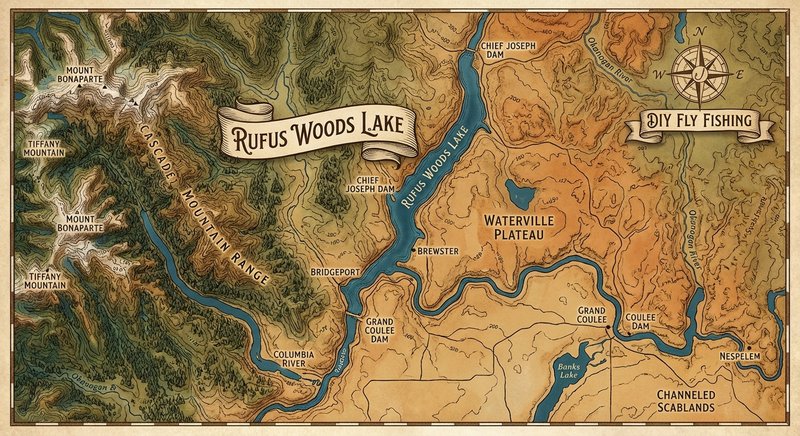
Rufus Woods Lake is a 51-mile long reservoir on the Columbia River, stretching from Grand Coulee Dam downstream to Chief Joseph Dam. Unlike many reservoirs that feel like stagnant lakes, Rufus Woods functions much like a massive, slow-moving river.
What makes it legendary are the Triploid Rainbow Trout. These are sterile, hatchery-raised fish that put all their energy into growth rather than reproduction. Combined with the nutrient-rich water and the presence of commercial net-pen salmon/trout farms, these fish reach gargantuan proportions—it is not uncommon to hook fish over 10 pounds, and the state record (nearly 30 lbs) came from these waters. The scenery is rugged, characterized by basalt cliffs, sagebrush, and clear, cold water.
🐟 Target Species & Behavior
The primary draw is the Rainbow Trout (Triploids).
- Behavior: These fish are opportunistic and highly nomadic. They tend to congregate near the commercial net pens where pellet feed spills through the mesh. However, "wild" acting Triploids roam the rocky shorelines and current breaks.
- Feeding: Their diet consists of high-protein pellets (near the pens), but they also forage on sculpins, leeches, chironomids, and crawfish.
- Holdings: Look for them in "seams" where the current from the dams meets slower water, near underwater rocky points, and especially in the vicinity of the Nespelem River confluence.
📅 Best Times to Fish
While the user requested Spring, Summer, and Fall, here is how those seasons break down:
- Spring (March – May): Prime Time. As water temperatures rise slightly, fish become highly active. This is the best window for shore anglers using streamers and nymphs.
- Summer (June – August): The water stays cold because it’s bottom-released from Grand Coulee, but the air temperature can exceed 100°F. Fish go deeper during the day. Focus on early mornings (dawn to 10 AM) and late evenings.
- Fall (September – November): Another peak season. As the light changes, big fish move back into the shallows to cruise the shorelines. October is often the best month for consistent trophy fish.
- The "Dam" Factor: The best fishing window is often determined by water flow. When the dams are pulling water, the current "turns on" the bite. Stagnant water usually means slower fishing.
🪰 Recommended Flies & Techniques
Top Fly Patterns
- Pellet Flies (Size 10-14): In tan, brown, or grey. It feels like "cheating" to some, but near the net pens, it is the most effective fly.
- Balanced Leeches (Size 8-12): Black, Olive, or "Bruised" (purple/black). These are deadly under an indicator.
- Woolly Buggers (Size 4-8): White (to mimic dead shad/minnows), Olive, and Thin Mints.
- Chironomids (Size 12-16): Chromies or "Ice Man" patterns in red or black.
- Soft Hackles/Mop Flies: In chartreuse or cream (mimicking pellets or larvae).
Effective Techniques
- Indicator Nymphing: This is the bread and butter here. Suspend a Balanced Leech or a Pellet Fly 6 to 12 feet deep. The wave action provides the movement.
- Stripping Streamers: Use a sink-tip line and cast toward the rocky shorelines. Use a "strip-strip-pause" retrieve to mimic a wounded sculpin or baitfish.
- The "Static" Drift: If fishing near the pens from a boat, simply letting a fly dangle in the current can be incredibly effective.
💡 Pro Tips & Local Knowledge
- The Net Pen Strategy: There are several sets of net pens. Fish the downstream side of the pens where the current carries "waste" feed. Even if you don't use pellet flies, the big fish are there waiting for smaller baitfish that gather to eat the pellets.
- Check the Flows: Use the "Chief Joseph Dam" flow charts online. If the CFS (cubic feet per second) is rising, get your fly in the water immediately.
- Heavy Timber: You are hunting giants. Leave the 4-weight at home. Use a 6-weight or 7-weight rod with a stout leader (0X or 1X). These fish are powerful and will use the current to snap light tippet.
- The Nespelem Area: The area around the mouth of the Nespelem River is a transition zone that often holds large pods of fish away from the crowds of the net pens.
⚠️ Important Information
Access Information
- Boat Access: The most popular ramps are at the State Park (lower end) and Army Corps of Engineers ramps near the dams.
- Shore Access: Limited, but available at the Brewster bridge area and the designated "Fishing Parks" on the Colville Reservation side.
Regulations & Permits
- The Two-License Rule: Rufus Woods is bordered by the Colville Indian Reservation.
- If you fish from the South shore (non-tribal), a Washington State Fishing License is required.
- If you fish from the North shore (Reservation side) or step foot on that land, you must have a Colville Tribal Fishing Permit.
- If fishing from a boat, either license is generally valid, but check the current "Reciprocal Agreement" as rules can change annually.
- Barbless Hooks: Highly recommended for easy release of these trophy fish.
- Catch Limits: Carefully check the WDFW regulations; Rufus Woods has specific daily limits, and once you retain your limit, you must stop fishing (no catch-and-release after retention).
Guide’s Final Word: Bring a big net—you’re going to need it. Respect the power of the Columbia River and the sacred lands of the Colville people. Tight lines!
Bug Hatches & Matching Flies
| Hatch | Type | Peak months | Time of day | Hook sizes | Matching flies |
|---|---|---|---|---|---|
| Chironomid (Midge) Chironomidae | midge | March, April, May, October | All Day | #12-22 | Chromie #14-18, Ice Cream Cone #12-16, Griffith's Gnat #18-22 |
| Speckled Dun (Callibaetis) Callibaetis spp. | mayfly | May, June, September | Morning/Afternoon | #14-16 | Callibaetis Spinner #14-16, Hare's Ear Nymph #14-16, Quigley Cripple #14-16 |
| Spotted Sedge Hydropsyche | caddis | June, July, August | Evening | #14-18 | Elk Hair Caddis #14-16, Pupa Sparkle Caddis #16-18, Soft Hackle Hare's Ear #14-16 |
| Blue Winged Olive Baetis | mayfly | April, October, November | Afternoon | #18-22 | BWO Parachute #18-22, RS2 #20-22, Pheasant Tail Nymph #18-20 |
| Traveling Sedge Hesperophylax | caddis | June, July | Evening | #8-12 | Goddard Caddis #8-10, Mikulak Sedge #8-12 |
| Carpenter Ant Camponotus | terrestrial | June, July | Afternoon | #10-14 | Black Foam Ant #12-14, Chernobyl Ant #10-12 |
| Grasshopper Melanoplus spp. | terrestrial | August, September | Afternoon | #8-12 | Dave's Hopper #10-12, Morrish Hopper #8-12 |
| Bloodworm Chironomus plumosus | midge | February, March | All Day | #10-14 | San Juan Worm (Red) #12-14, Yummy Chironomid #10-14 |