Sauk River
Fly fishing in Washington · Intermediate · Best seasons: Winter, Spring, Summer
Target Species
Steelhead, Bull Trout
About This Water
Major Skagit tributary with excellent steelhead and bull trout. Wild mountain river in the North Cascades.
Fishing Recommendations
The Sauk River is a crown jewel of the Pacific Northwest. Flowing from the slopes of Glacier Peak, it is a designated "Wild and Scenic River" and serves as one of the most vital spawning tributaries for the Skagit River system. For the fly angler, the Sauk is synonymous with tradition, big water, and the pursuit of wild, native fish in a rugged wilderness setting.
🎣 Location Overview
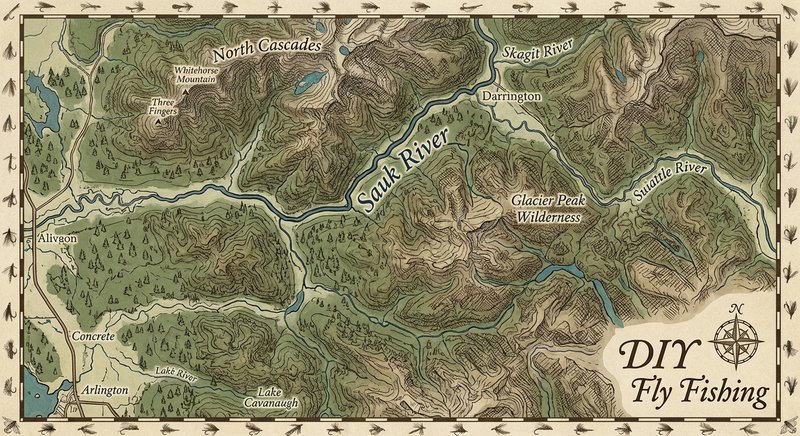
The Sauk is a powerful, classic freestone river. It is divided into the North and South Forks, which join near Bedal, but the primary "big water" fishing occurs from Darrington down to its confluence with the Skagit at Rockport.
What makes the Sauk special is its raw, untamed character. Unlike dam-controlled rivers, the Sauk is temperamental. It is a glacial-fed system, meaning its clarity is dictated by temperature and rainfall. The river is characterized by wide gravel bars, massive cedar log jams, and "classic" Spey water—long, walking-speed runs that seem designed specifically for swinging a fly.
🐟 Target Species & Behavior
Wild Winter Steelhead
The Sauk is legendary for its wild winter-run steelhead. These are some of the largest and most aggressive steelhead in Washington.
- Behavior: They enter the river late (February–April). Unlike hatchery fish, they are aggressive and will move a long way to grab a swung fly.
- Holding Water: Look for "tailouts" (the smooth water at the end of a pool) and "seams" where fast and slow water meet. In the cold water of late winter, they often hold in slightly deeper, slower water than they would in the summer.
Bull Trout
The Sauk is a stronghold for native Bull Trout (Dolly Varden). These are the apex predators of the river.
- Behavior: They are opportunistic and highly mobile. They follow salmon runs to gorge on eggs and flesh, but they also hunt sculpins and smolt.
- Holding Water: They love structure. Look for them near root balls, deep cut banks, and at the heads of deep emerald pools.
Summer Steelhead
A smaller run of summer fish exists, primarily in the upper reaches and the North Fork. They are extremely skittish and require stealthy approaches and lighter tackle.
📅 Best Times to Fish
- Winter Steelhead (Prime Time): March and April. This is the "Holy Grail" window. While fish enter in February, the highest concentrations and best water conditions usually occur in late spring before the glacial melt begins.
- Summer/Fall (Bull Trout & Summer Steelhead): July through September. This is when the river is lowest and most accessible for wading.
- The "Sauk Milk": In late spring and summer, warm temperatures melt the glaciers on Glacier Peak, turning the river a milky turquoise. If visibility is less than 2 feet, fishing is difficult. Look for a "cooling trend" to clear the water.
- Time of Day: In the winter, let the water warm up; the afternoon bite is often better. In the summer, "low light" (dawn and dusk) is essential.
🪰 Recommended Flies & Techniques
The Swing (Spey Casting)
The Sauk is built for the Spey rod. Swinging a fly is not just traditional here; it’s the most effective way to cover the massive amount of water.
- Steelhead Patterns:
- Intruders: Large, articulated patterns in Black/Blue, Pink/Orange, or Chartreuse.
- Prom Dress: A classic flashy PNW pattern.
- The Dirty Hoh: Exceptional movement in heavy current.
- Bull Trout Patterns:
- Sculpin Patterns: Olive or tan articulated sculpins (e.g., Dolly Waggler).
- White Streamers: Large, 4–6 inch white streamers (mimicking smolt) are highly effective for aggressive Bulls.
Presentation Tips
- Sink Tips: You must have a variety of Skagit tips. T-11 and T-14 in 10–12 foot lengths are the standard for getting the fly down to the "bucket" where steelhead rest.
- The "Broadside" Swing: Aim to keep your fly swimming broadside to the fish for as long as possible. Avoid "dangling" the fly straight downstream too early in the swing.
💡 Pro Tips & Local Knowledge
- Confidence in the "Milk": Don't be deterred by a slight glacial tint. A "steelhead green" tint with 3–4 feet of visibility is actually ideal—it makes the fish feel secure and more likely to hold in shallower water.
- Cover Water: The Sauk is huge. Don't spend two hours in one run. Take two steps between every cast. You are looking for the "player"—the fish that wants to bite.
- The Darrington Factor: The river changes significantly above and below the town of Darrington. The lower river (below the Suiattle confluence) is much larger and deeper. The upper river is more intimate and better for wade anglers.
- Watch the Suiattle: The Suiattle River flows into the Sauk and is often the source of heavy silt. If the Sauk is blown out at the mouth, check the water above the Suiattle confluence; it might be crystal clear.
⚠️ Important Information
- Regulations (CRITICAL): The Sauk is a catch-and-release only river for wild steelhead. Barbless hooks are mandatory. The river is often managed under "emergency rules." Always check the WDFW (Washington Department of Fish and Wildlife) website before heading out.
- Access:
- Boat Launches: Backman Park (Darrington), Government Bridge, and the Rockport Bridge.
- Wading: Access is available via the Mountain Loop Highway and various pull-offs along Highway 530.
- Safety: The Sauk is a dangerous river to wade. It features "moving" gravel bars and treacherous log jams. A wading staff and a PFD are highly recommended, especially if you are not in a boat.
- Gear: 7-weight or 8-weight Spey rods (12'6" to 13'6") are the tools of choice. For Bull Trout, a 6-weight single-handed rod with a sink tip works well.
Guide’s Final Word: The Sauk is not a numbers river; it is a "quality" river. You come here for the chance to touch a piece of living history—a wild Skagit-system Steelhead. Respect the fish, keep them in the water, and enjoy the scenery of the North Cascades.
Bug Hatches & Matching Flies
| Hatch | Type | Peak months | Time of day | Hook sizes | Matching flies |
|---|---|---|---|---|---|
| March Brown Rhithrogena morrisoni | mayfly | March, April, May | Mid-day/Afternoon | #12-14 | March Brown Parachute #12-14, Gold Ribbed Hare's Ear #12-14, March Brown Emerger #12-14 |
| Skwala Stonefly Skwala spp. | stonefly | March, April | Late Morning/Afternoon | #8-12 | Skwala Stone #10-12, Pat's Rubber Leg (Olive/Brown) #8-12, Bullet Head Skwala #10-12 |
| Blue Winged Olive (BWO) Baetis spp. | mayfly | March, April, September, October | Mid-day/Overcast | #16-20 | RS2 (Olive) #18-20, Parachute Adams #16-20, BWO Sparkle Dun #16-18 |
| Salmonfly Pteronarcys californica | stonefly | May, June | All Day | #4-8 | Chubby Chernobyl (Orange) #4-8, Kaufmann's Stone (Black/Orange) #4-8 |
| Golden Stonefly Hesperoperla pacifica | stonefly | June, July | Morning/Evening | #8-12 | Norm Wood Special #8-10, Golden Pat's Rubber Leg #8-12, Yrog Golden Stone #10-12 |
| Green Sedge Rhyacophila spp. | caddis | May, June, July, August | Late Afternoon/Evening | #12-16 | Elk Hair Caddis (Green) #14-16, Green Weenie #12-14, LaFontaine's Deep Sparkle Pupa #14-16 |
| Yellow Sally Isoperla spp. | stonefly | July, August | Late Afternoon | #14-16 | Yellow Sally Stimulator #14-16, Little Yellow Sloan #14-16 |
| October Caddis Dicosmoecus gilvipes | caddis | September, October | Afternoon/Evening | #8-12 | Orange Stimulator #8-10, October Caddis Pupa #10-12, Morrish's October Caddis #8-10 |