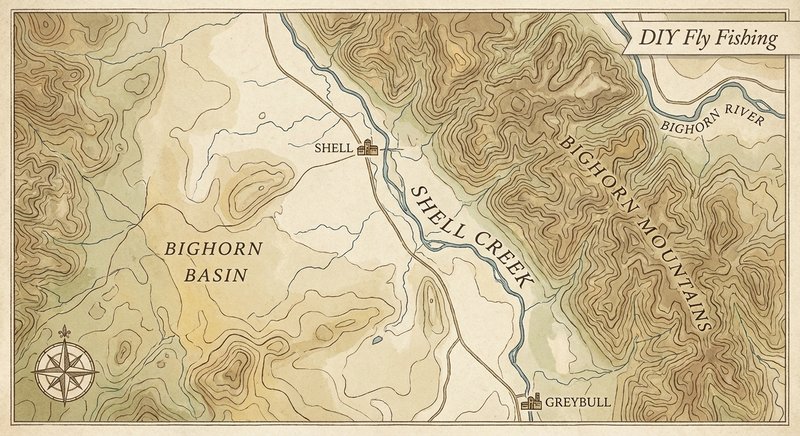
Shell Creek
Fly fishing in Wyoming · Beginner · Best seasons: Summer, Fall
Target Species
Rainbow Trout, Brown Trout
About This Water
Bighorn Mountains stream with trout near Shell Falls. Scenic canyon drive.
Fishing Recommendations
Shell Creek is one of the hidden gems of the Bighorn Mountains in north-central Wyoming. Carving a dramatic path through Shell Canyon, this freestone stream offers a quintessential Rocky Mountain fly fishing experience. It transitions from high-alpine meadows to a steep, rugged canyon before spilling out into the Bighorn Basin.
As your guide, here is the breakdown for tackling this technical and rewarding fishery.
🎣 Location Overview
Shell Creek is defined by its dramatic scenery and diverse water types. Located off U.S. Route 14 east of Greybull, it is famous for Shell Falls, a massive waterfall that serves as a natural barrier for fish migration.
- The Upper Section: Above the falls, the creek meanders through high-country meadows and timber. The water is smaller, easier to wade, and behaves like a classic meadow stream.
- The Canyon Section: Below the falls, the creek becomes a high-gradient, pocket-water paradise. Massive boulders, deep plunges, and fast riffles characterize this stretch.
- Why Anglers Love It: It offers solitude compared to the nearby Bighorn River. It is a "choose your own adventure" creek—you can fish delicate dry flies in the meadows or bushwhack through the canyon for aggressive strikes in the pockets.
🐟 Target Species & Behavior
While you may find the occasional Brook Trout in the highest reaches, the main draw is the wild Rainbow and Brown Trout.
- Rainbow Trout: These are the primary residents of the faster water. They hold in the "cushion" in front of boulders and in the bubbly oxygenated riffles. They are opportunistic and will often slash at attractors.
- Brown Trout: Found more frequently in the lower canyon and the deeper, slower pools. They are structure-oriented—look for them tucked under overhanging limestone ledges or in the dark shadows of the canyon walls. During the fall, the browns become highly aggressive as they prepare to spawn.
📅 Best Times to Fish
Optimal Seasons
- Summer (July – August): This is the prime window. Runoff usually subsides by late June or early July. This is the peak for dry fly action and "hopper-dropper" rigs.
- Fall (September – October): My personal favorite. The water temperatures drop, the crowds vanish, and the Brown Trout begin their pre-spawn feed. The colors in the canyon are spectacular.
Best Times of Day
- Summer: Early morning (8 AM – 11 AM) for nymphing; late afternoon and "golden hour" for heavy caddis and mayfly hatches.
- Fall: Midday is best. The water needs to warm up slightly to get the bugs moving. 11 AM to 4 PM is the "sweet spot."
🪰 Recommended Flies & Techniques
Top Fly Patterns
- Dry Flies:
- Attractors: Chubby Chernobyl (Size 10-14) in gold or purple.
- Classic: Elk Hair Caddis (Size 14-16) – tan or olive.
- Mayflies: Parachute Adams or Purple Haze (Size 16-18).
- Terrestrials: Amy’s Ant or Dave’s Hopper (Size 10-12).
- Nymphs:
- Pat’s Rubber Legs (Size 10-12) in coffee/black.
- Bead-head Prince Nymph (Size 14-16).
- Flashback Pheasant Tail (Size 16-18).
- Streamers:
- Gold Ribbed Hare’s Ear or thin Wooly Buggers in olive or black (Size 8-10).
Effective Techniques
- Dry-Dropper: This is the most effective way to fish Shell Creek. Use a buoyant Chubby Chernobyl as your indicator and hang a weighted nymph (like a Pheasant Tail) 18-24 inches below it.
- Pocket Picking: In the canyon, don't spend too much time on one hole. Cast into the soft water behind boulders, give it three seconds, and move on.
- High-Sticking: Because of the complex currents in the canyon, keep as much fly line off the water as possible to avoid drag.
💡 Pro Tips & Local Knowledge
- The "Shadow" Rule: Because the canyon walls are so steep, parts of the creek stay in the shade longer. Fish the sun/shadow line; trout often sit just inside the shadow to ambush prey drifting in the sunlight.
- Watch Your Step: The rocks in Shell Creek are notoriously slick and often loose. Felt-soled boots or studs are highly recommended, along with a wading staff.
- Stealth Matters: In the clear meadow sections, the fish are spooky. Approach from downstream and keep a low profile. If you see them, they have likely already seen you.
- The Confluence: Where Granite Creek meets Shell Creek is a legendary spot. The mixing of water temperatures and nutrients often holds the largest fish in the system.
⚠️ Important Information
- Access: Much of the creek is within the Bighorn National Forest, offering excellent public access. However, keep an eye out for private property boundaries as the creek leaves the forest near the town of Shell.
- Regulations: A valid Wyoming fishing license is required. Always check the current Wyoming Game & Fish Department regulations for specific creel limits or seasonal closures.
- Wildlife & Safety: This is bear country (both Black and occasionally Grizzly). Carry bear spray. Also, be wary of rattlesnakes in the lower, drier elevations of the canyon during the heat of summer.
- Cell Service: Expect zero cell service once you enter the canyon. Let someone know your plan before you head in.
Guide’s Final Word: Shell Creek isn't about trophy sizes (though 16-18 inchers exist); it’s about the wildness of the fish and the raw beauty of the Bighorns. Pack light, move fast, and keep your eyes on the dry fly!
Bug Hatches & Matching Flies
| Hatch | Type | Peak months | Time of day | Hook sizes | Matching flies |
|---|---|---|---|---|---|
| Blue-Winged Olive Baetis spp. | mayfly | April, May, September, October | Midday | #18-22 | RS2 #18-22, Parachute Adams #18-22, Pheasant Tail #18-20 |
| Golden Stonefly Hesperoperla pacifica | stonefly | June, July | Morning/Afternoon | #8-12 | Chubby Chernobyl #8-12, Pat's Rubber Leg #8-12, Golden Rogue Stone #10-12 |
| Pale Morning Dun Ephemerella excrucians | mayfly | July, August | Late Morning/Afternoon | #16-18 | PMD Sparkle Dun #16-18, Split Case PMD #16-18, Quigley Cripple #16-18 |
| Yellow Sally Isoperla spp. | stonefly | July, August | Afternoon/Evening | #14-16 | Yellow Sally Foam Stone #14-16, Iron Lotus #14-16, Little Yellow Fellow #14-16 |
| Spotted Sedge Hydropsyche | caddis | June, July, August | Evening | #14-16 | Elk Hair Caddis #14-16, LaFontaine's Deep Sparkle Pupa #14-16, Holy Grail #14-16 |
| Trico Tricorythodes | mayfly | August, September | Early Morning | #20-24 | Trico Spinner #20-24, Sunken Trico Spinner #20-22 |
| Grasshoppers Orthoptera | terrestrial | August, September | Late Morning/Afternoon | #8-12 | Morrish Hopper #8-12, Dave's Hopper #10-12, Thunder Thighs Hopper #12 |
| Midges Chironomidae | midge | March, April, October, November | All Day | #18-24 | Zebra Midge #18-22, Griffith's Gnat #18-22, Top Secret Midge #20-22 |