Shoshone River
Fly fishing in Wyoming · Beginner · Best seasons: Summer, Fall
Target Species
Rainbow Trout, Brown Trout
About This Water
Near Cody, offering excellent fishing for rainbow and brown trout in scenic canyon country.
Fishing Recommendations
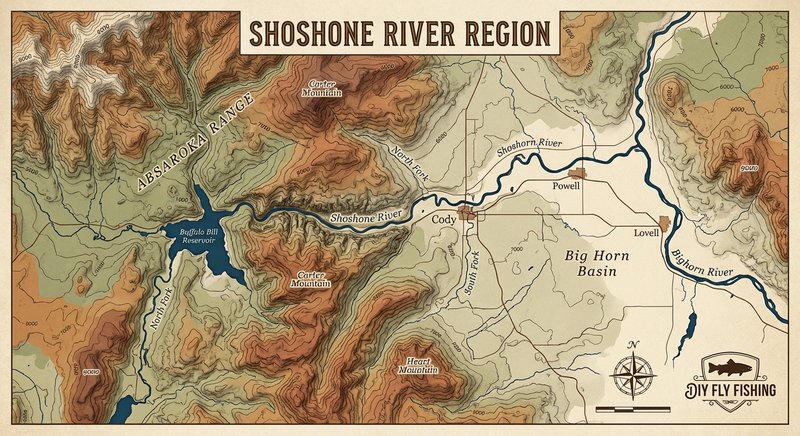
The Shoshone River near Cody, Wyoming, is one of the most underrated gems in the Rocky Mountains. Split primarily into two distinct fisheries—the North Fork (a wild, freestone river) and the Lower Shoshone (a nutrient-rich tailwater)—this river offers a diversity of water that can keep an angler busy for a lifetime.
🎣 Location Overview
The Shoshone River is defined by its rugged beauty and its relationship with Buffalo Bill Reservoir.
- The North Fork: Flows from the Absaroka Mountains into the reservoir. It is a classic high-gradient freestone river characterized by crystal-clear water, massive boulders, and some of the best dry-fly fishing in the state.
- The Lower Shoshone: Flows out of Buffalo Bill Dam through a steep canyon and into the town of Cody. As a tailwater, it stays cool in the summer and warm in the winter, creating a stable environment for massive insect biomass and "football-shaped" trout.
What makes it special is the sheer volume of fish per mile and the fact that, despite its quality, it often plays second fiddle to the nearby Yellowstone National Park, meaning less crowded runs for those in the know.
🐟 Target Species & Behavior
While the river holds Yellowstone Cutthroat, your primary targets are Rainbow and Brown Trout.
- Rainbow Trout: Found throughout both sections. In the North Fork, they are opportunistic and will smash large attractor dries in fast pocket water. In the Lower Shoshone, they congregate in the "noodle" water (the seams between fast and slow currents) and feed heavily on midges and scuds.
- Brown Trout: The Lower Shoshone is the place for trophy Browns. They are structure-oriented, often tucked under the red rock walls or beneath overhanging willows. In the fall, they become aggressive and territorial as they prepare for the spawn.
- Behavior: During the summer, fish are looking up. In the fall, the behavior shifts toward subsurface nymphs and aggressive streamer chasing as the water temperatures drop.
📅 Best Times to Fish
Summer (July – August)
- The Window: Once runoff subsides (usually late June or early July), the North Fork turns on.
- Conditions: Long, sunny days. This is "Hopper Time."
- Time of Day: 9:00 AM to 4:00 PM is prime for dry fly activity.
Fall (September – October)
- The Window: This is the local favorite. The crowds vanish, and the big Browns in the Lower Shoshone get active.
- Conditions: Crisp mornings and blue-winged olive (BWO) hatches on overcast days.
- Time of Day: Mid-morning for nymphs; late afternoon for streamers.
🪰 Recommended Flies & Techniques
North Fork (Freestone Techniques)
The North Fork is built for Hopper-Dropper rigs.
- Dry Flies: Chubby Chernobyls (Gold, Royal, or Purple), Amy’s Ant, and Jack Cabe’s.
- Nymphs: Prince Nymphs, Rubber Leg Stoneflies (size 8-12), and Flashback Pheasant Tails.
- Technique: High-sticking through pocket water. Don't be afraid to fish the heavy "bubbly" water; the fish sit right in the oxygenated foam.
Lower Shoshone (Tailwater Techniques)
Precision is more important here. Technical Nymphing is king.
- Nymphs: Zebra Midges (Red or Black, size 18-22), Ray Charles (Grey or Tan), and RS2s.
- Streamers: For the big Browns, swing or strip Gold Sparkle Minnows, Sex Dungeons, or Wooly Buggers in olive/black.
- Technique: Use a long leader (9ft - 12ft) and plenty of split shot to get small flies down deep in the canyon stretches.
💡 Pro Tips & Local Knowledge
- The "Cody Wind": The Shoshone is notorious for wind. If you're fishing the Lower section, bring a 6-weight rod to punch through the gusts.
- The Sleeper Spot: The "Corbett" stretch of the Lower Shoshone (below the canyon) offers great float fishing opportunities for large Browns, but it requires a drift boat or raft.
- The North Fork Migration: In early summer, large Rainbows and Cutthroats migrate out of Buffalo Bill Reservoir and into the North Fork to spawn. They stay for several weeks to feed. Target the deep pools near the reservoir inlet in July for the biggest fish of the year.
- Rock Snot (Didymo): The Lower Shoshone can sometimes have Didymo. Use felt-sole boots with studs for safety, as the rocks are incredibly slick.
⚠️ Important Information
- Grizzly Safety: The North Fork is Grizzly Country. It is highly recommended—if not mandatory for peace of mind—to carry bear spray and fish with a partner. Stay alert, especially when walking through thick willows.
- Access: Much of the North Fork follows Hwy 14/16/20 (the road to Yellowstone) and has excellent public access. The Lower Shoshone has great access in the canyon below the dam and at various parks within the City of Cody.
- Regulations:
- A Wyoming fishing license and Conservation Stamp are required.
- Check current WGFD regulations for creel limits, though Catch and Release is strongly encouraged to preserve this world-class fishery.
- Be mindful of private property boundaries on the Lower river; use an app like OnX Maps to stay legal.
Guide’s Final Word: If the North Fork is clear, go there for the views and the dry fly action. If it’s windy or you want a shot at a 20-inch Brown, head to the Lower tailwater. You can't lose either way.
Bug Hatches & Matching Flies
| Hatch | Type | Peak months | Time of day | Hook sizes | Matching flies |
|---|---|---|---|---|---|
| Blue Winged Olives (BWO) Baetis spp. | mayfly | March, April, May, September, October | Mid-day/Afternoon | #18-22 | Parachute Adams #18-22, RS2 #20-22, Pheasant Tail #18-20 |
| Pale Morning Duns (PMD) Ephemerella excrucians | mayfly | June, July, August | Late Morning/Afternoon | #16-18 | PMD Sparkle Dun #16-18, Split Case PMD #16-18, CDC Floating Nymph #16-18 |
| Golden Stoneflies Hesperoperla pacifica | stonefly | June, July | Morning/Evening | #6-10 | Chubby Chernobyl #8-12, Pat's Rubber Leg #6-10, Golden Rogue Stone #8-10 |
| Spotted Sedge (Caddis) Hydropsyche spp. | caddis | June, July, August | Evening | #14-18 | Elk Hair Caddis #14-16, LaFontaine's Deep Sparkle Pupa #14-18, Holy Grail #16-18 |
| Midges Chironomidae | midge | February, March, April | Late Morning | #18-24 | Zebra Midge #18-22, Griffith's Gnat #20-22, Manhattan Midge #20-24 |
| Tricos Tricorythodes spp. | mayfly | August, September | Early Morning | #20-24 | Trico Spinner #20-24, Sunken Trico #22-24 |
| Yellow Sally Isoperla spp. | stonefly | June, July | Afternoon/Evening | #14-16 | Yellow Sally Stimulator #14-16, Iron Sally #14-16 |
| Terrestrials (Hoppers/Ants) Orthoptera/Formicidae | terrestrial | July, August, September | Afternoon | #8-16 | Morrish Hopper #8-12, Cinnamon Ant #14-16, Beefus Beetle #12-14 |