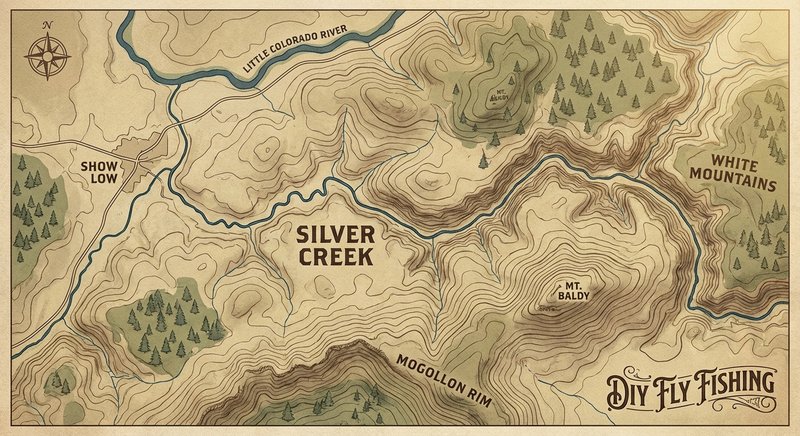
Silver Creek
Fly fishing in Arizona · advanced · Best seasons: spring, summer, fall
Target Species
Apache Trout, Rainbow Trout
About This Water
Spring creek near Show Low with excellent insect hatches. Technical fishing for wild Apache trout.
Fishing Recommendations
Welcome to one of Arizona’s most unique angling treasures. As a guide who has spent years navigating the high deserts and mountain plateaus of the Southwest, I can tell you that Silver Creek is a true gem. It is a spring-fed gem located in the high desert near Show Low, offering a distinct experience compared to the typical freestone streams of the White Mountains.
Here is your comprehensive guide to fishing Silver Creek, Arizona.
🎣 Location Overview
Silver Creek is a spring-fed tributary of the Little Colorado River. What makes it special is its consistent water temperature and clarity. Because it is fed by massive underground springs, the water stays cool in the summer and relatively warm in the winter, creating a stable biomass that supports large, healthy trout.
The creek is divided into two main sections: the upper section (within the Silver Creek Hatchery grounds) and the lower section. The water is generally slow-moving, characterized by deep, silty pools, undercut banks, and sections of dense aquatic vegetation. Anglers love it because it offers a "chalk stream" feel in the middle of the Arizona desert, and it is arguably the best place in the world to catch a trophy-sized Apache Trout.
🐟 Target Species & Behavior
- Apache Trout: Arizona’s state fish. In Silver Creek, these fish grow exceptionally large due to the hatchery influence and the rich forage. They are opportunistic but can be very "spooky" in the clear, slow water.
- Rainbow Trout: These are frequently stocked and can reach impressive sizes (20+ inches).
Behavior: Because the water is so clear, the fish are highly visual. They often hold in the deep shadows of the undercut banks or right at the "drop-off" where shallow riffles enter deeper pools. During the heat of the day, they will hug the bottom in the deepest holes. When a hatch is on, they will move into the seams to sip insects off the surface.
📅 Best Times to Fish
While Silver Creek is open year-round, its character changes drastically based on the season.
- Spring (March – May): This is prime time. As the high country thaws, Silver Creek remains stable. This is when you’ll see the best hatches and the fish are most active after the winter.
- Summer (June – August): Early mornings are essential. While the spring water stays cool, the ambient Arizona heat can stress fish by mid-afternoon. Focus on the "Trico" hatches at dawn.
- Fall (September – November): My personal favorite. The crowds thin out, and the fish become aggressive as they prepare for colder months. Terrestrials (hoppers) are deadly during this time.
- Optimal Windows: The first two hours of light and the last hour before sunset are the "Golden Hours" here. On overcast days, the "midday slump" often disappears, and the fish will feed confidently all day.
🪰 Recommended Flies & Techniques
Top Fly Patterns
- Nymphs:
- Zebra Midge (Size 18-22) in black/silver or red.
- Pheasant Tail Nymph (Size 16-20) – a staple for the Baetis hatches.
- Scuds (Size 16-18) in olive or orange – the creek is loaded with freshwater shrimp.
- Dry Flies:
- Parachute Adams (Size 18-22).
- Elk Hair Caddis (Size 14-16) for late evening.
- Griffith’s Gnat (Size 20-22) for midge clusters.
- Streamers/Leeches:
- Simi Seal Leech (Size 12) in blood leech or peacock – This is the legendary Arizona pattern.
- Woolly Bugger (Size 10-12) in olive or black.
Techniques & Presentation
- The "Sight-Nymphing" Approach: Because the water is clear, don't just blind cast. Spot a fish, stay low, and cast well upstream of its position. Use a very small strike indicator (or none at all) to avoid spooking the fish.
- The Slow Strip: When using a Simi Seal Leech, use a slow, rhythmic "strip-strip-pause" retrieve. Often, the fish will hit on the pause.
- Light Tackle: Use a 3wt or 4wt rod with a long leader (9–12 feet) tapering down to 6X or 7X fluorocarbon tippet. These fish are leader-shy.
💡 Pro Tips & Local Knowledge
- Stay Back from the Bank: The biggest mistake anglers make at Silver Creek is walking right up to the edge. The vibrations and your silhouette will send the trout into the undercut banks instantly. Kneel or stay 10 feet back from the water’s edge.
- The Hatchery Stretch: The upper mile of the creek is on the Arizona Game and Fish Hatchery property. This area holds the largest concentration of fish, but it also gets the most pressure. If it’s crowded, hike further downstream where the fish are wilder and less pressured.
- The "San Juan Shuffle" (Avoid this): Don't kick up the silt to attract fish. It’s unethical and ruins the fishing for others. Instead, look for "bubbles" or "rings" in the slow pools—that’s usually a big trout feeding on emergers just under the film.
⚠️ Important Information
- Access: The main access point is via the Silver Creek Hatchery, located off Hatchery Rd from Highway 77, about 5 miles north of Show Low.
- Regulations:
- October 1 – March 31: Catch and Release ONLY, artificial fly and lure only (Single barbless hooks). This is the "trophy season."
- April 1 – September 30: General regulations apply (bait is allowed, and you can keep fish). Note: Most serious fly anglers avoid the creek during the summer harvest season as it gets very crowded with families and bait fishermen.
- Permits: You must have a valid Arizona Fishing License. No special stamps are required for Apache Trout, but ensure you follow all posted signs at the hatchery regarding parking and entry times.
- Footwear: The bottom is very silty/muddy. Wading is generally not recommended (and often not allowed in certain stretches to protect the habitat). Fish from the bank whenever possible.
Bug Hatches & Matching Flies
| Hatch | Type | Peak months | Time of day | Hook sizes | Matching flies |
|---|---|---|---|---|---|
| Midges Chironomidae | midge | January, February, March, December | All Day | #18-24 | Zebra Midge #18-22, Griffith's Gnat #20-24, Morgan's Midge #20-22 |
| Blue Winged Olive Baetis | mayfly | March, April, October, November | Mid-day | #18-22 | RS2 #20-22, Parachute Adams #18-22, Pheasant Tail Nymph #18-20 |
| Trico Tricorythodes | mayfly | August, September, October | Morning | #22-26 | Trico Spinner #22-26, Sunray Trico #22-24 |
| Spotted Sedge Hydropsyche | caddis | May, June, July | Evening | #14-18 | Elk Hair Caddis #14-18, LaFontaine's Sparkle Pupa #16-18 |
| Pale Morning Dun Ephemerella | mayfly | June, July | Morning/Afternoon | #16-18 | PMD Sparkle Dun #16-18, Frenchie #16-18 |
| Grasshoppers Orthoptera | terrestrial | July, August, September | Mid-day/Afternoon | #8-12 | Dave's Hopper #10-12, Parachute Hopper #10-14 |
| Cinnamon Ants Formicidae | terrestrial | August, September | All Day | #16-20 | Cinnamon Ant #16-20, Transpar-ant #18-20 |
| Black Beetle Coleoptera | terrestrial | June, July, August | Mid-day | #14-18 | Foam Beetle #14-18 |