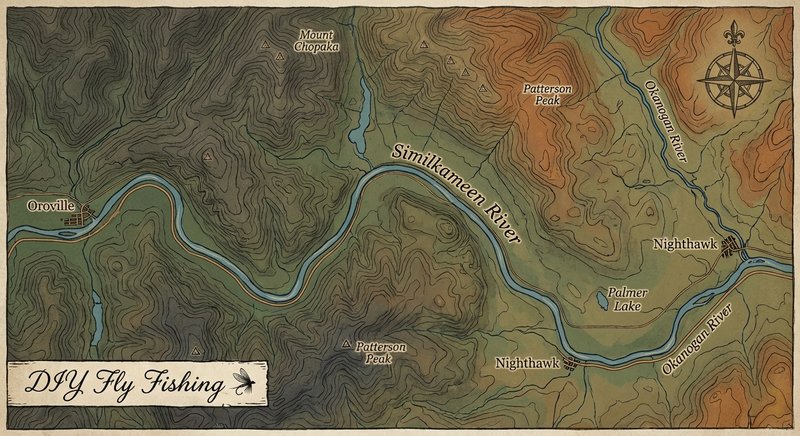
Similkameen River
Fly fishing in Washington · Beginner · Best seasons: Summer, Fall
Target Species
Smallmouth Bass, Rainbow Trout
About This Water
Northern Washington river near the Canadian border. Smallmouth bass and trout fishing.
Fishing Recommendations
The Similkameen River in North Central Washington is one of the state’s "hidden gems," often overshadowed by the larger Columbia or the nearby Methow. However, for the fly angler who values solitude and high-action fishing, the Similkameen offers a unique rugged beauty. Flowing from British Columbia through the high desert of Okanogan County before joining the Okanogan River, this is a freestone river characterized by dramatic canyon walls, massive boulders, and a surprisingly diverse fishery.
🎣 Location Overview
The Similkameen is a river of two faces. Above Enloe Dam (near Oroville), the river is a rugged canyon environment; below the dam, it meanders toward its confluence with the Okanogan. What makes this water special is the striking desert scenery and the diversity of the biomass.
Anglers love the Similkameen because it offers a "dual-threat" experience. You can spend the morning head-hunting rising Rainbow Trout in the riffles and the afternoon swinging big streamers for aggressive Smallmouth Bass in the deeper pools. The water is generally clear, but it can be powerful—the riverbed is littered with "pocket water" created by ancient glacial boulders, making it a playground for technical wading.
🐟 Target Species & Behavior
Smallmouth Bass
The Similkameen is arguably one of the best moving-water Smallmouth fisheries in the Pacific Northwest.
- Behavior: These are "river-run" bass—lean, muscular, and aggressive.
- Holding Water: Look for "slack water" seams, the downstream side of large boulders, and deep slow-moving pools. They love the transition zones where the fast current meets a quiet eddy.
- Feeding: They are opportunistic, feeding heavily on crawfish, sculpins, and large stonefly nymphs.
Rainbow Trout
These are wild, hard-fighting fish, typically ranging from 10 to 16 inches, though larger specimens hide in the deep slots.
- Behavior: They behave like classic freestone trout. They are highly oxygen-dependent and will move into the "bubbly" water at the head of pools during the heat of summer.
- Feeding: They focus on the prolific hatches of Caddis, Golden Stoneflies, and Mayflies (PMDs and Blue Winged Olives).
📅 Best Times to Fish
Summer (July – August)
This is the prime window for both species.
- Conditions: The spring runoff usually subsides by early July, clearing the water and making it wadeable.
- Time of Day: Early morning and late evening are critical. The high desert sun can be brutal; once the sun hits the water, the trout fishing often slows, but the bass fishing heats up.
- Prime Window: The Caddis hatch at dusk in July is legendary.
Fall (September – October)
Perhaps the most beautiful time on the river.
- Conditions: Water levels are at their lowest and clearest. The Cottonwoods turn gold, and the air cools.
- Time of Day: Mid-day becomes the most productive as the water needs time to warm up.
- Prime Window: Late September brings the October Caddis—large, orange insects that trigger violent strikes from the largest trout in the system.
🪰 Recommended Flies & Techniques
For Smallmouth Bass
- Flies: Clouser Minnows (Olive/White), Sculpzilla (Black or Tan), and Crayfish patterns with lead eyes.
- Technique: "Low and Slow." Use a sink-tip line to get the fly near the bottom. Strip-pause-strip.
- Pro Secret: On summer evenings, use a Popper or a Murdoch Minnow. There is nothing more exhilarating than a 3-pound Smallmouth smashing a surface fly.
For Rainbow Trout
- Dries: Chubby Chernobyls (Size 8-12) in gold or orange; Elk Hair Caddis (Size 14-16); Purple Haze (Size 14).
- Nymphs: Pat’s Rubber Legs (the "Similkameen Special"), Prince Nymphs, and Bead-head Pheasant Tails.
- Technique:
- Hopper-Dropper: Run a large buoyant dry fly with a weighted nymph 2-3 feet below it.
- Tight-Line Nymphing: Very effective in the heavy boulder runs where traditional indicators get caught in conflicting currents.
💡 Pro Tips & Local Knowledge
- Focus on the "Shade": Because the river runs through a deep canyon in many spots, one side of the river will often be shaded. Focus your efforts on the shaded banks during the transition hours—fish feel more secure and will move into shallower water to feed.
- The "Swing": Don't just dead-drift. Smallmouth and Rainbows in this river often respond to a "swinging" fly. At the end of your drift, let your nymph or streamer rise to the surface in the current. This mimics an emerging insect or a fleeing baitfish.
- Crayfish Color: The Similkameen has a high population of crayfish. In the summer, they are often olive/brown; in the fall, they can take on a more orange/rusty hue. Match your fly color accordingly.
- Stay Mobile: If a hole isn't producing after 20 minutes, move. The Similkameen is a "feature-rich" river. Sometimes the fish are stacked in one specific run while the next three are empty.
⚠️ Important Information
Access
- Highway 3 & 141: The river follows the highway for much of its length between Nightawk and Oroville. There are several pull-offs and WDFW access points.
- Nighthawk Area: Great access near the ghost town of Nighthawk.
- Similkameen Trail: For the adventurous, the Iron Horse/Similkameen Trail offers hike-in access to more remote canyon sections.
Regulations & Permits
- Washington Fishing License: A valid WA state freshwater fishing license is required.
- Catch and Release: While regulations vary by year, it is highly encouraged to practice catch and release for all wild Rainbow Trout to preserve the fishery.
- Barbless Hooks: Always check the current WDFW Sport Fishing Rules as the Similkameen often has specific gear rules (e.g., selective gear rules, barbless hooks).
Special Considerations
- Rattlesnakes: This is high-desert country. Be extremely mindful of where you step, especially when walking through tall grass or over rocky ledges.
- Wading Safety: The boulders here can be incredibly slick (greasy felt/rubber won't always cut it). Studded wading boots and a wading staff are highly recommended.
- Heat: Bring twice as much water as you think you’ll need. Summer temps regularly exceed 90°F.
Bug Hatches & Matching Flies
| Hatch | Type | Peak months | Time of day | Hook sizes | Matching flies |
|---|---|---|---|---|---|
| Salmonfly Pteronarcys californica | stonefly | May, June | All Day | #4-8 | Chubby Chernobyl #6-8, Pats Rubber Legs #4-8, Clark's Stone #6-10 |
| Golden Stonefly Hesperoperla pacifica | stonefly | June, July | Morning/Evening | #8-12 | Norm Wood Special #8-10, Golden 20-Incher #10-12, Yoshi's Golden Stone #10-12 |
| Pale Morning Dun Ephemerella spp. | mayfly | June, July | Late Morning/Afternoon | #14-18 | Sparkle Dun #16-18, Parachute Adams #14-18, Pheasant Tail #14-18 |
| Green Drake Drunella doddsii | mayfly | June, July | Afternoon | #10-12 | Quigley Cripple #10-12, Hairwing Green Drake #10-12, Hare's Ear #10-12 |
| Blue Winged Olive Baetis spp. | mayfly | March, April, September, October | Late Morning/Afternoon | #16-22 | RS2 #18-22, BWO Parachute #16-20, WD-40 #18-22 |
| Spotted Sedge Hydropsyche spp. | caddis | July, August, September | Evening | #14-16 | Elk Hair Caddis #14-16, LaFontaine's Deep Sparkle Pupa #14-16, Goddard Caddis #14 |
| Skwala Stonefly Skwala americana | stonefly | March, April | Afternoon | #10-12 | Skwala Stone #10-12, Olive Jimmy Legs #10-12, Bullet Skwala #12 |
| Grasshoppers Orthoptera | terrestrial | August, September | Late Morning/Afternoon | #8-12 | Morrish Hopper #8-12, Dave's Hopper #10-12, Fat Albert #8-10 |