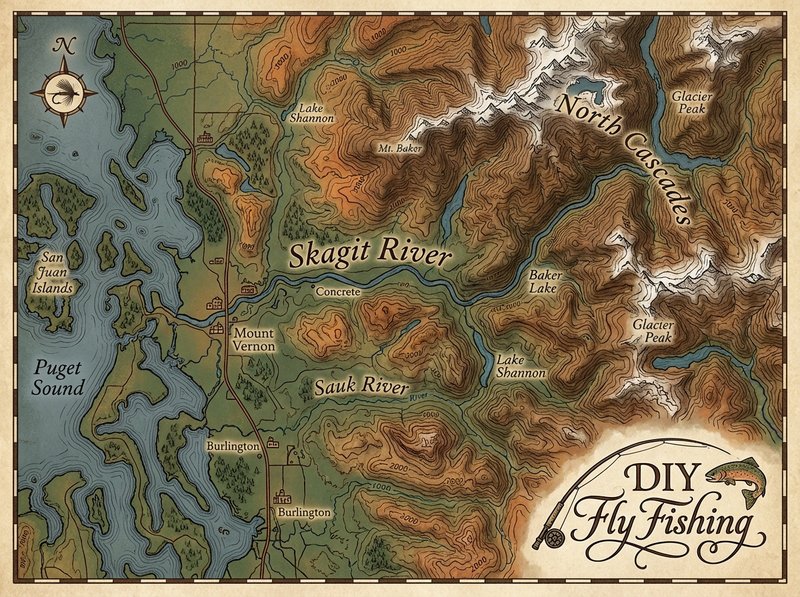
Skagit River
Fly fishing in Washington · Intermediate · Best seasons: Winter, Spring
Target Species
Steelhead, Bull Trout
About This Water
Legendary steelhead river with excellent fly water. Spey casting paradise and birthplace of modern steelhead techniques.
Fishing Recommendations
The Skagit River is the "Holy Grail" of steelhead fly fishing in the Pacific Northwest. Flowing from the North Cascades to the Salish Sea, it is a big, powerful, and majestic river that defined the evolution of modern Spey casting. For the angler who values the swing, the history, and the pursuit of wild, powerful fish in a dramatic mountain setting, the Skagit is hallowed ground.
🎣 Location Overview
The Skagit is the largest watershed in the Puget Sound basin. It is a classic "big water" experience—expansive gravel bars, deep emerald pools, and heavy flows. What makes it special is its lineage; this is the birthplace of Skagit-style Spey casting, developed here specifically to launch heavy tips and large flies in tight quarters against the river’s massive current.
The scenery is unmatched, with the jagged peaks of the North Cascades providing a backdrop of snow-capped granite and ancient evergreens. The river is wide, meaning you often need to make long casts (70–100+ feet) to cover the prime "buckets" where fish rest.
🐟 Target Species & Behavior
Wild Winter Steelhead
These are the crown jewels of the Skagit. Unlike hatchery fish, Skagit wild steelhead are renowned for their size and strength, often pushing into the 15–20 lb range.
- Behavior: They are "resting" migrants. They aren't looking for a meal so much as reacting out of territorial aggression or instinct.
- Holding Water: Look for "tailouts" (the smooth water just before a rapid), "seams" (where fast and slow water meet), and "inside bends" with walking-speed velocity.
Bull Trout
The Skagit is home to a world-class population of native Bull Trout, some reaching lengths over 30 inches.
- Behavior: They are apex predators and highly opportunistic. They follow the salmon and steelhead runs to feast on eggs, flesh, and fry.
- Holding Water: They prefer deeper, colder slots and often sit right behind spawning salmon or in the deep "guts" of a run.
📅 Best Times to Fish
Winter Steelhead (February – April)
- Prime Window: March is generally the peak. This is when the largest push of wild fish enters the system.
- Conditions: You want a "dropping and clearing" river. If the river is rising due to heavy rain or snowmelt, the fish hunker down. If it’s too clear, they become spooky. That "steelhead green" clarity (2–4 feet of visibility) is the magic ticket.
Bull Trout (Year-round, peak in Spring)
- Prime Window: March through May.
- Conditions: As the salmon fry begin to emerge from the gravel in the spring, Bull Trout become incredibly active, chasing "fry" into the shallows.
🪰 Recommended Flies & Techniques
The Swing (Spey Casting)
The Skagit is almost exclusively a Spey angler’s river. While you can nymph for Bull Trout, swinging is the traditional and most effective way to cover the vast runs for Steelhead.
Recommended Steelhead Flies:
- Intruders: Large, 3–5 inch patterns with lots of movement (ostrich herl, rhea). Colors: Black/Blue, Pink/Orange, and "Nightshade" (Purple/Black).
- Prom Dress: A classic flashy pattern for colored water.
- Hobo Spey: A smaller, more subtle profile for lower, clearer water.
Recommended Bull Trout Flies:
- Sculpin Patterns: Weighted patterns in olive, tan, or white.
- Fry Imitations: Small, epoxy-headed streamers (size 6–10) when the fry are out in the spring.
- Egg Patterns: Large "beads" or glo-bugs when salmon are spawning.
Presentation Tips
- The "Skagit" Swing: Cast at a 45-degree angle downstream. Use a heavy sink tip (T-11 to T-17) to get the fly down to the "zone" (about 6 inches off the bottom). Keep a tight line and let the current swing the fly across the run.
- The "Slow Down": In cold winter water, steelhead won't move far. You need to swing the fly as slowly as possible. Use a "big mend" upstream right after the fly hits the water to sink it deep before the swing starts.
💡 Pro Tips & Local Knowledge
- The "Step and Cast": This is a social river. The rule of thumb is to take two steps downstream between every cast. This ensures you cover the entire run and don't "high-hole" the person behind you.
- Focus on the Upper River: The stretches between Rockport and Marblemount are legendary. This area holds some of the best spawning gravel and classic "swing water."
- Watch the Gauge: Check the USGS gauge at Concrete. If the river is flowing over 15,000–20,000 cfs, it can be dangerous to wade and the fish are pushed into the trees. Ideal fishing flows are usually between 5,000 and 12,000 cfs.
- The "Hang Down": Many Steelhead strikes occur at the very end of the swing when the fly is dangling straight downstream. Wait 5–10 seconds before stripping in for your next cast.
⚠️ Important Information
Regulations (Crucial)
The Skagit is a highly regulated fishery.
- Catch and Release: Wild Steelhead and Bull Trout must be released. It is illegal to even remove a wild Steelhead from the water (keep them in the net).
- Barbless Hooks: Single barbless hooks are mandatory.
- Season Openings: The "Spring Catch and Release" season is not guaranteed every year. It is dependent on "escapement" numbers (how many fish are returning). Always check the WDFW (Washington Department of Fish and Wildlife) emergency rules before heading out.
Access
- Howard Miller Steelhead Park (Rockport): Great boat launch and bank access.
- Pressentin Park (Marblemount): Good bank access for those without a drift boat or jet boat.
- Wading Safety: The Skagit is powerful. Use a wading staff, wear a belt, and never "push it" in deep water. The bottom is often large, slick "bowling ball" cobble.
Gear Recommendation
- Rod: 13–14 foot 7-weight or 8-weight Spey rod.
- Reel: Large arbor with a sealed drag and plenty of backing.
- Line: Skagit Scout or Skagit Max head with a variety of 10–12 foot sink tips (MOW tips).
Bug Hatches & Matching Flies
| Hatch | Type | Peak months | Time of day | Hook sizes | Matching flies |
|---|---|---|---|---|---|
| March Brown Rhithrogena morrisoni | mayfly | March, April, May | Afternoon | #12-14 | March Brown Western Deceiver #12-14, Hare's Ear Nymph #12-14, March Brown Soft Hackle #14 |
| Blue Winged Olive Baetis | mayfly | March, April, September, October | Late Morning/Afternoon | #16-20 | Parachute Adams #16-20, RS2 #18-20, Pheasant Tail Nymph #16-20 |
| Skwala Stonefly Skwala americana | stonefly | February, March, April | Midday | #8-12 | Skwala Stone #8-10, Pat's Rubber Leg #8-12, Bullet Skwala #10 |
| Golden Stonefly Hesperoperla pacifica | stonefly | June, July | Morning/Evening | #6-10 | Chubby Chernobyl (Gold) #8-10, Kaufmann's Stone #6-10, Norm Wood Special #8 |
| Mother's Day Caddis Brachycentrus | caddis | May | Afternoon/Evening | #14-16 | Elk Hair Caddis #14-16, Peacock Caddis Larva #14-16, LaFontaine's Deep Sparkle Pupa #14-16 |
| Pale Morning Dun Ephemerella excrucians | mayfly | June, July, August | Morning/Afternoon | #14-18 | PMD Sparkle Dun #16-18, Split Case PMD #16-18, Quigley Cripple #16 |
| Green Sedge Rhyacophila | caddis | July, August, September | Evening | #10-14 | Green Weenie #12-14, Iris Caddis (Green) #12-14, Hydropsyche Larva #10-14 |
| Chironomid Chironomidae | midge | January, February, March, December | All Day | #18-24 | Zebra Midge #18-22, Griffith's Gnat #18-22, Black Beauty #20-22 |