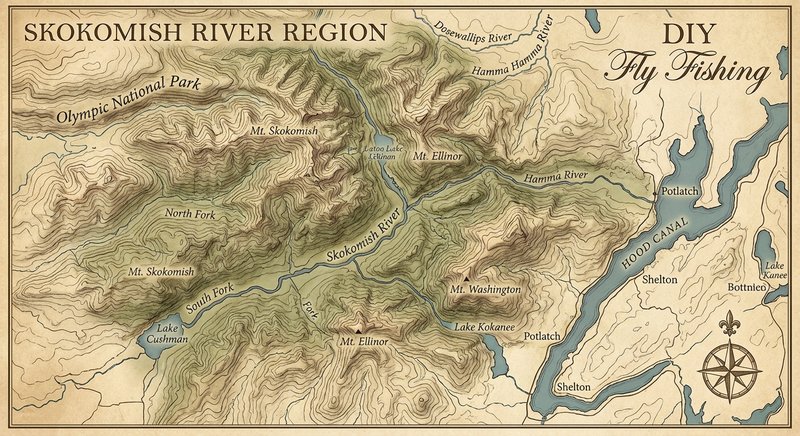
Skokomish River
Fly fishing in Washington · Intermediate · Best seasons: Fall, Winter
Target Species
Steelhead, Chum Salmon, Coho Salmon
About This Water
Southern Olympic Peninsula river with steelhead and salmon. Flows through Skokomish tribal lands.
Fishing Recommendations
Greetings, angler. It’s a pleasure to break down the Skokomish River for you. Located at the southern crook of the Hood Canal on the Olympic Peninsula, the "Skok" is a river of contrasts. It is famous for its massive returns of salmon and its intricate, ever-shifting channel through the valley floor.
Here is your guide to fishing the Skokomish.
🎣 Location Overview
The Skokomish is the largest source of freshwater entering the Hood Canal. It is a classic coastal river, characterized by low gradients, gravel bars, and a tendency to flood—which means the river's geography changes almost every year.
Anglers love the Skokomish because it offers some of the highest fish-per-mile counts in the state during peak runs. It’s a "working man’s river"—it isn't always pretty, and the lower sections can be muddy, but the sheer volume of fish is staggering. The river consists of a Main Stem, a North Fork (heavily dammed), and a South Fork (wilder and more rugged).
🐟 Target Species & Behavior
Chum Salmon (The "Dog" Salmon)
- Behavior: These are the heavyweights of the Skok. They enter the river in massive numbers. They are aggressive, hard-fighting, and known for their "tiger stripes" and large kype (hooked jaw).
- Holding: They prefer slower moving, shallower water near the edges of the main current or in the lower tidewater reaches.
Coho Salmon (Silvers)
- Behavior: Coho are acrobatic and can be temperamental. They move fast on high water and stall in deep, woody pools during low water.
- Holding: Look for "froggy" water—slow, deep pools, or behind root wade structures. They hate heavy current and will tuck into soft seams.
Steelhead (Winter Run)
- Behavior: These are the "ghosts" of the river. They enter later than the salmon. They are moving through to the upper tributaries.
- Holding: Classic "walking speed" water. They hold in the tail-outs of pools or in the "gut" of a run where there is 3–6 feet of depth and a steady flow.
📅 Best Times to Fish
- Fall (September – November): This is the "Main Event."
- September: Chinook (King) salmon arrive (check regulations, as this is often closed to protect runs).
- October – November: Peak season for Coho and the start of the massive Chum run.
- Winter (December – February):
- December: Late Chum salmon still linger.
- January – February: Prime window for wild and hatchery Winter Steelhead.
- Optimal Conditions: The Skok is very sensitive to rain. The best fishing occurs as the river is dropping and clearing after a storm. If it's "plumb colored" or rising, stay home. Look for visibility of at least 2–3 feet.
🪰 Recommended Flies & Techniques
For Chum Salmon
- Technique: High-stick nymphing or a short swing. You want the fly in the lower third of the water column.
- Flies: Pink and Purple are the magic colors.
- Patterns: Hareball Leeches, Pink Comets, or any weighted fly with cerise or fuchsia marabou.
For Coho Salmon
- Technique: The "Strip and Twitch." Use a slow-sinking line and twitch the fly back to you.
- Flies: Chartreuse and Orange.
- Patterns: Coho Blue Specials, Rolled Muddlers, or "Christmas Trees" (flashy tinsel flies).
For Steelhead
- Technique: The "Swing." Using a Spey rod or a heavy switch rod to cast across and down, letting the fly swing through the run.
- Flies: Blue/Black or Pink/White.
- Patterns: Intruder-style flies, Bunny Leeches, and the "Hobit Spey."
💡 Pro Tips & Local Knowledge
- The "Skokomish Twitch": Because the river is often crowded during salmon season, some people resort to snagging (which is illegal). As a fly angler, use weighted flies but long leaders to ensure the fish actually take the fly in their mouth. A "beaded" fly or a heavy brass eye is better than split shot.
- Tide Awareness: The lower Skok is highly tidal. A big incoming tide can "push" a fresh chrome school of fish miles upriver in a matter of an hour. Always fish the hour before and two hours after high tide in the lower reaches.
- The South Fork Secret: If the main stem is crowded or "blown out" (muddy), the South Fork often clears faster and offers a more wilderness-oriented experience for Steelhead, though the hiking is much tougher.
⚠️ Important Information
- Access: Much of the river runs through the Skokomish Indian Reservation. Be extremely respectful of tribal lands. Public access is primarily at the "Potholes" area or through the George Adams Hatchery vicinity. Always check for "No Trespassing" signs.
- Regulations (CRITICAL): The Skokomish has some of the most complex regulations in Washington. It frequently opens and closes on short notice based on escapement numbers.
- Anti-Snagging Rule: This is often in effect. It means your hook must be a certain distance from the weight.
- Barbless Hooks: Mandatory for all salmon and steelhead fishing.
- Release Rules: Wild Steelhead must never be removed from the water.
- Safety: The Skok is notorious for "quick sand" (silt deposits) and shifting log jams. Never wade into water where you cannot see the bottom, and always wear a wading belt.
Guide’s Final Word: The Skokomish is a high-reward river that requires patience with both the fish and the crowds. Go during the week if possible, bring plenty of pink marabou, and keep an eye on the USGS river gauges!
Bug Hatches & Matching Flies
| Hatch | Type | Peak months | Time of day | Hook sizes | Matching flies |
|---|---|---|---|---|---|
| Blue Winged Olive Baetis spp. | mayfly | March, April, September, October | Late Morning/Afternoon | #18-22 | Parachute Adams #18-20, RS2 #20, Pheasant Tail Nymph #18-22 |
| March Brown Rhithrogena morrisoni | mayfly | March, April | Mid-day | #12-14 | March Brown Western Deceiver #12-14, Gold Ribbed Hare's Ear #12-14, March Brown Wet Fly #14 |
| Golden Stonefly Hesperoperla pacifica | stonefly | June, July | All Day | #6-10 | Chubby Chernobyl (Gold) #8-10, Pat's Rubber Leg Stone #6-10, Golden Stone Nymph #8-12 |
| October Caddis Dicosmoecus atripes | caddis | September, October | Afternoon/Evening | #8-10 | Orange Stimulator #8-10, Morrish's October Caddis #10, Peeping Caddis #8-12 |
| Pale Morning Dun Ephemerella spp. | mayfly | June, July | Late Morning/Early Afternoon | #14-18 | PMD Sparkle Dun #16, Flashback Pheasant Tail #16-18, PMD Quigley Cripple #14-16 |
| Spotted Sedge Hydropsyche | caddis | July, August | Evening | #14-16 | Elk Hair Caddis (Tan) #14-16, Soft Hackle Hare's Ear #14-16, Hydropsyche Larva #14-16 |
| Little Black Stonefly Capniidae | stonefly | February, March | Mid-day | #14-18 | Little Black Stone #16-18, Zebra Midge (Black) #18-20, Prince Nymph #14-16 |
| Grannom Caddis Brachycentrus | caddis | April, May | Morning/Afternoon | #12-16 | Green Butt Caddis #14-16, Deep Sparkle Pupa #14-16, Caddis Larva (Green) #12-14 |