Skykomish River
Fly fishing in Washington · Intermediate · Best seasons: Summer, Fall, Winter
Target Species
Steelhead, Pink Salmon, Cutthroat Trout
About This Water
Central Cascades river with steelhead, salmon, and trout. Popular fly fishing destination near Seattle.
Fishing Recommendations
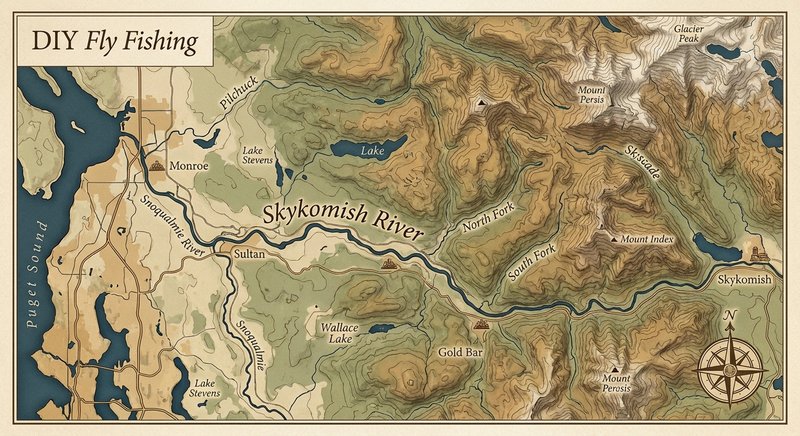
The Skykomish River, or simply "The Sky" to locals, is one of Washington State’s most storied and scenic fly fishing destinations. Flowing from the junction of the North and South Forks near Index and rushing down to meet the Snoqualmie, it offers a classic Pacific Northwest "big water" experience. It is the birthplace of many legendary steelhead patterns and techniques.
🎣 Location Overview
The Skykomish is a quintessential freestone river characterized by broad gravel bars, deep emerald pools, and heavy "classic" steelhead runs. What makes it special is its accessibility and its soul; it is a river where the mist clings to the evergreens and the water has a powerful, turquoise glacial tint.
Anglers love the Sky because it is a "swinging" river. The broad, consistent glides are tailor-made for Spey casting. While it is close to the Seattle metropolitan area, once you are waist-deep in the middle of a run like "Big Eddy," you feel miles away from civilization.
🐟 Target Species & Behavior
Steelhead (Summer & Winter Runs)
- Behavior: These are the crown jewels of the Sky. Summer-run fish (mainly Reiter Hatchery origin) arrive in the heat of summer and are known for their aggression and acrobatic fights. Winter-run fish are larger, stronger, and often arrive when the river is at its most volatile.
- Holding: Look for "walking speed" water. In summer, they hold in oxygenated riffles and at the heads of pools. In winter, they move to the softer "inside" seams and tailouts to conserve energy.
Pink Salmon (Odd Years Only)
- Behavior: Every odd-numbered year (2025, 2027, etc.), hundreds of thousands of Pinks flood the river. They are extremely aggressive towards small, pink flies.
- Holding: They congregate in massive schools in slow, shallow water and along gravel bars.
Coastal Cutthroat Trout
- Behavior: Often overlooked, these "sea-run" and resident cutthroats are opportunistic predators.
- Feeding: They follow the salmon to feast on eggs and flesh, but also key into caddis and mayfly hatches in the late summer.
📅 Best Times to Fish
- Summer Steelhead (June – August): Prime time is July. Low, clear water conditions are best. Fish the "edges of the day"—first light and last light—as these fish are light-sensitive.
- Winter Steelhead (December – February): This is the "hard yards" season. You are looking for a dropping and clearing river. The "magic" water color is about 2–3 feet of visibility (steelhead green).
- Pink Salmon (Late August – September): Only on odd years. This is high-volume fishing.
- Cutthroat (September – October): Best targeted as the water cools and the salmon begin to spawn.
🪰 Recommended Flies & Techniques
For Steelhead (The Swing)
- Technique: Use a 7 or 8-weight Spey rod. In summer, use a floating line or light sink tip with a Scandi head. In winter, switch to a Skagit head with heavy T-11 or T-14 tips.
- Flies:
- Summer: Green Butt Skunk, Purple Peril, and foam skaters (dry flies) for the brave.
- Winter: Intruder-style flies in black/blue, pink/orange, or "Nightshade" (black/purple).
For Pink Salmon
- Technique: Stripping small streamers on a floating line or light sink tip.
- Flies: Pink Comets, Humpy 62s, and small pink Marabou jigs. Keep them small—size 6 or 8.
For Cutthroat
- Technique: Single-hand 4 or 5-weight rods. Nymphing or swinging small streamers.
- Flies: Rolled Muddler Minnows, Bead-head Prince Nymphs, and Borden Special.
💡 Pro Tips & Local Knowledge
- The "Reiter" Factor: The area near the Reiter Ponds Hatchery is the most productive but also the most crowded. If you want solitude, avoid the hatchery stretch and float the lower river (Sultan to Monroe).
- The "Skykomish Sunrise": This is a famous local fly pattern (red, yellow, and white). While many use modern Intruders, having a traditional Skykomish Sunrise in your box is a nod to the river's history and still catches fish.
- Reading the Color: The Sky is heavily influenced by glacial melt and silt. If it looks like "chocolate milk," go home. If it looks like "jade or emerald," drop everything and go fishing.
- Boulder Hopping: The river bed is notoriously "greasy" and made of large, round cobble. Aluminum-barred wading boots or studs are highly recommended to avoid a swim.
⚠️ Important Information
- Access: Key access points include High Bridge, Big Eddy, the Sultan Boat Launch, and Ben Howard Road. Much of the river is bordered by private property, so stay below the ordinary high-water mark.
- Regulations: The Skykomish has very specific (and often changing) regulations.
- Always check the WDFW (Washington Department of Fish & Wildlife) Emergency Rules.
- Selective Gear Rules are often in effect (no bait, barbless hooks).
- Wild Steelhead: Must be released immediately without leaving the water. Only hatchery fish (clipped adipose fin) may be retained.
- Permits: You need a Washington State Freshwater Fishing License and a "Catch Record Card" for steelhead and salmon.
Guide’s Final Word: The Skykomish is a "big league" river. It can be intimidating due to its size, but if you focus on the "swing," keep your fly in the water, and cover ground, it will eventually reward you with one of the hardest-fighting fish in the world. Tight lines!
Bug Hatches & Matching Flies
| Hatch | Type | Peak months | Time of day | Hook sizes | Matching flies |
|---|---|---|---|---|---|
| March Brown Rhithrogena morrisoni | mayfly | March, April, May | Midday/Afternoon | #12-14 | March Brown Western Red #12-14, Hare's Ear Nymph #12-14, March Brown Wet Fly #12-14 |
| Blue Winged Olive (BWO) Baetis | mayfly | March, April, September, October | Afternoon | #16-20 | Parachute Adams #16-20, RS2 #18-20, Pheasant Tail Nymph #16-20 |
| Skwala Stonefly Skwala americana | stonefly | February, March, April | Midday | #8-12 | Skwala Stone #10-12, Pat's Rubber Leg #8-12, Bullet Head Skwala #10 |
| Golden Stonefly Hesperoperla pacifica | stonefly | June, July | Morning/Evening | #6-10 | Chubby Chernobyl (Gold) #6-10, Kaufmann’s Stone #6-10, Golden Stone Nymph #8 |
| Green Sedge Hydropsyche | caddis | June, July, August | Late Afternoon/Evening | #12-16 | Elk Hair Caddis #14-16, Soft Hackle Peacock #14-16, LaFontaine's Deep Sparkle Pupa #14-16 |
| Pale Morning Dun (PMD) Ephemerella excrucians | mayfly | June, July, August | Morning/Early Afternoon | #16-18 | PMD Sparkle Dun #16-18, Split Case PMD #16-18, PMD Cripple #16-18 |
| October Caddis Dicosmoecus | caddis | September, October | Afternoon | #8-10 | Orange Stimulator #8-10, October Caddis Pupa #8-10, Morrish October Caddis Adult #8-10 |
| Midges Chironomidae | midge | January, February, November, December | Midday | #18-24 | Zebra Midge #18-22, Griffith's Gnat #20-22, Mercury Midge #20-22 |