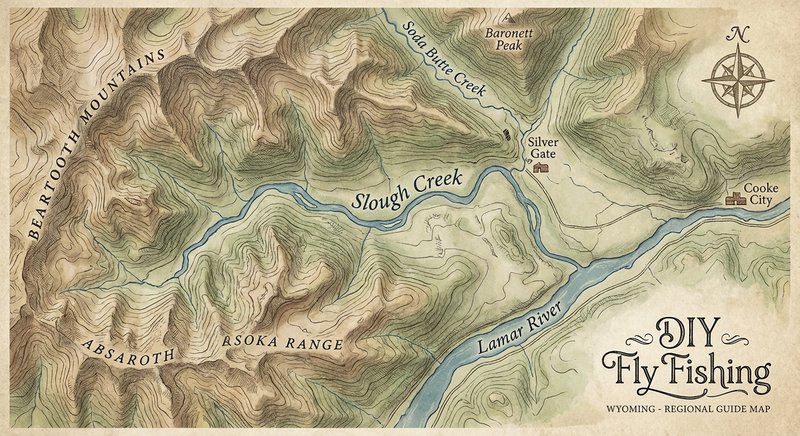
Slough Creek
Fly fishing in Wyoming · Intermediate · Best seasons: Summer, Fall
Target Species
Cutthroat Trout
About This Water
Yellowstone backcountry meadow stream with native cutthroat. Iconic Western fishing.
Fishing Recommendations
Slough Creek is often described as the "Holy Grail" of meadow stream fly fishing. Located in the northeastern corner of Yellowstone National Park, it is a place of pilgrimage for anglers who value technical dry-fly fishing, stunning scenery, and the opportunity to catch large, wild Yellowstone Cutthroat trout.
Here is your comprehensive guide to fishing Slough Creek, Wyoming.
🎣 Location Overview
Slough Creek is a high-altitude meadow stream that winds through wide, grassy valleys surrounded by rugged peaks. What makes Slough special is its character: it is a "spring creek" style fishery within a freestone system. The water is crystal clear, the current is often deceptively slow, and the fish are notoriously savvy.
The creek is divided into the "Lower Slough" (below the campground) and the "Upper Meadows" (accessible only by hiking or horse pack). It is famous for its three distinct meadows, each offering a slightly different experience, but all sharing the same hallmark: technical sight-fishing to rising trout in a landscape shared with bison, wolves, and bears.
🐟 Target Species & Behavior
The primary prize here is the Yellowstone Cutthroat Trout. You may also encounter the occasional Rainbow trout or "Cut-bow" hybrid in the lower reaches.
- Behavior: These are not your average "eager" backcountry trout. Because Slough is world-famous, the fish see a lot of flies. They are highly observant, often "hovering" just below the surface to inspect every meal.
- Holding Water: In the meadows, look for deep cut-banks, the tails of long pools, and subtle "buckets" in the middle of the channel. Because the water is so clear, fish will often hold in very shallow water near the banks if there is overhanging grass.
- Feeding: They are opportunistic but selective. They focus heavily on terrestrial insects in late summer and specific mayfly hatches in the morning and evening.
📅 Best Times to Fish
- Optimal Months:
- July: The "opener" (usually mid-July) features the legendary Drake hatches.
- August: The peak of terrestrial fishing (hoppers, ants, beetles).
- September: Cooler mornings and Blue Winged Olive (BWO) hatches; fewer crowds and aggressive fish.
- Best Time of Day:
- 10:00 AM – 4:00 PM: This is the prime window for terrestrial activity as the sun warms the meadows and insects become active.
- Prime Conditions: Overcast days are a gift on Slough Creek. The low light masks your presence and often triggers massive Blue Winged Olive hatches, causing every fish in the pool to start rising.
🪰 Recommended Flies & Techniques
Top Fly Patterns
- Terrestrials: Hopper Juan, Dave’s Hopper (Size 10-14), Furimsky’s Foam Ant (Size 16-18), and Black Beetles with a high-vis spot.
- Dry Flies: Parachute Adams (Size 16-22), Pale Morning Duns (PMD), and the Green Drake (Size 10-12) for early July.
- Nymphs: Pheasant Tail (Size 16-20), Zebra Midge (Size 18-22), and RS2s. Use these only if the fish aren't rising, and use a very small, unobtrusive indicator.
Effective Techniques
- The "Long and Fine" Approach: Use a 9-foot to 12-foot leader tapering down to 5X or 6X fluorocarbon tippet. Stealth is more important than the fly choice.
- Dry-Dropper: In the riffles between pools, a hopper with a small nymph (like a Pheasant Tail) dropped 18 inches below is lethal.
- Sight Fishing: Do not blind-cast. Walk slowly, stay back from the bank, and spot a feeding fish. Observe its rhythm before making your first cast.
💡 Pro Tips & Local Knowledge
- The First Meadow vs. The Rest: The First Meadow is easiest to reach (a short walk from the trailhead) and gets the most pressure. If you have the lungs for it, hike to the Second or Third Meadow. The fish there are slightly less "educated," and the scenery is even more spectacular.
- Crawl to the Bank: If you can see the fish, they can see you. Experienced Slough guides often stay 10 feet back from the water's edge or literally crawl on their hands and knees to avoid "lining" the fish.
- The "Downstream Drift": To avoid showing the fish your leader, try to get above the fish and cast downstream, using a reach cast or a pile cast to let the fly drift into their window before the line does.
⚠️ Important Information
- Access: The trailhead is near the Slough Creek Campground in the Lamar Valley. The hike to the First Meadow is easy; the hike to the Second Meadow involves a steep climb over a ridge (approx. 2-3 miles).
- Regulations:
- A Yellowstone National Park Fishing Permit is required (State licenses from WY/MT are not valid).
- Slough Creek is Catch and Release only for Cutthroat trout.
- Barbless hooks only.
- No lead weights or scented baits.
- Bear Safety: This is prime Grizzly Bear habitat. Always carry bear spray, know how to use it, and fish with a partner. Keep your gear close to you; bison are also common and can be unpredictable.
- Check the Slough: In early summer, the creek can be blown out by snowmelt. Check the USGS gauges or call a fly shop in Silver Gate or Cooke City before making the drive.
Guide’s Final Word: Slough Creek is a test of patience. Don't be frustrated if you get refused ten times by the same fish. Change your tippet, check your drift, and enjoy being in one of the wildest places left in the lower 48.
Bug Hatches & Matching Flies
| Hatch | Type | Peak months | Time of day | Hook sizes | Matching flies |
|---|---|---|---|---|---|
| Pale Morning Dun (PMD) Ephemerella excrucians | mayfly | July, August | Late Morning/Afternoon | #16-18 | Sparkle Dun #16-18, Pheasant Tail #16-18, Rusty Spinner #16-18 |
| Green Drake Drunella doddsi | mayfly | July | Mid-day/Afternoon | #10-12 | Hairwing Green Drake #10-12, Quigley Cripple #12, Drake Nymph #10-12 |
| Blue Winged Olive (BWO) Baetis spp. | mayfly | June, September, October | Late Morning/Afternoon | #18-22 | RS2 #20-22, Parachute Adams #18-22, WD-40 #20-22 |
| Grasshoppers Melanoplus spp. | terrestrial | August, September | Late Morning/Afternoon | #8-12 | Morrish Hopper #10-12, Parachute Hopper #8-12, Letort Hopper #12 |
| Gray Drake Siphlonurus occidentalis | mayfly | July, August | Evening | #12-14 | Gray Drake Spinner #12-14, Hare's Ear #12-14 |
| Black Ants Formicidae | terrestrial | July, August, September | All Day | #14-18 | Cinnamon Ant #16-18, Carpenter Ant #14, Transparant #16-18 |
| Spotted Sedge (Caddis) Hydropsyche spp. | caddis | July, August | Evening | #14-16 | Elk Hair Caddis #14-16, LaFontaine's Sparkle Pupa #14-16, Peacock Caddis #16 |
| Midges Chironomidae | midge | June, September | Morning | #20-24 | Zebra Midge #20-22, Griffith's Gnat #20-24, Morgan's Midge #22 |