Snake River
Fly fishing in Washington · Intermediate · Best seasons: Summer, Fall, Spring
Target Species
Steelhead, Smallmouth Bass, White Sturgeon
About This Water
Major Columbia tributary with steelhead, sturgeon, and smallmouth bass. Diverse fishing opportunities.
Fishing Recommendations
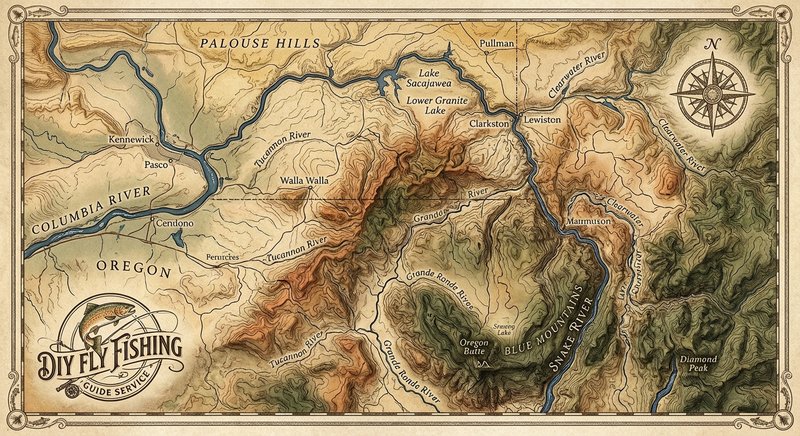
The Snake River in Washington is a powerful, high-desert waterway that offers some of the most diverse and rugged fly fishing in the Pacific Northwest. Flowing through basalt canyons and punctuated by four major dams (Lower Granite, Little Goose, Lower Monumental, and Ice Harbor), this river is a massive tailwater system that demands respect and big-water tactics.
🎣 Location Overview
The Lower Snake River in Washington is a landscape of stark beauty—towering basalt cliffs, golden rolling hills, and deep, emerald-green water. What makes this water special is its sheer scale. This is "big water" fly fishing. Unlike the intimate mountain streams of the Rockies, the Snake is a wide, powerful corridor that serves as a primary "fish highway" for migrating salmonids and a permanent home to world-class bass.
Anglers love the Snake because it offers the rare opportunity to swing for legendary "B-Run" Steelhead (the giants of the Columbia Basin) while simultaneously enjoying some of the most productive Smallmouth Bass fishing in the United States.
🐟 Target Species & Behavior
Steelhead (Summer-run A-Run and B-Run)
- Behavior: These fish are migratory. "A-Run" fish (typically 4–8 lbs) arrive first in late summer. The "B-Run" fish (often exceeding 12–15 lbs) follow in late September and October.
- Holding Water: They look for "traveling water"—walking-speed flows over cobble bottoms. Look for tailouts above rapids, seam lines near the banks, and the classic "V" slicks.
Smallmouth Bass
- Behavior: The Snake is a factory for Smallmouth. They are incredibly aggressive and congregate in massive numbers.
- Holding Water: They love the basalt rip-rap near dams, rocky points, submerged ledges, and the slower "eddies" behind large boulders.
- Feeding: They feast on crayfish, sculpins, and juvenile shad/shiners.
White Sturgeon
- Behavior: These are prehistoric giants. While rarely targeted on a fly rod due to their depth (often 40–100 feet) and size (up to 10 feet long), they are a frequent sight, often breaching the surface.
- Note: If you target them, it is almost exclusively a heavy-tackle bait game, but fly anglers should appreciate them as part of the river’s ancient ecosystem.
📅 Best Times to Fish
- Summer (June – August): Prime time for Smallmouth Bass. The water is warm, and the topwater action can be explosive. This is also when the first "A-Run" Steelhead begin to trickle past the dams.
- Fall (September – November): The "Golden Window." This is peak Steelhead season. September offers great "dry line" Steelhead fishing (skating flies), while October and November are the heart of the B-Run swing season. Smallmouth remain active until the water temps drop below 50°F.
- Spring (March – May): A great time for Sturgeon activity and the beginning of the Smallmouth pre-spawn. Note that most Steelhead in the river during Spring are "kelts" (returning to the ocean) or spawning in tributaries; most anglers leave them alone at this time.
🪰 Recommended Flies & Techniques
Steelhead: The "Swing" is King
- Technique: Spey casting with Skagit or Scandi lines is the standard. Swing flies through tailouts and across seams.
- Top Patterns:
- Early Fall: Green Butt Skunks, Blue Charms, or skating dry flies like the Steelhead Bee.
- Late Fall/Cold Water: Large "Intruder" style flies in Black/Blue, Pink/Orange, or Purple. Hobo Speys and Dirty Hoes are local favorites.
Smallmouth Bass: Aggressive & Visual
- Technique: 6-weight or 7-weight rods. Use sinking tip lines for streamers or floating lines for poppers.
- Top Patterns:
- Surface: Boogle Bugs, Murdich Minnows, and foam poppers in chartreuse or white.
- Sub-surface: Clouser Minnows (Olive/White), Meat Whistles, and any crayfish pattern with heavy lead eyes to bounce along the rocks.
💡 Pro Tips & Local Knowledge
- The "Step-Down" Method: When swinging for Steelhead, consistency is key. Cast, swing, take two steps downstream, and repeat. This ensures you cover every square inch of a run.
- Focus on the Confluences: The areas where the Clearwater or Palouse rivers enter the Snake are major staging areas for fish. These "thermal refuges" often hold higher concentrations of Steelhead.
- The Wind Factor: The Snake River canyon is a wind tunnel. If you are Spey casting, learn to cast over both shoulders (cack-handed). If the wind is blowing upriver, it's a Spey caster's dream; if it's blowing downriver, be extremely careful with your D-loop.
- Shadow Management: In the deep canyons, the sun disappears early. Steelhead often become very active during the "change of light" when the sun leaves the water.
⚠️ Important Information
- Access: Much of the Washington side of the Snake is accessible via Army Corps of Engineers parks and boat ramps. A jet boat is the best way to access the best water, but there is significant bank access near the dams (e.g., Little Goose and Lower Granite).
- Regulations: Washington Department of Fish and Wildlife (WDFW) rules are strict.
- Barbless Hooks: Mandatory for all Steelhead fishing.
- Permits: You need a WA Fishing License plus a Columbia River Salmon/Steelhead Endorsement.
- Wild Fish: Wild Steelhead (intact adipose fin) must be released immediately without being removed from the water.
- Safety: The Snake is deep, cold, and has powerful currents. Always wear a PFD if in a boat and be cautious when wading the basalt ledges—they can be incredibly slick and drop off abruptly.
Guide’s Final Thought: "The Snake isn't a river that gives up its secrets easily. You have to put in the time and the casts. But when a 15-pound B-Run Steelhead grabs your fly in the middle of a basalt canyon, you’ll understand why we keep coming back."
Bug Hatches & Matching Flies
| Hatch | Type | Peak months | Time of day | Hook sizes | Matching flies |
|---|---|---|---|---|---|
| Salmonfly Pteronarcys californica | stonefly | May, June | All Day | #4-8 | Rogue River Stone #4-6, Pat's Rubber Leg #4-8, Chubby Chernobyl (Orange) #6-8 |
| Blue Winged Olive (BWO) Baetis | mayfly | March, April, September, October | Mid-day/Afternoon | #18-22 | RS2 #18-22, Parachute Adams #18-22, Pheasant Tail Nymph #18-20 |
| Golden Stonefly Hesperoperla pacifica | stonefly | June, July | Morning/Evening | #8-12 | Golden Chubby Chernobyl #8-12, 20-Incher Stone #8-12, Clark's Golden Stone #10-12 |
| Pale Morning Dun (PMD) Ephemerella excrucians | mayfly | June, July, August | Late Morning/Afternoon | #14-18 | PMD Sparkle Dun #16-18, Split Case PMD #14-16, Rusty Spinner #16-18 |
| Spotted Sedge (Caddis) Hydropsyche | caddis | May, June, July, August | Evening | #14-18 | Elk Hair Caddis #14-18, LaFontaine's Deep Sparkle Pupa #14-16, Holy Grail #14-18 |
| October Caddis Dicosmoecus | caddis | September, October | Afternoon/Evening | #8-12 | Orange Stimulator #8-10, Morrish October Caddis Pupa #10-12, Mikulak Sedge #8-10 |
| Midges Chironomidae | midge | January, February, March, December | Mid-day | #18-24 | Zebra Midge #18-22, Griffith's Gnat #18-22, Top Secret Midge #20-24 |
| Grasshoppers Acrididae | terrestrial | August, September | Afternoon | #6-12 | Morrish Hopper #8-12, Dave's Hopper #10-12, Yeti Hopper #8-10 |