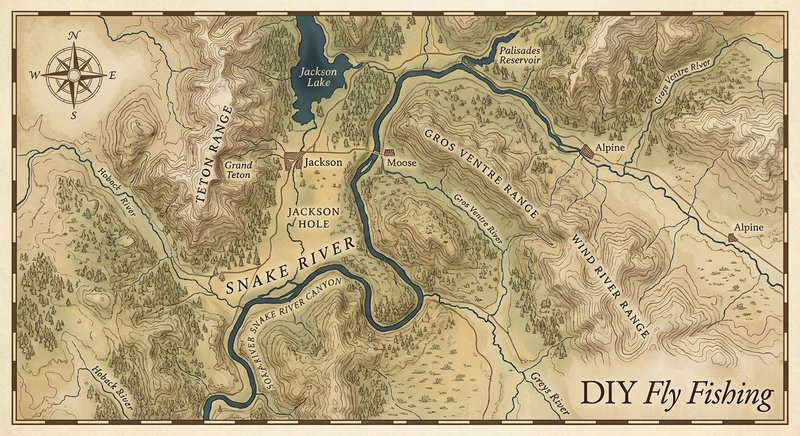
Snake River
Fly fishing in Wyoming · Intermediate · Best seasons: Summer, Fall
Target Species
Cutthroat Trout, Brown Trout
About This Water
Fine-spotted Snake River cutthroat subspecies. Float fishing through Grand Teton National Park.
Fishing Recommendations
As an expert guide who has spent countless days rowing the braids of the Snake River, I can tell you that this is one of the most iconic fly fishing destinations in the world. Set against the jagged backdrop of the Teton Range, it offers a combination of world-class scenery and aggressive, surface-oriented trout.
Here is your comprehensive guide to fishing the Snake River in Wyoming.
🎣 Location Overview
The Snake River in Wyoming, particularly the stretch through Grand Teton National Park and south of Jackson Hole, is a "bucket list" fishery. What makes it special is the Snake River Fine-Spotted Cutthroat Trout—a subspecies found nowhere else on earth.
The river is characterized by its massive gravel bars, complex braids, and "heavy" water. Unlike slow, technical spring creeks, the Snake is a big, powerful freestone river. It features deep drop-offs, swirling eddies, and classic riffle-run-pool structures. Anglers love it because the fish are notoriously "lookers"—they are famously willing to rise to large, bushy dry flies even when there isn't a massive hatch occurring.
🐟 Target Species & Behavior
Snake River Fine-Spotted Cutthroat Trout
These are the stars of the show. Unlike many trout that hide in deep holes, these Cutthroats love "the skin"—the shallow water right against the bank or the soft seams between fast and slow water.
- Behavior: They are opportunistic surface feeders. They aren't as "spooky" as Browns, but they require a drag-free drift.
- Holding Water: Look for "pillows" in front of logs, "tail-outs" at the end of runs, and the "seams" where two currents meet.
Brown Trout
Found more frequently in the lower sections (South of Jackson and through the Canyon), these fish grow large and are much more predatory.
- Behavior: Browns here are light-sensitive. They stay deep during the bright midday sun and move into the shallows to hunt during low light or under overcast skies.
- Feeding: They focus on sculpins, small whitefish, and occasionally large stoneflies.
📅 Best Times to Fish
Optimal Seasons
- Summer (Late July – August): This is prime time. Once the spring runoff subsides and the water clears (usually by mid-July), the "dry fly feast" begins. This coincides with the famous Stonefly and Hopper seasons.
- Fall (September – October): My personal favorite. The crowds thin out, the Cottonwoods turn gold, and the Mahoganies and Blue Winged Olives (BWO) hatch. The Cutthroats are aggressive, bulking up for winter.
Best Times of Day
- Summer: 9:00 AM to 4:00 PM. The Snake is a "heat of the day" fishery because the terrestrial insects (hoppers, ants, beetles) are most active when it’s warm.
- Fall: 11:00 AM to 3:00 PM. Wait for the water to warm slightly to trigger the aquatic insect activity.
🪰 Recommended Flies & Techniques
Top Fly Patterns
- Dry Flies:
- Circus Peanuts or Chernobyl Ants (Size 8-12) – The "Jackson Hole Special."
- Turck’s Tarantula – A classic local favorite.
- Parachute Adams (Size 14-18) – For matching specific mayfly hatches.
- Nymphs:
- Pat’s Rubber Legs (Coffee/Black) – Mimics the Giant Stonefly.
- Princess Nymph or Pheasant Tail (Size 14-16).
- Streamers:
- Goldy’s or Sex Dungeon (Olive/Black) – For targeting those big Browns in the Canyon.
Techniques & Presentation
- The "Hopper-Dropper": This is the standard Snake River rig. Tie a large, buoyant foam dry fly (Hopper) and drop a weighted nymph 2-3 feet below it on 4X or 5X fluorocarbon.
- Pound the Banks: When floating in a drift boat, you must land your fly within inches of the bank. The Cutthroats often sit in water so shallow their back fins are almost showing.
- The "Twitch": When fishing large stonefly or hopper patterns, give the fly a tiny "twitch" to mimic a struggling insect. This often triggers a violent strike.
💡 Pro Tips & Local Knowledge
- Focus on the Braids: On the upper river (inside the Park), the river splits into many small channels. These "braids" hold fish that see much less pressure than the main channel.
- The "Canyon" Stretch: From Alpine Junction up to Hoback, the river enters a deep canyon. This is "big fish" water. Use heavier rods (6-weight) and larger streamers here.
- Structure is King: The Snake is full of downed timber (sweepers). Some of the biggest Cutthroats live right in the middle of tangled branches. If you aren't losing a few flies to the trees, you aren't fishing where the fish are.
- The "Snake River Reach Cast": Because the current is fast and turbulent, mastering the reach cast is essential to prevent your fly from dragging immediately.
⚠️ Important Information
Access
- Inside Grand Teton National Park: High-quality wade fishing is available at Deadmans Bar and Schwabacher Landing.
- The Lower Snake: Most fishing here is done via drift boat. Popular ramps include Wilson Bridge, Von Gontard, and West Table.
Regulations & Permits
- License: You need a Wyoming State Fishing License. If fishing inside the National Park, you do not need an additional permit, but you must follow Park-specific rules.
- Special Rules: The Snake is generally "wild trout" water. Most sections are Catch and Release only for Cutthroat Trout. Always check the current Wyoming Game & Fish Department (WGFD) regulations for "Area 1."
- Invasive Species: You must have an AIS (Aquatic Invasive Species) decal if you are launching any watercraft (even a paddleboard).
Safety
- Wildlife: This is Grizzly and Moose country. Always carry bear spray, even when standing in the middle of the river.
- Water Safety: The Snake is a powerful river with many "strainers" (fallen trees). If you are rowing, you must be an experienced oarsman.
Bug Hatches & Matching Flies
| Hatch | Type | Peak months | Time of day | Hook sizes | Matching flies |
|---|---|---|---|---|---|
| Midges Chironomidae | midge | February, March, April | Late Morning/Afternoon | #18-24 | Zebra Midge #18-22, Griffith's Gnat #18-20, Morgan's Midge #20-22 |
| Skwala Stonefly Skwala americana | stonefly | April, May | Mid-day/Afternoon | #8-12 | Skwala Stone #10-12, Pat's Rubber Leg #8-12, Bullet Head Skwala #10-12 |
| Blue Winged Olive Baetis spp. | mayfly | April, May, September, October | Late Morning/Afternoon | #16-22 | BWO Sparkle Dun #18-20, RS2 #18-22, Pheasant Tail #16-20 |
| Salmonfly Pteronarcys californica | stonefly | June, July | All Day | #4-8 | Chubby Chernobyl #6-10, Cat's Whisker Salmonfly #4-8, Girdle Bug #4-8 |
| Golden Stonefly Hesperoperla pacifica | stonefly | July | Morning/Afternoon | #8-12 | Water Walker #8-10, Golden Half-Back #8-12, Norm Wood Special #10-12 |
| Pale Morning Dun Ephemerella excrucians | mayfly | July, August | Morning/Early Afternoon | #14-18 | PMD Parachute #16-18, Quigley Cripple #14-16, Split Case PMD #16-18 |
| Yellow Sally Isoperla spp. | stonefly | July, August | Afternoon/Evening | #14-16 | Yellow Sally Foam #14-16, Iron Sally #14-16, Stimulator #14-16 |
| Grasshoppers Orthoptera | terrestrial | August, September | Mid-day/Afternoon | #8-14 | Rainy's Grand Hopper #10-12, Morrish Hopper #8-12, Parachute Hopper #12-14 |
| Mahogany Dun Paraleptophlebia spp. | mayfly | September, October | Afternoon | #16-18 | Mahogany Sparkle Dun #16-18, Mahogany Parachute #16-18, Mercer's Micro Mayfly #16-18 |
| Caddis Hydropsyche / Brachycentrus | caddis | July, August, September | Morning/Evening | #14-18 | Elk Hair Caddis #14-18, LaFontaine's Deep Sparkle Pupa #14-16, X-Caddis #14-18 |