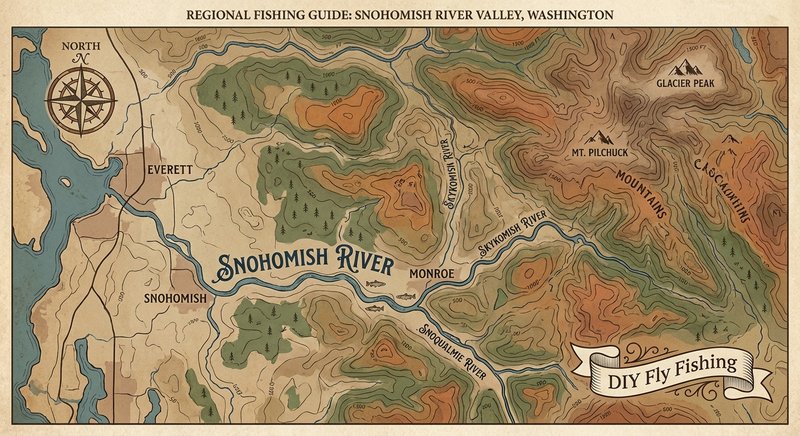
Snohomish River
Fly fishing in Washington · Beginner · Best seasons: Fall, Winter
Target Species
Chinook Salmon, Coho Salmon, Steelhead
About This Water
Large Puget Sound river formed by Skykomish and Snoqualmie. Salmon and steelhead in tidal influenced water.
Fishing Recommendations
The Snohomish River is one of Western Washington’s most storied systems. Formed by the confluence of the Skykomish and Snoqualmie rivers near Monroe, it winds through a broad valley before dumping into Puget Sound at Everett. It is a massive, powerful waterway that serves as a primary highway for migrating salmon and steelhead.
Here is your comprehensive guide to fly fishing the Snohomish River.
🎣 Location Overview
The Snohomish is a "big water" river. Unlike its mountain-fed tributaries, the Snohomish is characterized by its lower gradient, deep pools, and significant tidal influence in its lower reaches.
What makes it special is its accessibility and volume. Because it is the final corridor for fish returning to two major sub-basins (the Sky and the Snoqualmie), the sheer number of fish passing through can be staggering. Anglers love it because it offers a "big river" Spey casting experience just 45 minutes from Seattle. The river features long gravel bars and deep, slow-moving "slots" that are perfect for swinging flies.
🐟 Target Species & Behavior
Chinook (King) Salmon
- Behavior: These are the heavyweights. They enter the system in late summer and early fall. Chinook are notorious for holding in the deepest, darkest holes during the day and moving through shallower riffles at night or during low-light conditions.
- Holding: They prefer the "guts" of the pools—the deepest water with the most structure.
Coho (Silver) Salmon
- Behavior: Known for their aggression and acrobatic fights. Coho love to "stall" in the lower river, especially in slack water, sloughs, and behind root wads. They are very sensitive to pressure but will chase a stripped fly with a ferocity that Chinook rarely match.
- Holding: Look for "froggy" water—slow-moving seams and the edges of soft eddies.
Winter Steelhead
- Behavior: The "Ghost of the Coast." These fish are focused on one thing: getting upstream to spawn. They don't eat to survive at this stage, but they strike out of territorial aggression or instinct.
- Holding: They prefer "walking pace" water—about 3 to 6 feet deep with a basketball-sized rocky bottom.
📅 Best Times to Fish
- Coho & Chinook (The Fall Window): September through November.
- Chinook peak in late August through September.
- Coho peak in October and early November.
- Winter Steelhead: December through February. This is a "wait for the rain" game. You want to fish as the river is "dropping and clearing" after a storm.
- The Tidal Factor: In the lower Snohomish (below Douglas Bar), the tide is everything. An incoming tide pushes fresh fish into the river. The two hours before and after high tide are often the most productive.
- Time of Day: Low light is your best friend. Get to the water before the sun hits it, or fish the "magic hour" at dusk.
🪰 Recommended Flies & Techniques
Recommended Fly Patterns
- For Coho: The Rolled Muddler or Flash Trap. Coho love chartreuse, pink, and orange. Small, flashy streamers (Size 4-6) are often more effective than large ones.
- For Chinook: Comets and Bunny Leeches. Use heavy, large flies in black/chartreuse or purple/pink.
- For Steelhead: Intruders and Prom Dress patterns. Large, articulated flies that move a lot of water. Blue/Black or Pink/Orange are the standard colors.
Techniques
- The Swing (Spey/Switch): This is the primary method on the Snohomish. Use a Sink Tip (Type 3 to Type 6) to get the fly down. Cast 45 degrees downstream, let the fly swing across the current, and hold on.
- The "Twitch": For Coho in slow water, use a weighted fly (like a Jig-fly) and "twitch" it back to you with short, sharp strips. This erratic movement often triggers a strike when a steady swing fails.
- The "Hang": At the end of your swing, let the fly dangle in the current for 10-15 seconds. Coho are famous for following a fly all the way to the bank and striking just as you prepare to recast.
💡 Pro Tips & Local Knowledge
- Watch the Flow: The Snohomish is prone to blowing out. Check the USGS Gauge at Snohomish. If the graph is a vertical line up, stay home. You want a "descending limb" on the graph.
- Structure over Depth: In the lower river, look for "Snags." The Snohomish is full of sunken timber. While you will lose flies, the fish congregate around these wood structures for safety.
- The "Douglas Bar" Area: This is one of the most famous stretches. It offers great wading access and is a classic "interception point" for fish moving up from the salt.
- Barbless is Best: Even when not required by law, barbless hooks make releasing these powerful fish much easier and safer for the fish.
⚠️ Important Information
Access
- Boat Ramps: Langus Waterfront Park (Everett), Rotary Park (Lowell), and the Snohomish Lincoln Ave boat launch.
- Bank Access: Douglas Bar and various points along the Lowell-Snohomish River Road offer spots to park and walk in. Be mindful of private property signs.
Regulations & Permits
- WDFW Rules: The Snohomish has very specific (and often changing) regulations. Always check the WDFW Emergency Rules before heading out.
- Endorsement: You need a Washington State Freshwater Fishing License plus a "Columbia River Salmon and Steelhead Endorsement" (even though this isn't the Columbia, the fee applies to most salmon/steelhead waters).
- Punch Cards: You must have a Catch Record Card on your person and record any retained fish immediately.
Safety
- The Mud: The banks of the Snohomish can be "glacial flour" mud. It looks solid but can act like quicksand. Test your footing with a wading staff.
- Life Jackets: If fishing from a boat or wading deep in the lower tidal sections, wear a PFD. The current is deceptively strong.
Tight lines! The Snohomish is a rewarding river for those who put in the time to learn its moods and tides.
Bug Hatches & Matching Flies
| Hatch | Type | Peak months | Time of day | Hook sizes | Matching flies |
|---|---|---|---|---|---|
| Blue Winged Olive Baetis tricaudatus | mayfly | March, April, September, October | Late Morning/Afternoon | #16-20 | Parachute Adams #16-20, RS2 #18-20, Pheasant Tail #16-18 |
| March Brown Rhithrogena morrisoni | mayfly | March, April | Mid-day | #12-14 | March Brown Western Red #12-14, Gold Ribbed Hare's Ear #12-14, March Brown Wet #12-14 |
| October Caddis Dicosmoecus atripes | caddis | September, October | Afternoon/Evening | #8-10 | Orange Stimulator #8-10, Peeking Caddis #8-12, Morrish October Caddis #8-10 |
| Pale Morning Dun Ephemerella excrucians | mayfly | June, July, August | Late Morning/Afternoon | #14-18 | PMD Sparkle Dun #16-18, Split Case PMD #14-16, Quigley Cripple #16 |
| Grannom Caddis Brachycentrus occidentalis | caddis | April, May | Afternoon/Evening | #14-16 | Elk Hair Caddis (Olive) #14-16, Deep Sparkle Pupa #14-16, Iris Caddis #14-16 |
| Golden Stonefly Hesperoperla pacifica | stonefly | June, July | All Day | #8-12 | Pat's Rubber Leg #8-12, Rogue Foam Stone #8-10, Golden Chubby Chernobyl #8-12 |
| Spotted Sedge Hydropsyche | caddis | July, August, September | Evening | #14-18 | Tan Elk Hair Caddis #14-18, Hydropsyche Larva #14-16, Goddard Caddis #14-16 |
| Midges Chironomidae | midge | January, February, March, December | Late Morning | #18-24 | Griffith's Gnat #18-22, Zebra Midge #18-24, Top Secret Midge #20-22 |