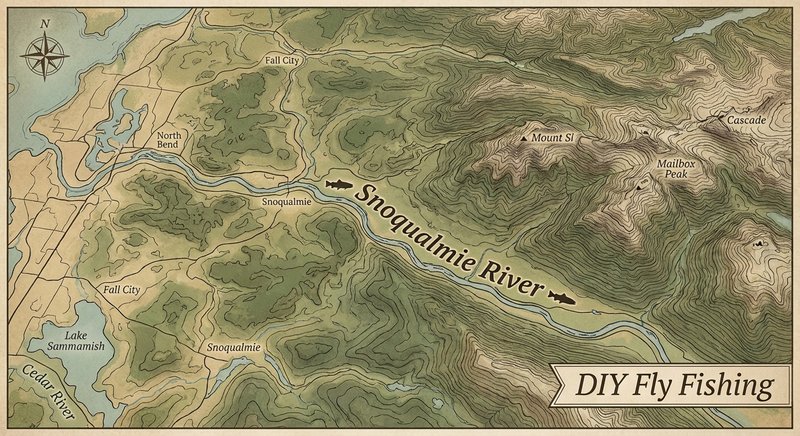
Snoqualmie River
Fly fishing in Washington · Beginner · Best seasons: Spring, Summer, Fall
Target Species
Rainbow Trout, Steelhead, Cutthroat Trout
About This Water
Accessible Cascade foothills river east of Seattle. Good trout fishing with steelhead in lower sections.
Fishing Recommendations
The Snoqualmie River is a jewel of the Pacific Northwest, located just a short drive from the Seattle metropolitan area. It is uniquely divided by the massive 268-foot Snoqualmie Falls, which creates two distinct fisheries: the freestone "Upper Forks" (North, Middle, and South) and the larger, meandering "Lower Mainstem."
🎣 Location Overview
The Snoqualmie system is beloved for its diversity and accessibility.
- The Upper Forks: These are classic mountain freestone streams. They flow through granite boulder gardens, deep evergreen forests, and alpine valleys. The water is crystal clear, cold, and oxygen-rich. It’s a "dry fly paradise" where the fish are opportunistic and the scenery is world-class.
- The Lower Mainstem: Below the falls, the river transforms into a larger, slower-moving system that eventually joins the Skykomish to form the Snohomish. This section is the domain of migratory fish and larger resident trout.
What makes it special is the Middle Fork. Once a degraded ecosystem, decades of conservation have turned it into one of the finest "backyard" wild trout fisheries in the country, recently designated as a Wild and Scenic River.
🐟 Target Species & Behavior
Coastal Cutthroat & Rainbow Trout
In the Upper Forks, you’ll find wild Coastal Cutthroat and Rainbows.
- Behavior: These fish are rarely "trophy" size (averaging 8–12 inches), but they are incredibly feisty and beautiful.
- Holding Water: Look for "pocket water"—the small slicks behind boulders, the soft edges of fast riffles, and the tail-outs of deep pools.
- Feeding: Because the mountain water is nutrient-poor, these fish are not picky. They will slash at almost any well-presented dry fly.
Steelhead
Found primarily below the falls.
- Behavior: Snoqualmie Steelhead are known for their resilience. Winter runs (Dec–March) are more common, but a small summer run exists.
- Holding Water: They prefer "walking speed" water, usually 3 to 6 feet deep with a cobblestone bottom.
- Feeding: They aren't feeding for hunger, but striking out of aggression or instinct.
📅 Best Times to Fish
- Spring (April – June): This is "runoff season." The river is often high and dangerous from snowmelt. However, the lower river can have great windows for Sea-run Cutthroat if the flows are stable.
- Summer (July – September): The Prime Window. As the snowmelt subsides, the Upper Forks become wadeable. July and August offer the best dry fly fishing.
- Fall (September – October): The "Second Peak." Water temperatures drop, and the October Caddis hatch begins. This is also when Sea-run Cutthroat move up into the lower river in great numbers.
- Best Time of Day: In the heat of summer, the "Evening Rise" (7:00 PM to dark) is legendary on the Middle Fork.
🪰 Recommended Flies & Techniques
Upper Forks (Trout)
- Dry Flies:
- Patterns: Parachute Adams (#14-16), Elk Hair Caddis (#12-16), Royal Wulff (#14), and Stimulators (#10-14) in orange or yellow.
- Technique: A "Dry-Dropper" rig is the most effective. Use a high-visibility Stimulator on top and hang a small nymph 18 inches below it.
- Nymphs:
- Patterns: Gold-ribbed Hare’s Ear (#14-16), Pheasant Tail (#14-18), and Prince Nymphs.
- Technique: High-stick nymphing through deep boulder pockets.
Lower River (Steelhead & Large Cutthroat)
- Streamers:
- Patterns: Woolly Buggers (Black or Olive), Bunny Leeches, and intruders for Steelhead.
- Technique: The "Swing." Cast quartering downstream, mend the line, and let the fly swing through the current.
💡 Pro Tips & Local Knowledge
- The "Middle Fork" Rule: Focus your efforts on the Middle Fork for the truest wilderness experience. The further you drive up the Middle Fork Road (past the paved section), the better the fishing gets and the fewer people you will see.
- Stealth is Key: Because the water is so clear, these fish can see you from a distance. Wear earthy colors (tans/greens) and try to stay low when approaching a pool.
- The "Snotty" Rocks: The Snoqualmie is notorious for incredibly slippery, algae-covered rocks. Studded wading boots are highly recommended. A wading staff is a life-saver here.
- Look for Confluences: Where smaller creeks dump into the main forks, the oxygen levels are higher and food is more concentrated. These are "honey holes."
⚠️ Important Information
- Regulations: The Snoqualmie system has complex regulations. Most of the Upper Forks are Catch and Release only and Selective Gear Rules (barbless single hooks, no bait).
- Permits: You will need a Washington State Freshwater Fishing License. If parking in the Mt. Baker-Snoqualmie National Forest or at state trailheads, you will need a Discover Pass or a Northwest Forest Pass.
- Check the Gauges: Always check the USGS water flows before heading out. For the Middle Fork, you want to see the "Snoqualmie River near Tanner" gauge below 1,000 cfs for safe wading.
- Safety: The falls are a hard barrier. Never attempt to boat or tube anywhere near the crest of Snoqualmie Falls.
Guide’s Final Word: The Snoqualmie isn't about catching the biggest fish of your life; it's about the beauty of the PNW and the joy of a wild trout rising to a dry fly in a mountain stream. Tight lines!
Bug Hatches & Matching Flies
| Hatch | Type | Peak months | Time of day | Hook sizes | Matching flies |
|---|---|---|---|---|---|
| March Brown Rhithrogena morrisoni | mayfly | March, April | Afternoon | #12-14 | Western March Brown #12-14, Hare's Ear Nymph #12-14, March Brown Emerger #14 |
| Blue Winged Olive (BWO) Baetis | mayfly | March, April, September, October | Afternoon | #16-20 | Parachute Adams #16-20, RS2 #18-20, BWO Sparkle Dun #16-18 |
| Mother's Day Caddis Brachycentrus occidentalis | caddis | April, May | Afternoon/Evening | #14-16 | Grannom Caddis #14-16, Peacock Caddis #14-16, Deep Sparkle Pupa #14-16 |
| Golden Stonefly Hesperoperla pacifica | stonefly | June, July | Morning/Evening | #6-10 | Chubby Chernobyl (Gold) #8-12, Pat's Rubber Leg #6-10, Golden Stone Nymph #8-10 |
| Pale Morning Dun (PMD) Ephemerella | mayfly | June, July | Late Morning/Afternoon | #16-18 | PMD Sparkle Dun #16-18, Pheasant Tail Nymph #16-18, PMD Quigley Cripple #16 |
| Yellow Sally Isoperla | stonefly | June, July, August | Evening | #14-16 | Yellow Sally Dry #14-16, Little Yellow Sloan #14-16 |
| Spotted Sedge Hydropsyche | caddis | July, August | Evening | #14-16 | Elk Hair Caddis (Tan) #14-16, LaFontaine's Emergent Pupa #14-16 |
| October Caddis Dicosmoecus | caddis | September, October | All Day | #8-12 | Orange Stimulator #8-10, October Caddis Pupa #8-12, Morrish's October Caddis #10 |
| Winter Midges Chironomidae | midge | January, February, March | Afternoon | #18-24 | Griffith's Gnat #18-22, Zebra Midge #18-22 |