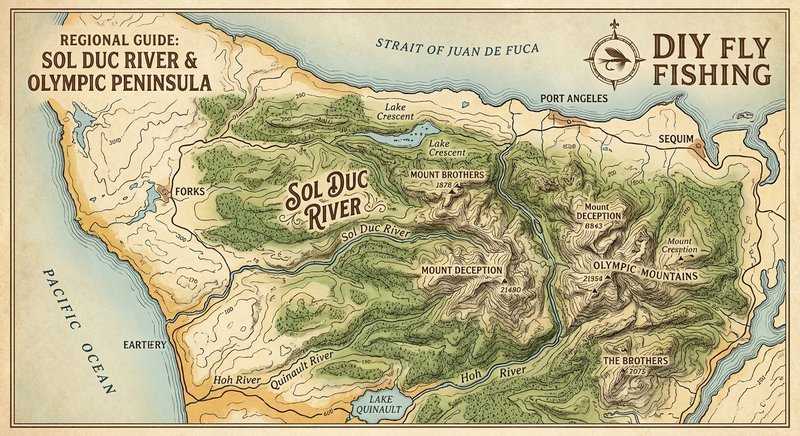
Sol Duc River
Fly fishing in Washington · Intermediate · Best seasons: Fall, Winter, Spring
Target Species
Steelhead, Coho Salmon, Chinook Salmon
About This Water
Olympic Peninsula gem with wild steelhead and salmon. Flows through old-growth rainforest with excellent fly water.
Fishing Recommendations
The Sol Duc River is arguably the crown jewel of the Olympic Peninsula (OP) in Washington State. Known for its breathtaking scenery—winding through ancient rainforests and moss-draped cedars—it is one of the few rivers in the lower 48 that still boasts a healthy run of wild "super-fish." Its name, translated from the Quileute language, means "Sparkling Waters," a fitting description for its clear, bouldery runs.
🎣 Location Overview
The Sol Duc is a classic freestone river characterized by high gradients, large boulders, and turquoise-tinted pools. Unlike its neighbors, the Hoh or the Bogachiel, the Sol Duc often stays fishable when other rivers are blown out from rain, thanks to its headwaters being buffered by the Olympic Mountains and a slightly steeper drop that helps it clear faster.
It is a "technical" river. Anglers love it because it rewards precision. The structure is complex, with deep pocket water, heavy riffles, and classic tailouts. It is widely considered the best river on the OP for swinging flies for wild winter steelhead.
🐟 Target Species & Behavior
Wild Winter Steelhead
The stars of the show. Sol Duc steelhead are famous for their size and aggression.
- Behavior: They are "active" travelers. They hold in "soft" water during high flows and move into the heads of runs and tailouts as the water clears.
- Feeding: While they don't "feed" traditionally in freshwater, they are highly territorial and reactive to large, colorful swung flies or drifted eggs/nymphs.
Coho Salmon (Silver)
- Behavior: Known for being acrobatic and aggressive. They love "frog water"—slow, deep sloughs or the seams between fast and slow water.
- Feeding: They have a high predatory instinct and will chase moving flies, especially those in chartreuse, pink, or orange.
Chinook Salmon (King)
- Behavior: The heavyweights. They hold deep in the main current or at the very base of deep pools.
- Feeding: They are harder to entice on fly gear than Coho, requiring deep presentations and large, high-contrast flies.
📅 Best Times to Fish
- Winter Steelhead (Late January – April): This is the prime window. March and April are the peak months for wild fish. These are the legendary "grey ghosts" of the OP.
- Fall Coho (September – November): The best time for silver salmon. Early October is usually the sweet spot, especially after the first significant rain "pulls" them into the river.
- Spring/Summer Chinook (May – July): There is a unique run of springers in the Sol Duc. They are incredibly strong and highly prized for their oil content and fighting ability.
- Prime Conditions: On the Sol Duc, look for a "dropping and clearing" river gauge. A flow between 1,500 and 2,500 cfs at the Quillayute gauge is often ideal for the Sol Duc.
🪰 Recommended Flies & Techniques
Swinging (Spey Casting)
This is the soul of Sol Duc fishing.
- Flies: Intruder-style patterns are king. Use black/blue, pink/orange, or purple for Steelhead. For Coho, think flashy and green.
- Patterns: Prom Dress, Hobo Spey, Dirty Hoh, and the Sol Duc Spey.
- Technique: Use a Skagit head with various T-series sink tips (T-11, T-14) to get the fly down to the fish’s eye level.
Nymphing / Indicator Fishing
Highly effective for those who want to maximize their catch rate.
- Flies: 10mm–12mm beads (mottled orange or light roe), Glo-bugs, and rubber-legged stones.
- Technique: Focus on the "seams" and the walking-speed water. Depth control is critical.
Streamer Stripping (For Coho)
- Flies: Bunny Leeches, Clouser Minnows, and "Comets" in bright colors.
- Technique: Cast into slow water and use a fast, erratic strip to trigger a chase response.
💡 Pro Tips & Local Knowledge
- "Boulder Hopping": The Sol Duc is full of large rocks. Don't just fish the obvious tailouts. Some of the biggest steelhead hold in the "pocket water"—small cushions of soft water created by large boulders in the middle of heavy rapids.
- The "Sol Duc Shuffle": If you are swinging flies, take two steps downstream between every cast. This river is large, and you need to cover water to find a willing participant.
- Water Clarity: If the water is "Gin Clear," go small and dark (black or olive). If it has a "Glacial Green" tint, go big and bright (pink or orange).
- The Upper River: The water above the Salmon Cascades is stunning but has different regulations and seasons. Most fly anglers focus on the stretches between Maxfield Boat Launch and the confluence with the Bogachiel.
⚠️ Important Information
- Regulations: The Sol Duc is strictly regulated to protect wild stocks. Always check the WDFW (Washington Department of Fish and Wildlife) pamphlet before heading out.
- Wild Fish Policy: All wild Steelhead must remain in the water. It is illegal to lift a wild steelhead out of the water for a photo. Keep them wet!
- Barbless Hooks: Required for all salmon and steelhead fishing in this region.
- Wading Safety: The Sol Duc is a powerful, slippery river. A wading staff and studded boots are highly recommended. Felt soles are legal in WA, but many guides prefer aluminum bars/studs for the slick basalt rocks.
- Access: Much of the river runs through private timberland or Olympic National Park. Use designated boat launches (Whitcomb-Dimmel, Maxfield, Leyendecker) for foot access points.
Guide’s Final Thought: Respect the river and the fish. These wild runs are a gift. If you hook a 20lb wild buck in the middle of a rainforest rainstorm, you’ll understand why people travel from across the globe to fish the "Duc."
Bug Hatches & Matching Flies
| Hatch | Type | Peak months | Time of day | Hook sizes | Matching flies |
|---|---|---|---|---|---|
| March Brown Rhithrogena morrisoni | mayfly | March, April, May | Mid-day to Afternoon | #12-14 | Western March Brown #12-14, Hare's Ear #12-14, March Brown Emerger #14 |
| Blue Winged Olive Baetis spp. | mayfly | March, April, October, November | Afternoon | #16-20 | RS2 #18-20, Parachute Adams #16-20, Pheasant Tail #16-20 |
| Golden Stonefly Hesperoperla pacifica | stonefly | June, July, August | Morning/Evening | #6-10 | Pat's Rubber Leg #6-10, Rogue Foam Stone #8-10, Golden Demon #8-12 |
| Yellow Sally Isoperla spp. | stonefly | June, July | Afternoon/Evening | #14-16 | Little Yellow Sloan #14-16, Yellow Sally Nymph #14-16 |
| October Caddis Dicosmoecus atripes | caddis | September, October | All day/Evening | #8-12 | Orange Stimulator #8-12, Peeping Caddis #8-10, Morrish's October Caddis #10 |
| Skwala Stonefly Skwala americana | stonefly | February, March | Mid-day | #10-12 | Skwala Stone #10-12, Dark 20-Incher #10-12 |
| Salmonfly Pteronarcys californica | stonefly | May, June | All day | #4-8 | Chubby Chernobyl #6-8, Giant Stone Nymph #4-8 |
| Green Sedge Rhyacophila spp. | caddis | May, June, July | Evening | #12-16 | Green Spratley #12-14, Elk Hair Caddis (Green) #14-16, Green Drake #12-14 |