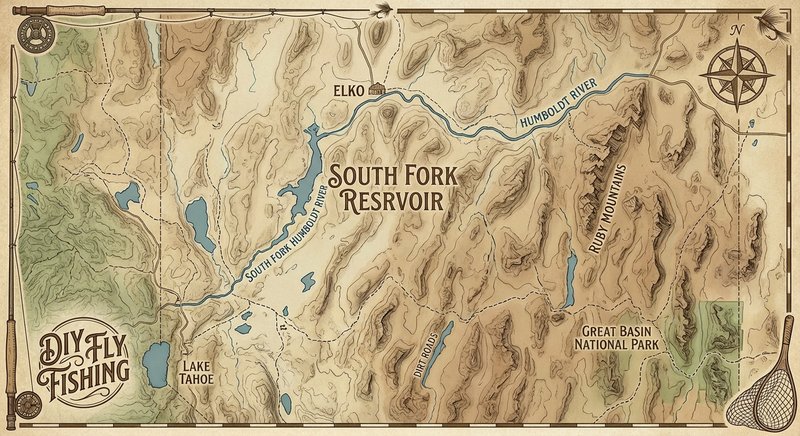
South Fork Reservoir
Fly fishing in Nevada · intermediate · Best seasons: spring, summer, fall
Target Species
Rainbow Trout, Brown Trout
About This Water
State recreation area with quality trout. Elko County destination with facilities.
Fishing Recommendations
South Fork Reservoir, located just south of Elko, Nevada, is often whispered about in fly fishing circles as one of the most productive "trophy" stillwaters in the Great Basin. As a guide, I consider this a "must-fish" destination for anyone looking to tangle with heavy-shouldered trout in a high-desert setting.
🎣 Location Overview
South Fork Reservoir is a 1,650-acre impoundment of the South Fork of the Humboldt River. Set against the stunning backdrop of the snow-capped Ruby Mountains, this reservoir is a biological factory. Unlike many high-desert lakes that are sterile, South Fork is rich in nutrients, leading to massive populations of scuds, damselflies, and midges.
What makes it special is the growth rate of the fish. Because of the incredible biomass, trout here are notoriously "girthy"—often referred to by locals as "footballs." The water is characterized by extensive weed beds (potamogeton), shallow flats, and a few rocky points and cliffs, providing a diverse range of habitats for both fish and the bugs they eat.
🐟 Target Species & Behavior
- Rainbow Trout: These are the primary target. They are hard-fighting and grow rapidly. You’ll find them cruising the weed edges and shallow flats (5–12 feet deep) looking for easy meals. They are particularly active during the spring and early summer.
- Brown Trout: The "glamour" species of South Fork. The Browns here can reach legendary proportions (8+ lbs). They are more secretive than the rainbows, often holding near the dam’s rocky face or deep along the submerged river channel during the day, moving into the shallows to hunt at dawn and dusk.
- Forage Base: The fish here are opportunistic but focus heavily on Chironomids (midges), Scuds (freshwater shrimp), Damselfly nymphs, Callibaetis, and Leeches.
📅 Best Times to Fish
- Spring (Late March – May): This is prime time. As the ice melts, trout move into the shallows to warm up and feed aggressively after winter. This is the best time for Chironomid fishing.
- Summer (June – July): The Damselfly migration usually peaks in late June or early July. This is some of the most exciting stillwater fishing you’ll ever experience, with fish crashing nymphs in inches of water.
- Fall (September – November): As water temperatures drop, the big Browns become aggressive in preparation for spawning. The weed beds begin to die back, making it easier to strip streamers without snagging.
- Time of Day: Early morning (first light) and the "magic hour" before sunset are essential, especially for the larger Brown trout. Mid-day can be productive if there is a slight "chop" on the water to mask your presence.
🪰 Recommended Flies & Techniques
Chironomid (Midge) Fishing
This is the bread and butter of South Fork.
- Flies: Zebra Midges (black/silver, red/silver), Ice Cream Cones, and Chromies in sizes #12–18.
- Technique: Use a long leader (12–18 feet) under a strike indicator. Suspend your flies 6 inches to 2 feet off the bottom in 8–15 feet of water.
The "Damsel Crawl"
- Flies: Marabou Damsel Nymphs (olive or light green) in sizes #10–14.
- Technique: Use an intermediate sinking line. Cast toward the weed beds and use a slow, rhythmic "inchworm" retrieve. The take is often a sharp "thud."
Streamer Stripping
- Flies: Simi Seal Leeches (black, olive, or blood red), Wooly Buggers, and Bunny Leeches.
- Technique: Use a Type 3 or Type 5 sinking line to get down near the submerged river channel or along the dam face. A fast, erratic strip often triggers a reaction from the big Browns.
Dry Fly Action
- Flies: Parachute Adams or Callibaetis Spinners (#14–16).
- Technique: Look for rising fish on calm summer mornings in the "no-wake" zones.
💡 Pro Tips & Local Knowledge
- The "No-Wake" Zones: The upper end of the reservoir (where the river enters) is a no-wake zone. This is the best area for float tubers and kayakers. The water is shallower, the weed beds are denser, and the fish feel more secure.
- The Wind is Your Friend (and Enemy): Elko can be windy. A slight breeze creates "surface distortion," which makes the fish less spooky. However, if the whitecaps start, get off the water for safety.
- Tackle Up: Don't bring a 4-weight. Use a 9-foot 6-weight rod. You need the backbone to punch through the wind and to keep a 5-pound rainbow from burying itself in the thick weeds.
- The "Hang": When stripping streamers or damsels, always pause for 5 seconds when your fly is right next to the boat/tube. Fish often follow the fly from the weeds and will hit it during that final pause.
⚠️ Important Information
- Access: South Fork State Recreation Area has excellent boat ramps and developed campgrounds. There is a daily vehicle entrance/boating fee.
- Watercraft: While bank fishing is possible near the dam and boat ramps, this is a vessel-heavy fishery. To be successful, you really need a float tube, pontoon, or boat to reach the weed lines.
- Regulations: A valid Nevada fishing license is required. South Fork is open year-round, but always check the Nevada Department of Wildlife (NDOW) for current limit regulations and any emergency closures.
- Environment: This is high-desert country (approx. 5,200 ft elevation). The sun is intense, and the weather can change in minutes. Bring polarized sunglasses, high-SPF sunscreen, and a windbreaker even in summer.
Guide’s Final Word: South Fork is a "thinking person's" lake. You have to watch the water, find the weed edges, and match the depth of the bugs. If you do, you’ll catch some of the heaviest trout of your life. Tight lines!
Bug Hatches & Matching Flies
| Hatch | Type | Peak months | Time of day | Hook sizes | Matching flies |
|---|---|---|---|---|---|
| Chironomids (Midges) Chironomidae | midge | April, May, September, October | All Day | #12-22 | Ice Cream Cone #14-18, Zebra Midge #16-20, Griffith's Gnat #18-22 |
| Callibaetis (Speckled Duns) Callibaetis | mayfly | June, July, August | Morning/Afternoon | #12-16 | Parachute Adams #14-16, Callibaetis Spinner #14-16, Hare's Ear Nymph #12-16 |
| Damselfly Enallagma | terrestrial | June, July | Morning/Afternoon | #10-14 | Marabou Damsel Nymph #10-12, Adult Damsel #12-14 |
| Dragonfly Anisoptera | terrestrial | July, August | Afternoon | #4-10 | Dragonfly Nymph #6-10, Woolly Bugger (Olive/Brown) #4-8 |
| Scuds (Freshwater Shrimp) Gammarus | midge | April, May, October | All Day | #12-18 | Ray Charles #14-18, Olive Scud #12-16 |
| Water Boatman / Backswimmer Corixidae / Notonectidae | terrestrial | September, October | Afternoon | #12-16 | Water Boatman #14-16, Prince Nymph #12-16 |
| Traveling Sedge (Caddis) Hesperophylax | caddis | July, August | Evening | #8-12 | Goddard Caddis #8-12, Elk Hair Caddis #10-14 |
| Trico Tricorythodes | mayfly | August, September | Morning | #20-24 | Trico Spinner #20-24, RS2 #20-22 |