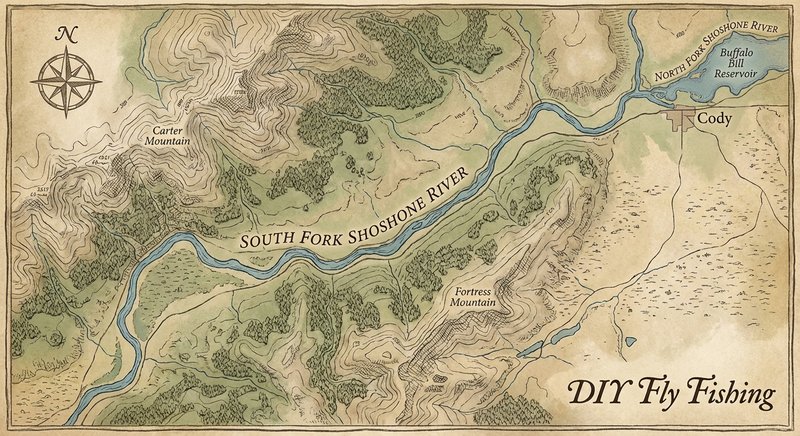
South Fork Shoshone River
Fly fishing in Wyoming · Intermediate · Best seasons: Summer, Fall
Target Species
Cutthroat Trout, Rainbow Trout
About This Water
Absaroka wilderness stream with cutthroat trout. Remote backcountry fishing.
Fishing Recommendations
Welcome to one of the most rugged and rewarding fly fishing destinations in the Rocky Mountains. As your guide, I’m excited to break down the South Fork of the Shoshone River.
Located southwest of Cody, Wyoming, the South Fork is a stunning freestone river that drains the high Absaroka Mountains. Unlike its cousin, the North Fork (which follows the highway to Yellowstone), the South Fork feels more intimate, remote, and wild. It is a true "Western" experience characterized by massive cottonwood galleries, towering volcanic cliffs, and some of the purest strains of Yellowstone Cutthroat trout you’ll ever find.
🎣 Location Overview
The South Fork Shoshone is a high-desert mountain river. The upper reaches flow through the Washakie Wilderness, eventually winding through a broad valley of private ranches before emptying into Buffalo Bill Reservoir.
What makes it special is the visual clarity and the solitude. While the North Fork gets the "drive-by" traffic from Yellowstone tourists, the South Fork requires a bit more intent to fish. The water is classic freestone: pocket water, long glassy glides, and deep emerald pools. It is a "big sky" river where you can spend an entire day without seeing another angler, surrounded by the dramatic backdrop of Castle Rock and the Ishawooa Hills.
🐟 Target Species & Behavior
- Yellowstone Cutthroat Trout: The crown jewel. They are opportunistic, beautiful, and often willing to rise to a dry fly even when no hatch is present. They tend to hold in the softer "seams" and tailouts of pools.
- Rainbow Trout & "Cutt-bow" Hybrids: Found throughout the system, particularly in the middle and lower stretches. They are hard fighters and often hold in the faster, highly oxygenated "heavy" water or at the heads of riffles.
- Behavior: In the heat of summer, these fish are "looking up." They hold in classic positions: behind submerged boulders, under overhanging willow banks, and in the "cushion" in front of rocks. Because the water is so clear, they can be spooky; a long leader and a stealthy approach are often necessary.
📅 Best Times to Fish
The South Fork is a seasonal fishery that relies heavily on the timing of the spring runoff.
- Summer (Late June – August): This is the prime window. Once the spring melt subsides (usually by late June or early July), the dry fly fishing is world-class.
- July: The Golden Stonefly and Yellow Sally hatches are legendary.
- August: Terrestrial season. Grasshoppers, ants, and beetles become the primary food source.
- Fall (September – October): My personal favorite time. The crowds vanish, the cottonwoods turn gold, and the fish become aggressive before winter.
- The "Fall Run": Large Rainbows and the occasional Brown trout move out of Buffalo Bill Reservoir and up into the river.
- Best Time of Day: During mid-summer, the "9 to 5" window is excellent. In the heat of August, focus on early morning and the "golden hour" before dusk.
🪰 Recommended Flies & Techniques
Dry Flies (The Main Event)
- Attractors: Chubby Chernobyl (Size 8-12) in Gold, Olive, or Purple. This is the "standard" South Fork fly.
- Mayflies: Parachute Adams (14-18), Purple Haze (14-16), and PMDs (16).
- Stoneflies: Yellow Sallies (14-16) and Stimulators (10-14).
- Terrestrials: Morrish Hopper (Pink or Tan), Foam Beetles, and Carpenter Ants.
Nymphs (When they aren't rising)
- Droppers: Tungsten Bead-head Pheasant Tails (14-18), Prince Nymphs, and Sexy Walt’s Worms.
- Attractor Nymphs: Pat’s Rubber Legs (Coffee/Black) for the deeper holes.
Techniques
- Dry-Dropper: This is the most effective way to cover the South Fork. Hang a small nymph 2–3 feet below a high-floating Chubby Chernobyl.
- High-Sticking: In the pocket water sections, keep as much fly line off the water as possible to avoid drag caused by complex currents.
- The "Twitch": When fishing grasshopper patterns in August, give the fly a tiny "skitter" near the bank to mimic a struggling insect.
💡 Pro Tips & Local Knowledge
- The Wind is Real: The South Fork valley acts as a funnel. Afternoon winds can be brutal. Carry a 6-weight rod in addition to your 5-weight to punch through the gusts.
- Respect Private Property: Much of the South Fork valley is private ranch land. In Wyoming, you must stay within the high-water marks. If you step onto the bank above the high-water line on private land, you are trespassing.
- Look for "Skinny" Water: Everyone fishes the deep pools. On the South Fork, Cutthroats will often hold in water so shallow you’d think it couldn't hold a fish. Don't skip the shallow riffle corners.
- The Road End: Drive to the very end of South Fork Road (Hwy 291). This is the "Cabin Creek" trailhead. From here, you can hike into the Shoshone National Forest for miles of public, untouched water.
⚠️ Important Information
Safety: This is Grizzly Country
The South Fork has one of the highest densities of Grizzly Bears in the lower 48.
- Always carry Bear Spray on your person (not in your pack).
- Make noise while walking through thick willow galleries.
- Fish with a partner whenever possible.
Regulations & Access
- License: A valid Wyoming Fishing License and Conservation Stamp are required.
- Limits: Check the current Wyoming Game & Fish Department (WGFD) regulations for the "Basin" area. Many anglers practice 100% Catch and Release here to protect the native Cutthroat.
- Access Points: Use the WGFD "Public Access Areas." Major ones include the Ishawooa access and the public stretches near the Forest Service boundary.
The South Fork of the Shoshone isn't just a fishing trip; it's a wilderness experience. Take a moment to look up from your fly and realize you are in one of the last truly wild places in America. Tight lines!
Bug Hatches & Matching Flies
| Hatch | Type | Peak months | Time of day | Hook sizes | Matching flies |
|---|---|---|---|---|---|
| Blue Winged Olive Baetis spp. | mayfly | April, May, September, October | Midday | #16-20 | Parachute Adams #16-20, RS2 #18-20, Pheasant Tail #16-18 |
| Salmonfly Pteronarcys californica | stonefly | June, July | All Day | #4-8 | Rogue River Stone #4-8, Pat's Rubber Leg #4-8, Chubby Chernobyl #6-8 |
| Golden Stonefly Hesperoperla pacifica | stonefly | July | Morning/Afternoon | #8-12 | Golden Chubby #8-12, Iron Lotus #12-14, Halfback #8-12 |
| Pale Morning Dun Ephemerella excrucians | mayfly | July, August | Late Morning/Early Afternoon | #14-18 | PMD Sparkle Dun #16-18, Split Case PMD #16-18, Quigley Cripple #14-16 |
| Brachycentrus Caddis Brachycentrus occidentalis | caddis | May, June, July | Evening | #14-16 | Elk Hair Caddis #14-16, LaFontaine Sparkle Pupa #14-16, Peacock Caddis #14-16 |
| Yellow Sally Isoperla spp. | stonefly | July, August | Afternoon/Evening | #14-16 | Yellow Sally Foam Stone #14-16, Little Yellow Sloan #14-16, Stimulator #14-16 |
| Grasshoppers Orthoptera | terrestrial | August, September | Late Morning/Afternoon | #8-12 | Morrish Hopper #8-12, Thunder Thighs Hopper #10-12, Parachute Hopper #12 |
| Midges Chironomidae | midge | March, April | Midday | #18-24 | Zebra Midge #18-22, Griffith's Gnat #20-22, Buzzer #18-20 |