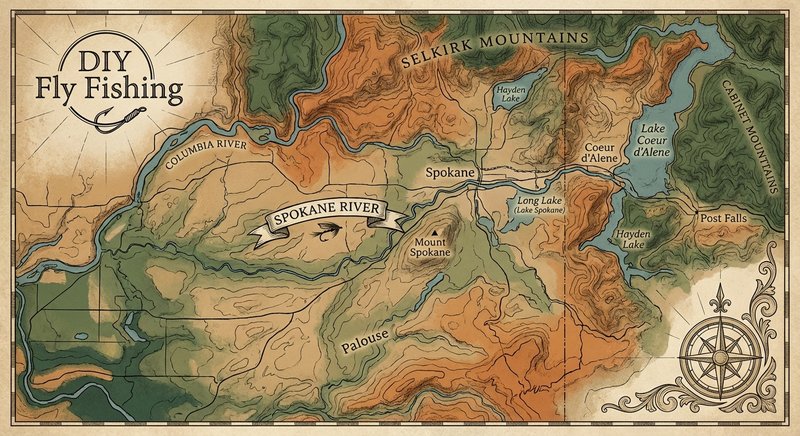
Spokane River
Fly fishing in Washington · Beginner · Best seasons: Spring, Summer, Fall
Target Species
Rainbow Trout, Brown Trout
About This Water
Urban fishing opportunity with good rainbow trout. Multiple wadeable sections through the Spokane area.
Fishing Recommendations
As an expert guide who has spent years rowed across the currents of the Inland Northwest, I can tell you the Spokane River is one of the most underrated blue-ribbon fisheries in the West. It is a unique urban fishery that transitions quickly from a downtown centerpiece into a rugged, basalt-lined canyon wilderness.
Here is your comprehensive guide to fly fishing the Spokane River.
🎣 Location Overview
The Spokane River is a freestone-style river regulated by dams, flowing from Lake Coeur d’Alene in Idaho through the heart of Spokane, Washington, before joining the Columbia River.
What makes it special is the Basalt Canyon topography. The river cuts through ancient volcanic rock, creating deep pools, heavy riffles, and massive "pocket water" sections. This isn't a gentle meadow stream; it is a big, powerful, and often pushy river. Anglers love it because it offers true wild-trout fishing within minutes of a major city, and its "redband" trout are known for being some of the hardest-fighting salmonids in the country.
🐟 Target Species & Behavior
Columbia River Redband Trout (Rainbow)
These are the stars of the show. They are a unique subspecies of rainbow trout adapted to the desert environment.
- Behavior: They are incredibly hardy and powerful. They prefer fast, highly oxygenated water.
- Where they hold: Look for them in the "heavy" water—the heads of riffles, behind large basalt boulders (pocket water), and in the "seams" where fast and slow water meet.
- Feeding: They are opportunistic but can be technical during specific hatches.
Brown Trout
Found primarily in the upper sections (near the Idaho border) and certain slower stretches.
- Behavior: More elusive and light-sensitive than the Redbands.
- Where they hold: Deep undercut banks, submerged logs, and the darker tails of large pools.
- Feeding: They transition to piscivorous (fish-eating) diets early; if you want a trophy Brown, you’ll be throwing streamers.
📅 Best Times to Fish
Spring (April – June)
- The Window: This is "big bug" season.
- Conditions: Runoff can make the river unfishable in May, but the weeks before and after the peak flow are prime for March Browns and the beginning of the Salmonfly hatch.
Summer (July – September)
- The Window: Late June through August is the dry fly enthusiast’s dream.
- Conditions: The water drops and clears. This is when the Pteronarcys (Salmonflies) and Golden Stones emerge. Evening caddis flights are spectacular.
Fall (September – November)
- The Window: My personal favorite time.
- Conditions: The crowds thin out, and the Blue Winged Olives (BWO) emerge. The water temperatures drop, triggering the big Browns to become aggressive before their spawn.
🪰 Recommended Flies & Techniques
Top Fly Patterns
- Dries: Chubby Chernobyl (Size 6-10) in gold, orange, or purple; Stimulators; Elk Hair Caddis; Parachute Adams (Size 14-18).
- Nymphs: Pat’s Rubber Legs (the "Spokane River Candy"); Perdigons (various colors); Prince Nymphs; San Juan Worms (after rain).
- Streamers: Olive or Black Woolly Buggers; Sculpzilla; Galloup’s Dungeon (for big Browns).
Effective Techniques
- Dry-Dropper: In the summer, a high-floating Chubby Chernobyl with a weighted nymph (like a Perdigon) dropped 2–3 feet below it is the most effective way to cover water.
- High-Stick Nymphing: Because of the basalt boulders, the currents are complex. Keeping your line off the water is essential to prevent drag.
- Streamer Stripping: On cloudy days, swing streamers through deep runs or strip them fast near the banks.
💡 Pro Tips & Local Knowledge
- Focus on the "Upper": The stretch from the State Line to Harvard Road is prime for drift boats and has high fish densities.
- The Downtown Stretch: Don't overlook the water right near the T.J. Meenach Bridge. It looks urban, but the pocket water there holds massive Redbands.
- The "Basalt Hop": The riverbed is incredibly slippery and rugged. Studded wading boots and a wading staff are non-negotiable. Do not underestimate the power of this current.
- Swing the Riffles: During the evening caddis hatch, don't just fish the dry; swing a soft-hackle wet fly through the riffles. The takes are violent.
⚠️ Important Information
Access
- Drift Boats: Best put-ins are Barker Rd, Harvard Rd, and Sullivan Rd.
- Wade Access: Riverside State Park offers miles of access but requires a Discover Pass for parking.
Regulations & Permits
- Washington Fishing License: Required.
- Special Rules: The Spokane River is largely Catch and Release for wild trout (specifically the Redbands). Most sections are Barbless Hooks Only and Selective Gear Rules (no bait).
- Closure: Be aware of seasonal closures near the dams and specific tributaries; always check the current WDFW Regulations.
Conservation
The Spokane River has faced historical pollution issues. While water quality has improved drastically, there are still consumption advisories for fish. Practice 100% Catch and Release to protect the unique Redband genetics and your own health.
Bug Hatches & Matching Flies
| Hatch | Type | Peak months | Time of day | Hook sizes | Matching flies |
|---|---|---|---|---|---|
| Skwala Stonefly Skwala americana | stonefly | March, April | Afternoon | #8-12 | Skwala Stone Dry #10-12, Pat's Rubber Leg #8-12, Bullet Head Skwala #10 |
| Blue Winged Olive (BWO) Baetis tricaudatus | mayfly | March, April, September, October | Late Morning/Afternoon | #16-22 | RS2 #18-20, Parachute Adams #16-20, BWO Sparkle Dun #18-22 |
| March Brown Rhithrogena morrisoni | mayfly | April, May | Afternoon | #12-14 | March Brown Western Red #12-14, Gold Ribbed Hare's Ear #12-14, March Brown Soft Hackle #14 |
| Pale Morning Dun (PMD) Ephemerella excrucians | mayfly | June, July | Morning/Early Afternoon | #16-18 | PMD Sparkle Dun #16-18, Pheasant Tail Nymph #16-18, Split Case PMD #16 |
| Golden Stonefly Hesperoperla pacifica | stonefly | June, July | Evening | #6-10 | Chubby Chernobyl (Gold) #8-12, Golden Stone Nymph #6-10, Norm Wood Special #8-10 |
| Spotted Sedge / Caddis Hydropsyche | caddis | June, July, August | Evening | #14-16 | Elk Hair Caddis (Tan) #14-16, LaFontaine's Deep Sparkle Pupa #14-16, Godzilla Caddis #14 |
| Trico Tricorythodes | mayfly | August, September | Early Morning | #20-24 | Trico Spinner #20-24, Zebra Midge #20-22, Griffith's Gnat #20-22 |
| Terrestrials (Grasshoppers) Orthoptera | terrestrial | July, August, September | Afternoon | #8-12 | Morrish Hopper #8-12, Parachute Hopper #10-12, Black Foam Beetle #14-16 |