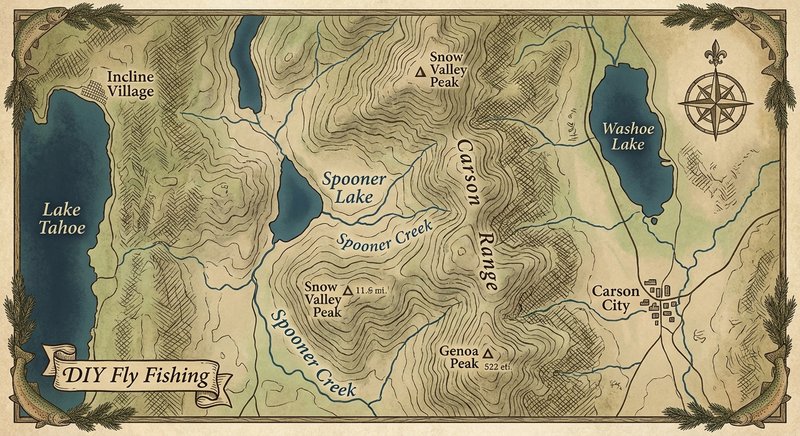
Spooner Lake
Fly fishing in Nevada · beginner · Best seasons: spring, summer, fall
Target Species
Rainbow Trout
About This Water
Lake Tahoe Nevada State Park lake. Scenic mountain lake with rainbow trout.
Fishing Recommendations
Spooner Lake is a hidden gem nestled in the Carson Range of the Sierra Nevada, sitting at an elevation of approximately 7,100 feet. While most people flock to the massive expanse of Lake Tahoe just down the road, fly anglers head to Spooner for its tranquility, its "trophy" management regulations, and its spectacular alpine scenery.
Here is your comprehensive guide to fly fishing Spooner Lake, Nevada.
🎣 Location Overview
Spooner Lake is a man-made reservoir located within the Spooner Lake & Backcountry State Park. It is a relatively shallow lake, with an average depth of 10 to 15 feet and a maximum depth of about 20 feet.
What makes it special is the environment: it is surrounded by dense stands of aspens and Jeffrey pines. Because it is managed as a Catch and Release fishery with gear restrictions, the pressure remains manageable, and the fish have a chance to grow. It offers a quintessential "mountain lake" experience where the water is often glass-calm in the mornings, reflecting the surrounding peaks.
🐟 Target Species & Behavior
The primary target here is the Rainbow Trout. While you may occasionally encounter a Lahontan Cutthroat or a stray Brown Trout, the Nevada Department of Wildlife (NDOW) focuses heavily on Rainbows here.
- Behavior: Because the lake is shallow and rich in vegetation, the trout are "cruisers." They move along the edges of the weed beds looking for insects.
- Feeding: The lake has a massive population of Damselflies. In mid-summer, the "Damselfly Migration" is the main event. They also feed heavily on midges (Chironomids), Callibaetis mayflies, and small leeches.
📅 Best Times to Fish
Seasons
- Spring (Late April – June): This is prime time. As the ice melts (ice-out), the fish move into the shallows to warm up and feed aggressively after the winter.
- Summer (July – August): Fishing remains good, but the lake develops significant weed growth. Focus on the early morning or late evening. This is the peak for Damselfly activity.
- Fall (September – October): As temperatures drop, the weeds begin to die back, and the trout become very active again, bulking up for winter. The aspen trees turning gold make this the most beautiful time to fish.
Time of Day
- First Light to 10:00 AM: The best window. The water is calm, and midges are hatching.
- Evening "Power Hour": The hour before sunset often sees a flurry of rising fish as the wind dies down.
🪰 Recommended Flies & Techniques
Top Fly Patterns
- Damselflies: Olive Balanced Leech, Marabou Damsel Nymph (Size 12-14), or a Blue Adult Damsel (dry) for when they are egg-laying.
- Midges/Chironomids: Zebra Midges (Red, Black, or Olive) in sizes 16-20. Ice Buds or Tiger Midges.
- Mayflies: Callibaetis Sparkle Duns or Parachute Adams (Size 14-16).
- Attractor/Leech: Wooly Buggers (Olive or Thin Mint) and Rickard’s Seal Buggers.
Effective Techniques
- Indicator Nymphing: The most productive method. Suspend a Chironomid or a small nymph 4–8 feet below an indicator. Give it the occasional "twitch" to trigger a strike.
- The "Naked" Nymph Retrieve: Use a long leader (12–15 feet) and a slow, hand-twist retrieve with a Damselfly nymph. This is deadly in the lanes between weed beds.
- Dry Fly Fishing: Look for rising fish in the shadows of the trees during the morning. A size 16 Parachute Adams is a great "prospecting" fly here.
💡 Pro Tips & Local Knowledge
- Bring a Float Tube: While you can fish from the shore near the dam and the picnic areas, a float tube or kayak is a massive advantage. It allows you to reach the offshore weed lines where the larger fish patrol.
- The "Tahoe Wind": Like all lakes in the Sierras, a stiff wind usually kicks up around 1:00 PM or 2:00 PM. Plan to be off the water or in a sheltered cove by then.
- Focus on the Weed Lines: Don't just cast into the middle of the lake. The trout at Spooner are almost always hovering within 5 feet of a weed edge.
- The North End: The north end of the lake is marshier and shallower. This is often where the Damselfly hatch is most intense.
⚠️ Important Information
Access
- Located at the junction of Hwy 50 and Hwy 28.
- There is a vehicle entrance fee to enter Spooner Lake State Park (currently $10 for NV residents, $15 for non-residents).
- The path from the parking lot to the water is an easy, flat walk.
Regulations & Permits
- License: A valid Nevada Fishing License is required.
- Season: Open year-round, but usually frozen in winter.
- Limits: Catch and Release ONLY.
- Gear: Artificial lures and flies only. No bait allowed.
- Hooks: Single barbless hooks are required. (Standard flies are fine if you pinch the barb down with pliers).
Special Considerations
- Water Levels: In drought years, Spooner can get very low and warm by late August. If the water feels warm to the touch, please refrain from fishing to avoid over-stressing the trout.
- Bear Country: This is active black bear territory. If you bring snacks or a lunch, keep them in a bear-resistant container or close to you at all times.
Bug Hatches & Matching Flies
| Hatch | Type | Peak months | Time of day | Hook sizes | Matching flies |
|---|---|---|---|---|---|
| Chironomids Chironomidae | midge | April, May, June | All Day | #14-22 | Ice Cream Cone #14-18, Zebra Midge #16-20, Griffith's Gnat #18-22 |
| Callibaetis Callibaetis spp. | mayfly | June, July, August | Morning/Afternoon | #12-16 | Parachute Adams #14-16, Callibaetis Spinner #14-16, Pheasant Tail Nymph #12-16 |
| Damselfly Enallagma | other | June, July | Morning/Afternoon | #10-14 | Marabou Damsel #10-12, Adult Damsel #12-14 |
| Scuds Gammarus | other | April, May, September, October | All Day | #12-18 | Ray Charles #14-16, Olive Scud #12-18 |
| Traveling Sedge Hesperophylax | caddis | July, August | Evening | #10-14 | Goddard Caddis #10-12, Elk Hair Caddis #12-14 |
| Terrestrials (Ants & Beetles) Formicidae / Coleoptera | terrestrial | August, September | Afternoon | #12-16 | Black Foam Ant #14-16, Chernobyl Ant #10-12, Juicy Beetle #12-14 |
| Water Boatman Corixidae | other | September, October | Afternoon | #14-18 | Boatman Pattern #14-16, Prince Nymph #14-18 |
| Dragonfly Nymph Anisoptera | other | July, August | All Day | #06-10 | Dragonfly Nymph #08-10, Woolly Bugger (Olive) #06-10 |