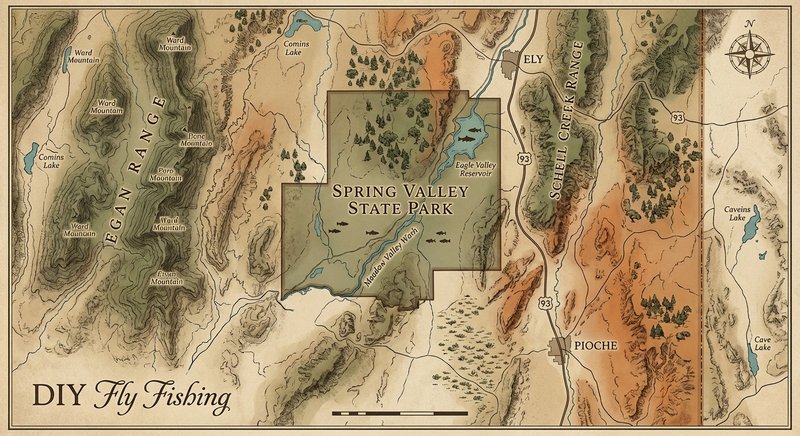
Spring Valley State Park
Fly fishing in Nevada · beginner · Best seasons: spring, fall
Target Species
Rainbow Trout
About This Water
Eastern Nevada reservoir with rainbow trout. Beautiful valley setting.
Fishing Recommendations
Spring Valley State Park, located about 20 miles east of Pioche in Lincoln County, is a true "desert oasis" for fly anglers. At its heart lies Eagle Valley Reservoir, a 65-acre impoundment surrounded by stunning volcanic rock formations and high-desert scenery. This is a high-elevation fishery (approx. 5,800 ft) that offers a tranquil escape from the heat of the Nevada desert.
Here are your professional guide recommendations for fishing Spring Valley State Park.
🎣 Location Overview
Spring Valley is beloved by locals because it offers consistent trout fishing in a state where fishable water can be scarce. The reservoir is fed by several small springs and Meadow Valley Wash.
What makes it special is the clarity of the water and the accessible shoreline. While many Nevada reservoirs require a boat, Eagle Valley has a well-maintained fishing trail along the western shore and a fishing pier. The water is relatively shallow (averaging 12-20 feet), which allows for extensive weed beds—the perfect habitat for a rich biomass of scuds, damselflies, and midges.
🐟 Target Species & Behavior
- Rainbow Trout: The primary target. The Nevada Department of Wildlife (NDOW) stocks this water heavily. You will find "stocker" rainbows in the 10-12 inch range, but because of the high nutrient content, many "holdovers" reach 16-18 inches and become quite girthy.
- Tiger Trout: Occasionally stocked to help control non-game fish. They are aggressive predators and a prized catch here.
- Behavior: In the spring, fish are found in the shallows near the inlets and along the dam face. As the water warms, they retreat to the deeper channels near the center. They are primarily subsurface feeders, focusing on the dense insect life within the submerged vegetation.
📅 Best Times to Fish
- Optimal Seasons:
- Spring (April – June): This is the prime window. As the ice thaws and the water hits 50°F, the trout become incredibly active. This coincides with the major midge and damselfly hatches.
- Fall (September – November): As temperatures drop, trout move back into the shallows to bulk up for winter. The "Tiger" trout become particularly aggressive during this time.
- Best Time of Day: Early morning (dawn until 10:00 AM) and the "Golden Hour" before sunset. The desert wind often kicks up in the afternoon, making casting difficult.
- Conditions: Overcast days are rare but productive. Generally, look for "calm glass" mornings for the best dry fly opportunities.
🪰 Recommended Flies & Techniques
Top Fly Patterns
- Nymphs: Zebra Midges (#18-22) in black/silver or red; Gold Ribbed Hare’s Ear (#14-16); Pheasant Tail (#16).
- Scuds: This is a "scud-heavy" lake. Use Olive or Orange scud patterns (#14-16) with a bit of flash.
- Streamers: Woolly Buggers (#8-12) in Olive, Black, or Thin Mint. These are killers for the larger holdovers and Tiger trout.
- Dry Flies: Parachute Adams (#16-20) for general hatches; Griffiths Gnat (#20) for midge clusters.
Effective Techniques
- Indicator Nymphing: This is the most productive method. Suspend a Zebra Midge or a Scud 4–6 feet below an indicator. Fish it along the edges of the weed beds.
- The "Slow Strip": Using an intermediate sinking line, cast an olive Woolly Bugger or a damselfly nymph. Use a very slow, rhythmic "figure-eight" retrieve.
- Dry-Dropper: During calm mornings, use a high-visibility dry fly with a tiny midge nymph dropped 18 inches below it.
💡 Pro Tips & Local Knowledge
- The Inlet Advantage: Focus your efforts on the northern end of the reservoir where the Meadow Valley Wash enters. The moving water brings in oxygen and nutrients, making it a magnet for hungry trout.
- Float Tubes are King: While the shore is accessible, a float tube or kayak allows you to reach the "drop-off" where the shallow shelf meets the deeper channel. This is where the 16+ inch fish patrol.
- Watch the Weeds: If you are catching moss on every cast, you are too deep. Adjust your indicator so your fly sits just 6-12 inches above the weed line. That’s the strike zone.
- The "Pioche Special": Locals know that when the bite is slow, a slightly larger, flashy streamer (like a Silver or Gold Sparkle Minnow) can trigger an instinctual strike from a territorial Tiger trout.
⚠️ Important Information
- Access: The park is about a 3-hour drive from Las Vegas. There are excellent camping facilities (Horsethief Gulch and Stone Cabin) with showers and hookups.
- Regulations: A valid Nevada Fishing License is required. Ensure you check the current NDOW regulations for bag limits, though it is generally a standard 5-fish limit.
- Climate: Even in the spring and fall, the high-desert sun is intense. Bring polarized sunglasses (essential for spotting weed lines), sunblock, and plenty of water.
- Winter Note: The reservoir does freeze over in mid-winter, offering ice fishing opportunities, but the "shoulder seasons" remain the gold standard for fly anglers.
Guide’s Final Word: Spring Valley is a "confidence" water. If you use small flies, light tippet (5X or 6X), and fish the edges of the vegetation, you are almost guaranteed a productive day on the water.
Bug Hatches & Matching Flies
| Hatch | Type | Peak months | Time of day | Hook sizes | Matching flies |
|---|---|---|---|---|---|
| Chironomids Chironomidae | midge | March, April, May, September, October | All Day | #16-22 | Zebra Midge #18-22, Ice Midge #16-20, Griffith's Gnat #18-22 |
| Callibaetis Callibaetis nigritus | mayfly | June, July, August | Late Morning | #12-16 | Parachute Adams #14-16, Callibaetis Nymph #12-16, Quigley Cripple #14-16 |
| Blue Winged Olive Baetis tricaudatus | mayfly | April, May, September, October | Mid-day | #18-22 | RS2 #20-22, BWO Parachute #18-22, Baetis Nymph #18-20 |
| Cinnamon Caddis Hydropsyche | caddis | June, July | Evening | #14-16 | Elk Hair Caddis #14-16, LaFontaine's Deep Sparkle Pupa #14-16 |
| Pale Morning Dun Ephemerella excrucians | mayfly | June, July | Morning | #16-18 | PMD Sparkle Dun #16-18, Pheasant Tail Nymph #16-18 |
| Grasshoppers Melanoplus | terrestrial | August, September | Afternoon | #8-12 | Dave's Hopper #10-12, Morrish Hopper #8-12 |
| Trico Tricorythodes | mayfly | August, September | Early Morning | #20-24 | Trico Spinner #22-24, Sunken Trico Spinner #20-22 |
| Little Brown Sedge Lepidostoma | caddis | May, June | Evening | #16-18 | Deer Hair Sedge #16-18, Caddis Larva #16-18 |