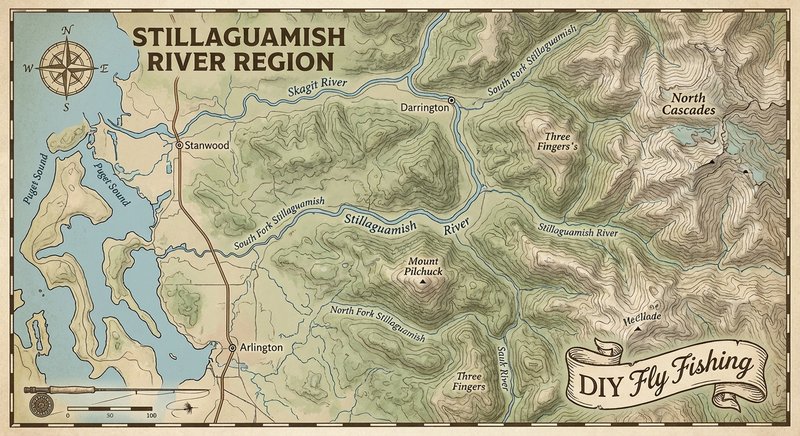
Stillaguamish River
Fly fishing in Washington · Intermediate · Best seasons: Winter, Summer
Target Species
Steelhead, Cutthroat Trout
About This Water
North Puget Sound river with winter and summer steelhead runs. Both North and South forks offer quality fishing.
Fishing Recommendations
Welcome to "The Stilly." As a guide in the Pacific Northwest, I can tell you that the Stillaguamish River holds a sacred place in fly fishing history. It is the birthplace of many modern steelhead techniques and was a favorite haunt of legends like Roderick Haig-Brown and Zane Grey.
While the river has faced environmental challenges—most notably the 2014 Oso slide—it remains a resilient and beautiful fishery that demands technical skill and a deep respect for the water.
🎣 Location Overview
The Stillaguamish (divided into the North Fork and South Fork) is a classic Puget Sound freestone river.
- The North Fork (NF): This is the crown jewel for fly anglers. It is famous for the Deer Creek summer-run steelhead. The NF is characterized by long, classic fly-fishing drifts, boulder-strewn runs, and manageable wading. Much of it is "Fly Fishing Only" or "Selective Gear Rules," preserving its traditional feel.
- The South Fork (SF): More rugged and prone to high flows, the SF offers great pocket water and deeper pools, primarily targeting winter-run fish and resident trout.
- The Mainstem: Formed by the confluence at Arlington, the mainstem is larger and influenced by the tide near its mouth at Stanwood.
Anglers love the Stilly for its accessibility from Seattle/Everett and its historical "swing" water—it is a river designed for the Spey rod.
🐟 Target Species & Behavior
Steelhead (Summer & Winter)
- Summer Run: These fish enter the river as early as May and peak in July/August. They are known for being aggressive and willing to rise to a surface or sub-surface "swung" fly. They often hold in the faster, highly oxygenated "heads" of pools.
- Winter Run: Larger, harder-fighting fish that enter from December through March. They hold deeper and closer to the bottom, often in the "tail-outs" or slower "guts" of pools to conserve energy in cold water.
Coastal Cutthroat Trout
- Sea-Run Cutthroat: Locally called "Harvest Trout," these fish move in and out of the salt. They are aggressive predators.
- Resident Cutthroat: Found year-round in the upper reaches and tributaries. They feed on insects but are highly opportunistic and will chase small baitfish or salmon fry.
📅 Best Times to Fish
- Summer Steelhead: June through August. The North Fork is the place to be. Look for "gray" days or fish the early morning/late evening "magic hour" to avoid the bright sun that puts fish down.
- Winter Steelhead: December through February. Watch the hydrograph closely. The Stilly blows out easily; you want to fish it when the river is "dropping and clearing" (the color of green tea).
- Sea-Run Cutthroat: August through October. These fish follow the salmon into the river to feast on eggs and dislodged nymphs.
🪰 Recommended Flies & Techniques
For Steelhead (The Swing)
The Stillaguamish is a "Swing Only" culture for most fly anglers.
- Summer Patterns:
- Dry Flies: Steelhead Bee, Waller Walker, or a Bomber (riffling hitch is deadly here).
- Wet Flies: Green Butt Skunk, Blue Heron, or the Skykomish Sunrise. Size 4-8.
- Winter Patterns:
- Intruders: Large, weighted patterns in black/blue, pink/orange, or purple.
- Technique: Use a Spey rod with a Skagit head and T-11 or T-14 sink tips to get the fly into the "bucket."
For Cutthroat (The Strip & Twitch)
- Patterns:
- Streamers: Rolled Muddler Minnow, Mickey Finn, or small Woolly Buggers (olive/white).
- Topwater: Stimulators or Royal Wulffs during summer evenings.
- Technique: Swing and strip. Cutthroat love movement. If you're using a dry fly, a little "twitch" can trigger a strike.
💡 Pro Tips & Local Knowledge
- The "Deer Creek" Factor: The NF Steelhead are genetically distinct. They are famous for their ability to jump and their "surface-oriented" nature. If you see a fish roll, don't just change your fly—change your presentation. Try a dry fly even if you don't see them rising.
- The "Oso" Silt: The river can still run "milky" even when other rivers are clear due to the clay banks near the Oso slide site. If the NF is too dirty, check the South Fork or the mainstem below the confluence.
- Low Water Stealth: In the summer, the Stilly can get very low and clear. Long leaders (12ft+) and 8lb-10lb tippet are necessary. Avoid wading deep; stay on the bank and cast to the far seams to avoid spooking fish.
- The "Stilly Twitch": When swinging for steelhead, give the rod a slight pulse. Sometimes that extra movement is all it takes to trigger a lethargic summer run.
⚠️ Important Information
- Regulations: Check the WDFW (Washington Department of Fish and Wildlife) pamphlet religiously. The Stilly has complex "Fly Fishing Only" sections and "Selective Gear" rules. Many sections are "Catch and Release" only for wild fish.
- North Fork Special Rule: Historically, the NF has specific closures to protect spawning grounds. Always verify if the section you are fishing is currently open.
- Access:
- NF Stillaguamish: Great access along Hwy 530. Look for the "Blue Bridge" and various WDFW pull-offs.
- SF Stillaguamish: Access near Granite Falls and along the Mountain Loop Highway.
- Safety: The riverbed can be slippery with "river snot" (algae) in the summer. Studded wading boots and a wading staff are highly recommended.
Guide’s Final Word: The Stillaguamish isn't a "numbers" river; it's a "heritage" river. You come here for the beauty of the swing and the chance to touch a piece of fly fishing history. Respect the wild fish—keep them in the water!
Bug Hatches & Matching Flies
| Hatch | Type | Peak months | Time of day | Hook sizes | Matching flies |
|---|---|---|---|---|---|
| Blue Winged Olive (BWO) Baetis spp. | mayfly | March, April, September, October | Late Morning/Afternoon | #16-20 | Parachute Adams #16-20, RS2 #18-20, Pheasant Tail #16-20 |
| March Brown Rhithrogena morrisoni | mayfly | March, April, May | Afternoon | #12-14 | March Brown Western Deceiver #12-14, Gold Ribbed Hare's Ear #12-14, March Brown Wet Fly #12-14 |
| Skwala Stonefly Skwala americana | stonefly | February, March, April | Midday | #8-12 | Skwala Stone #10-12, Pat's Rubber Leg (Olive/Brown) #8-12, Bullet Skwala #10-12 |
| Pale Morning Dun (PMD) Ephemerella spp. | mayfly | June, July, August | Morning/Afternoon | #14-18 | Sparkle Dun #16-18, PMD Emerger #14-16, Frenchie #14-18 |
| Golden Stonefly Hesperoperla pacifica | stonefly | June, July | Evening/All Day (Nymph) | #6-10 | Chubby Chernobyl (Gold) #8-12, 20-Incher Stone #6-10, Yazidi Stone #8-10 |
| Spotted Sedge Hydropsyche spp. | caddis | June, July, August | Evening | #14-16 | Elk Hair Caddis (Tan) #14-16, Soft Hackle Hare's Ear #14-16, Hydropsyche Larva #14-16 |
| October Caddis Dicosmoecus gilvipes | caddis | September, October | Afternoon/Evening | #8-10 | Orange Stimulator #8-10, October Caddis Pupa #8-10, Peeking Caddis #8-12 |
| Little Black Caddis Brachycentrus occidentalis | caddis | April, May | Midday/Afternoon | #16-18 | Black Elk Hair Caddis #16-18, Deep Sparkle Pupa #16-18, Zebra Midge #18 |