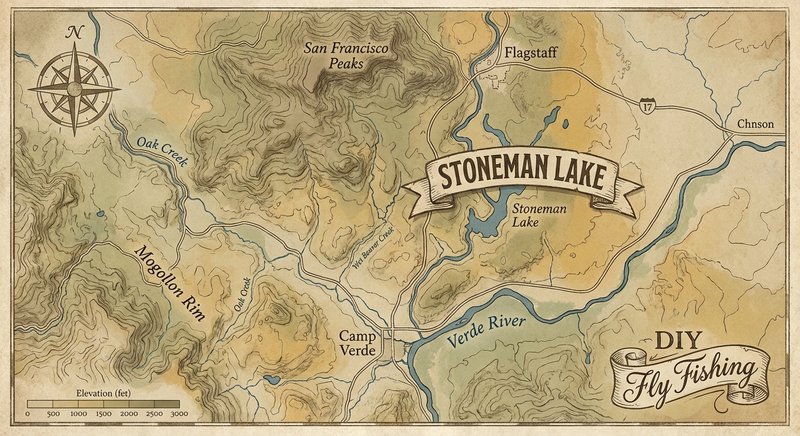
Stoneman Lake
Fly fishing in Arizona · intermediate · Best seasons: spring
Target Species
Rainbow Trout
About This Water
Intermittent lake when water levels allow. Remote setting with wild trout.
Fishing Recommendations
As an expert guide who has navigated the unique challenges of Arizona’s high-country waters, I have to provide a bit of "real talk" regarding Stoneman Lake.
Stoneman Lake is one of the few natural lakes in Arizona, sitting in a volcanic cinder basin. However, it is notoriously fickle. It is a shallow, "playa" style lake, meaning its water levels fluctuate drastically based on snowpack and rainfall. In wet years, it is a productive oasis; in dry years, it can nearly disappear.
Here is the comprehensive guide for fly fishing Stoneman Lake during a productive spring season.
🎣 Location Overview
Located about 30 miles south of Flagstaff in the Coconino National Forest, Stoneman Lake is a beautiful, bowl-shaped natural lake surrounded by ponderosa pines and Gambel oaks. Unlike the deep, dammed reservoirs nearby (like Upper Lake Mary), Stoneman is very shallow, rarely exceeding 8–10 feet in depth even at capacity.
What makes it special: It is incredibly rich in nutrients. Because it is shallow and sun-drenched, it produces massive amounts of aquatic vegetation and insect life. When the water level is up, the growth rate of trout here is explosive. Anglers love it for its "stillwater stalking" vibe—it feels more like fishing a flooded meadow than a mountain lake.
🐟 Target Species & Behavior
While Arizona Game and Fish stocks Rainbow Trout here when water levels permit, you may also find Northern Pike (which are illegally introduced but persistent) and occasionally Yellow Perch.
- Rainbow Trout Behavior: Because the lake is shallow, the trout are "cruisers." They don't hold in deep thermoclines; instead, they patrol the edges of weed beds and the transition zones between the muddy bottom and rocky shorelines.
- Feeding: They are highly opportunistic. In the spring, they focus heavily on Chironomids (midges), Scuds (freshwater shrimp), and Damselfly nymphs.
📅 Best Times to Fish
Spring is the undisputed prime season. Once the ice melts (usually March/April) and before the summer heat causes algae blooms and oxygen depletion (late June), the fishing can be electric.
- Optimal Months: Late April through early June.
- Best Time of Day: Early morning (dawn until 10:00 AM) and "the magic hour" before sunset. The wind often picks up in the afternoon on the Mogollon Rim, which can make casting light fly lines difficult.
- Prime Windows: Overcast, slightly breezy days are best. The "chop" on the water provides cover for the trout in this shallow environment, making them less spooky.
🪰 Recommended Flies & Techniques
Because the lake is shallow and weedy, traditional heavy sinking lines will often just snag vegetation.
Top Fly Patterns
- Chironomids (Size 14-18): Zebra Midges in black/silver or red/silver. This is the "bread and butter" of Stoneman Lake.
- Scuds (Size 12-16): Olive or "Dead Orange" patterns. The lake is crawling with freshwater shrimp.
- Simi Seal Leeches: Developed in Arizona, these are deadly here. Colors: Blood Leech, Olive, or Peacock.
- Damselfly Nymphs (Size 12-14): Long, slender olive patterns with marabou tails for movement.
Effective Techniques
- Indicator Nymphing: This is the most effective method. Suspend a Chironomid or Scud 12 inches off the bottom. Use a slip-indicator if you are fishing the "deeper" center holes.
- The "Slow Strip": Using an intermediate (slow-sinking) line or a floating line with a long leader, cast a Simi Seal Leech or Damselfly nymph and retrieve it with very slow, 2-inch tugs.
- Dry Fly: On calm spring evenings, look for midge clusters. A Size 18 Griffith’s Gnat can provide exciting surface action.
💡 Pro Tips & Local Knowledge
- Check Water Levels First: Crucial Tip. Before you drive out, check the Coconino National Forest alerts or local Flagstaff fly shops (like Flagstaff Fly) for water levels. If Arizona is in a drought, Stoneman may be a mud puddle. If it’s a high snowpack year, it’s a gold mine.
- Focus on the "Blue Holes": As the weeds grow in late spring, look for pockets of open, clear water within the weed mats. Trout will circle these pockets looking for snacks falling off the vegetation.
- The Float Tube Advantage: Accessing the water from the shore can be muddy and difficult. A float tube or kayak is the best way to fish Stoneman, allowing you to reach the center where the water is slightly cooler and deeper.
- Stealth Matters: Because it is shallow, these fish are sensitive to "hull slap" and heavy wading. Approach your spots quietly.
⚠️ Important Information
- Access: Take I-17 to the Stoneman Lake Road exit (Exit 306). Follow the paved/gravel road about 9 miles to the lake. The road is generally passenger-car friendly but can be muddy in early spring.
- Regulations: A valid Arizona Fishing License is required. Check the current AZGFD Fishing Regulations for bag limits, as they can change based on the lake's health and "salvage" orders (if the lake is drying up).
- Facilities: There is a boat ramp and primitive vault toilets, but no potable water. Cell service is spotty at best.
- Special Consideration: Stoneman Lake is a fragile ecosystem. Please practice "Leave No Trace" and be mindful of the nesting waterfowl that frequent the basin in the spring.
Final Guide Note: If you arrive and find the water levels too low, don't despair—Upper Lake Mary and Ashurst Lake are nearby alternatives that also hold quality Rainbows and are less prone to drying out!
Bug Hatches & Matching Flies
| Hatch | Type | Peak months | Time of day | Hook sizes | Matching flies |
|---|---|---|---|---|---|
| Chironomids Chironomidae | midge | April, May, June, September | All Day | #12-22 | Zebra Midge #16-20, Chromie #12-18, Ice Budgie #14-16 |
| Callibaetis Callibaetis ferrugineus | mayfly | May, June, August, September | Morning/Early Afternoon | #12-16 | Parachute Adams #14-16, Hare's Ear Nymph #14-16, Callibaetis Spinner #16 |
| Damselflies Enallagma spp. | terrestrial | June, July | Mid-day | #10-14 | Marabou Damsel #10-12, Braided Butt Damsel #12-14 |
| Dragonflies Anisoptera | terrestrial | June, July, August | Afternoon | #6-10 | Dragonfly Nymph #6-10, Olive Woolly Bugger #8-10 |
| Caddisflies Oecetis spp. | caddis | July, August | Evening | #14-18 | Elk Hair Caddis #14-16, LaFontaine's Deep Sparkle Pupa #14-18 |
| Water Boatmen Corixidae | terrestrial | September, October | All Day | #14-18 | Water Boatman #14-16, Prince Nymph #16-18 |
| Grasshoppers Melanoplus spp. | terrestrial | August, September | Afternoon | #8-12 | Dave's Hopper #10-12, Hopper Juan #12 |
| Trico Mayfly Tricorythodes spp. | mayfly | August, September | Early Morning | #20-24 | Trico Spinner #20-22, RS2 #20-24 |