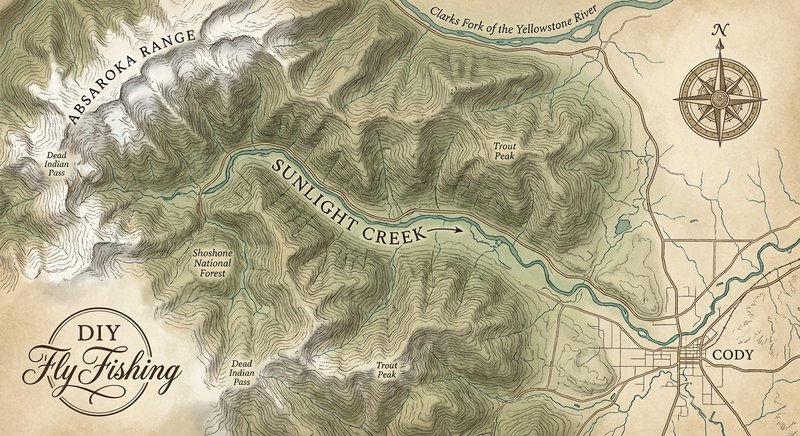
Sunlight Creek
Fly fishing in Wyoming · Intermediate · Best seasons: Summer, Fall
Target Species
Cutthroat Trout
About This Water
Clarks Fork tributary with cutthroat trout. Remote Absaroka wilderness.
Fishing Recommendations
Sunlight Creek is one of the hidden gems of the Greater Yellowstone Ecosystem. Tucked away in the Absaroka Mountains northwest of Cody, Wyoming, this freestone stream offers some of the most scenic and rewarding backcountry fly fishing in the lower 48. As your guide, I’m excited to walk you through what makes this water a bucket-list destination for any serious trout angler.
🎣 Location Overview
Sunlight Creek is a high-gradient mountain stream that flows through the rugged Sunlight Basin. It eventually carves a spectacular, deep limestone canyon before joining the Clark’s Fork of the Yellowstone River.
What makes it special is the pure alpine environment. The water is gin-clear and cold, flanked by towering peaks like Dead Indian Peak and Pilot Peak. The creek transitions from a classic mountain meadow stream in its upper reaches to a fast-moving, pocket-water boulder garden in the mid-section, and finally into a dramatic, difficult-to-access canyon. Anglers love it because it offers high catch rates of wild fish in a wilderness setting where you’re more likely to see a grizzly bear than another fisherman.
🐟 Target Species & Behavior
The star of the show here is the Yellowstone Cutthroat Trout. You will also find some Rainbow trout and Brook trout in the upper tributaries, but the Sunlight is managed primarily for its native Cutthroats.
- Behavior: These fish are opportunistic feeders due to the short growing season and nutrient-poor alpine water. They aren't usually "selective" about fly patterns, but they are wary of shadows and heavy footsteps.
- Where they hold: In the swifter sections, look for the "cushion" in front of large boulders or the soft seams right behind them. In the meadow stretches, they hold tight to undercut banks and under overhanging willows.
- Feeding: They are highly keyed into terrestrial insects (grasshoppers, ants, beetles) in the late summer and opportunistic nymph feeders year-round.
📅 Best Times to Fish
Optimal Seasons
- Summer (July – August): This is the prime window. Runoff typically subsides by early July. This is the time for classic dry fly fishing.
- Fall (September – early October): My personal favorite. The cottonwoods turn gold, the air gets crisp, and the fish feed aggressively to bulk up for winter.
Best Times of Day
- Mid-morning to Late Afternoon: In high-altitude freestones, the water stays cold at night. The "magic hour" usually starts around 10:00 AM once the sun hits the water and wakes up the bugs, lasting until about 4:00 PM.
Prime Conditions
Look for "Indian Summer" days in September. Low, clear water is standard; if the water is off-color due to a summer thunderstorm, the fishing can actually improve as the fish lose their spookiness.
🪰 Recommended Flies & Techniques
Top Fly Patterns
- Dries:
- Chubby Chernobyl (Tan or Orange, Size 8-12): The ultimate searching pattern.
- Purple Haze (Size 14-16): Cutthroats love purple for reasons known only to them.
- Amy’s Ant: Great for the "splat" factor near banks.
- Yellowstone Stimulator: Mimics the golden stones found in the basin.
- Nymphs:
- Pheasant Tail (Beadhead, Size 14-18): A staple for mimicking Mayfly nymphs.
- Prince Nymph: Effective in the faster runs.
- Pat’s Rubber Legs: In coffee/black, great for the deeper holes in the canyon.
- Streamers:
- Woolly Bugger (Olive or Black, Size 8-10): Swing these through the deeper pools for the larger resident Cutthroats.
Techniques & Presentation
- Dry-Dropper: This is the most effective way to fish Sunlight Creek. Use a buoyant dry (like a Chubby) and hang a small nymph 18–24 inches below it.
- The "Splat" Cast: Don't be too delicate with terrestrials. Landing a hopper pattern with a little "thump" often triggers a strike.
- Short Line Nymphing: In the pocket water, keep as much fly line off the water as possible to avoid drag caused by conflicting currents.
💡 Pro Tips & Local Knowledge
- Focus on the Confluences: Where smaller tributaries enter Sunlight Creek, you’ll often find the highest concentration of fish.
- The "Canyon" Challenge: The Sunlight Bridge on the Chief Joseph Scenic Byway is one of the highest in the state. Fishing the canyon below requires a steep hike and "rock hopping." It’s physically demanding but holds the largest fish.
- Stealth is Key: Because the water is so clear, if you can see the fish, they’ve likely already seen you. Wear earthy tones and approach the banks low.
- The "Cutthroat Shake": Cutthroats often take a dry fly very slowly—almost in slow motion. Wait for the fish to turn its head down before setting the hook, or you’ll pull it right out of its mouth.
⚠️ Important Information
Access
- Public Access: Much of Sunlight Creek is within the Shoshone National Forest. There are several public campgrounds (Sunlight and Dead Indian) that provide easy foot access to the water.
- Roads: Sunlight Basin Road is gravel and can be washboarded. A high-clearance vehicle is recommended, though not always strictly necessary in mid-summer.
Regulations & Permits
- License: A valid Wyoming Fishing License and a Conservation Stamp are required.
- Species Protection: Be sure to check current Wyoming Game & Fish regulations regarding creel limits. Most local anglers practice 100% Catch and Release for native Cutthroats to preserve the fishery.
Special Considerations (Safety)
- Grizzly Country: This is prime grizzly bear habitat. Always carry bear spray, make noise while moving through willows, and never fish alone if possible.
- Weather: High mountain weather changes in minutes. Even in July, carry a rain shell and a fleece.
- Wading: The rocks in Sunlight Creek are notoriously slick and "rolly." Felt soles (where legal) or studded boots and a wading staff are highly recommended.
Tight lines, and enjoy the solitude of the Sunlight!
Bug Hatches & Matching Flies
| Hatch | Type | Peak months | Time of day | Hook sizes | Matching flies |
|---|---|---|---|---|---|
| Blue Winged Olive Baetis spp. | mayfly | April, May, September, October | Midday | #18-22 | Parachute Adams #18-22, RS2 #20-22, Pheasant Tail #18-20 |
| Golden Stonefly Hesperoperla pacifica | stonefly | June, July | All Day | #8-12 | Chubby Chernobyl (Gold) #8-12, Pat's Rubber Leg #8-12 |
| Pale Morning Dun Ephemerella excrucians | mayfly | July, August | Late Morning/Afternoon | #14-18 | PMD Sparkle Dun #16-18, Split Case PMD #16-18 |
| Yellow Sally Isoperla spp. | stonefly | July, August | Afternoon/Evening | #14-16 | Yellow Sally Foam Stone #14-16, Iron Lotus #16 |
| Spotted Sedge Hydropsyche | caddis | July, August | Evening | #14-16 | Elk Hair Caddis (Tan) #14-16, LaFontaine's Deep Sparkle Pupa #14-16 |
| Salmonfly Pteronarcys californica | stonefly | June, July | All Day | #4-8 | Rogue River Stone #4-8, 20 Incher #6-10 |
| Grasshoppers Acrididae | terrestrial | August, September | Midday/Afternoon | #8-12 | Morrish Hopper #10-12, Dave's Hopper #8-12 |
| Western Black Midge Chironomidae | midge | March, April, October, November | All Day | #20-24 | Zebra Midge (Black) #20-22, Griffith's Gnat #20-24 |