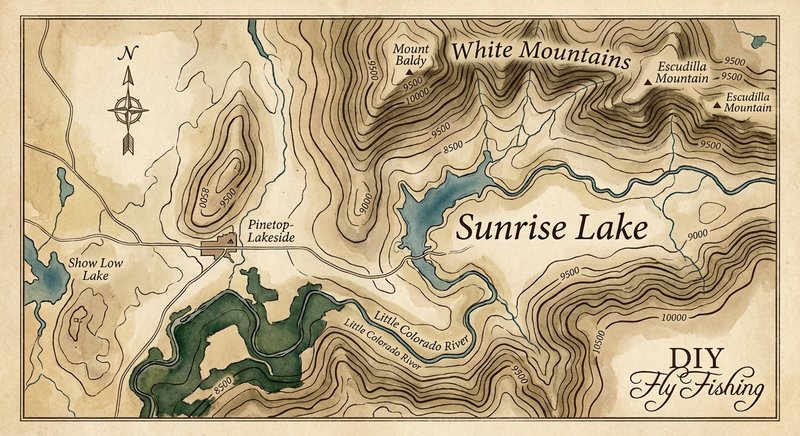
Sunrise Lake
Fly fishing in Arizona · beginner · Best seasons: spring, summer, fall, winter
Target Species
Rainbow Trout, Brook Trout
About This Water
Apache tribal lake near ski resort. Year-round fishing with winter ice fishing.
Fishing Recommendations
Sunrise Lake is a crown jewel of the White Mountains in Arizona. Located at approximately 9,100 feet on the White Mountain Apache Reservation, it is one of the most productive "stillwater" fisheries in the Southwest. Known for producing trophy-sized trout and boasting incredible insect biomass, it is a must-visit for any serious fly angler.
🎣 Location Overview
Sunrise Lake is a high-altitude reservoir characterized by its expansive weed beds, shallow shelves, and crystal-clear water. Unlike the smaller mountain ponds nearby, Sunrise is a large body of water that requires an understanding of wind and depth.
What makes it special is its productivity. The volcanic soil of the White Mountains provides a nutrient-rich environment that supports a massive population of scuds (freshwater shrimp) and chironomids (midges). This "bug soup" allows trout to grow rapidly, often reaching lengths of 20+ inches. The scenery is quintessential Arizona high country: rolling alpine meadows, dense pine forests, and the nearby peaks of Mount Baldy.
🐟 Target Species & Behavior
- Rainbow Trout: These are the primary residents. They are hard-fighting and often aerial. They cruise the edges of the weed lines in 5–10 feet of water, vacuuming up scuds and snails.
- Brook Trout: Sunrise is famous for its "trophy" Brookies. These fish are more opportunistic and aggressive. During the fall spawn, they move into the shallower gravel areas and near the inlets, displaying brilliant orange bellies.
- Behavior: Because the water is so clear, these fish can be "spooky." They are highly attuned to overhead shadows (birds of prey/boats). They tend to feed heavily along the transition zones where the shallow flats drop off into deeper channels.
📅 Best Times to Fish
- Spring (Late April – June): This is the prime window. "Ice-off" occurs in late April or May. As the ice retreats, fish move into the shallows to gorge on anything that moves. The Damselfly migration in June is legendary.
- Summer (July – August): The weather is pleasant (monsoon season). Fish move deeper during the heat of the day but cruise the shallows during low-light hours. Focus on the "Chironomid hatch" early in the morning.
- Fall (September – October): This is the best time for Brook Trout. As temperatures drop, fish become aggressive before winter. The "caddis" activity can be excellent on warm afternoons.
- Winter (November – March): The lake typically freezes over. While ice fishing is popular here, fly fishing is generally not an option until the spring thaw.
Prime Window: 30 minutes before sunrise to 10:00 AM, and 4:00 PM until dusk.
🪰 Recommended Flies & Techniques
Top Fly Patterns
- Scuds: Sizes 12–16 in Olive, Orange, or Pink. (The #1 food source).
- Chironomids: Sizes 14–18 in "Zebra Midge" (Black/Silver) or "Chromie" (Silver/Red).
- Damselfly Nymphs: Size 10–12 in Olive (Long tails for movement).
- Simi Seal Leeches: Developed specifically for Arizona lakes. Colors: Blood Leech, Peacock, or Canadian Olive.
- Dry Flies: Parachute Adams (14–18) or Elk Hair Caddis for evening rises.
Effective Techniques
- The "Static" Indicator Rig: Suspend a midge or scud 12–18 inches off the bottom. Use a long leader (12–15 feet) to reach the fish without spooking them with the fly line.
- The "Slow Crawl" Strip: Using an intermediate sinking line, cast a Simi Seal Leech or Damselfly nymph over weed beds and retrieve it with very slow, 2-inch tugs.
- The Wind Drift: Let the wind move your boat/float tube while dragging a wooly bugger or leech behind you at varying depths.
💡 Pro Tips & Local Knowledge
- The Wind Factor: Sunrise is notoriously windy. If you are in a float tube, stay upwind of where you want to fish so you can drift back. Always bring an anchor.
- Focus on the Weed Lines: The "inner" and "outer" walls of the submerged weed beds are the highways for trout. Use a pair of polarized sunglasses to locate these transitions.
- The "Magic" Depth: Most fish at Sunrise are caught in 8 to 12 feet of water. If you aren't getting hits, adjust your indicator depth by 6 inches at a time.
- Stealth Matters: Because the water is clear, use 5X or 6X fluorocarbon tippet. The fish have plenty of time to inspect your fly; fluorocarbon’s invisibility is a game-changer here.
⚠️ Important Information
Access & Permits
- Tribal Lands: Sunrise Lake is on the White Mountain Apache Reservation. An Arizona State Fishing License is NOT valid here. You must purchase a WMAT Tribal Fishing Permit. These can be bought online (wmatoutdoor.org) or at local shops in Pinetop-Lakeside or Hon-Dah.
- Boat Access: There is a paved boat ramp. Most fly anglers use float tubes, pontoons, or small boats with electric motors.
Regulations
- Motors: Internal combustion (gas) engines are generally prohibited or restricted to "no wake." Electric motors are preferred.
- Bag Limits: Regulations can change seasonally. Always check your permit for current bag and possession limits (often 5 fish, but many fly anglers practice 100% Catch & Release here to preserve the trophy quality).
Special Considerations
- Weather: Storms move in fast. At 9,000 feet, lightning is a serious danger. If you hear thunder, get off the water immediately.
- Altitude: Drink plenty of water. If you are coming from the desert (Phoenix/Tucson), the altitude will affect you quickly.
Bug Hatches & Matching Flies
| Hatch | Type | Peak months | Time of day | Hook sizes | Matching flies |
|---|---|---|---|---|---|
| Chironomids Chironomidae | midge | May, June, September | All Day | #12-22 | Zebra Midge #16-20, Chromie #12-16, Griffith's Gnat #18-22 |
| Callibaetis Callibaetis pictus | mayfly | June, July, August | Late Morning/Afternoon | #12-16 | Parachute Adams #14-16, Pheasant Tail Nymph #14-18, Callibaetis Spinner #14-16 |
| Damselflies Enallagma spp. | terrestrial | June, July | Morning/Afternoon | #10-12 | Marabou Damsel Nymph #10-12, Braided Butt Damsel #12 |
| Cinnamon Caddis Hesperophylax spp. | caddis | July, August | Evening | #12-16 | Elk Hair Caddis #12-16, Godzilla Caddis Pupae #14 |
| Scuds Gammarus lacustris | terrestrial | May, June, October | All Day | #12-16 | Ray Charles #14-16, Orange Scud #12-16 |
| Dragonflies Anisoptera | terrestrial | July, August | Afternoon | #4-10 | Gomphus Nymph #6-10, Olive Woolly Bugger #4-8 |
| Water Boatman Corixidae | terrestrial | September, October | Afternoon | #14-16 | Water Boatman #14-16, Prince Nymph #14-16 |
| Terrestrial Ants and Beetles Formicidae / Coleoptera | terrestrial | August, September | Afternoon/Evening | #12-18 | Chernobyl Ant #10-14, Black Foam Beetle #14-18 |