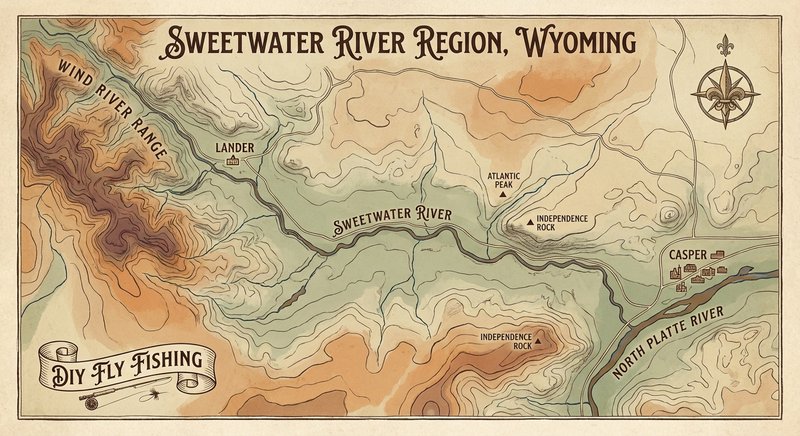
Sweetwater River
Fly fishing in Wyoming · Beginner · Best seasons: Summer, Fall
Target Species
Brown Trout, Rainbow Trout
About This Water
Central Wyoming freestone with brown and rainbow trout. Historic Oregon Trail water.
Fishing Recommendations
The Sweetwater River in Wyoming is a hidden gem for the angler who values solitude and history over easy access and giant tailwater crowds. Flowing through the high-desert sagebrush country of central Wyoming, the Sweetwater is steeped in the history of the Oregon, Mormon, and California Trails. For a fly fisher, it offers a "classic" small-stream experience: meandering meadow bends, undercut banks, and aggressive trout that rarely see a well-presented fly.
🎣 Location Overview
The Sweetwater is a high-desert freestone river. Unlike the nearby North Platte, which is dominated by massive dams and deep canyons, the Sweetwater is intimate. It winds through vast plains and granite outcroppings (like the famous Devil’s Gate and Independence Rock).
What makes it special is the wildness. This isn't a river where you'll see a drift boat every five minutes; in fact, you won’t see many boats at all because the river is largely too small and shallow. It is a walk-and-wade paradise. The water is generally tea-colored or clear, flowing over a mix of sandy bottoms and gravel runs. It is a "technical" fishery not because the fish are picky, but because the banks are often high and the water is skinny—making a stealthy approach vital.
🐟 Target Species & Behavior
- Brown Trout: The stars of the show. The Sweetwater holds a healthy population of wild Browns. They are opportunistic but wary. They love the deep, dark water found beneath undercut banks and near submerged woody debris.
- Rainbow Trout: Found more frequently in the faster riffles and oxygenated runs, especially in the early summer.
- Behavior: These fish are highly "structure-oriented." Because the river is relatively shallow, the trout are acutely aware of overhead predators (ospreys and herons). They will hold tight to the banks. During a hatch, they will move into the tail-outs of pools, but otherwise, look for them in the "shadows."
📅 Best Times to Fish
- Summer (Late June – August): This is the prime window. Once the spring runoff subsides (usually by late June), the river becomes fishable. This is the era of terrestrial fishing.
- Fall (September – October): My personal favorite time. The Brown Trout begin to get aggressive as they prepare for the spawn. The cottonwoods turn gold, the crowds (already thin) disappear, and the fish are eager to bulk up.
- Best Time of Day:
- Summer: Early morning and late evening to avoid the high-desert heat.
- Fall: Mid-day. As the water temperatures drop, the fish wait for the sun to warm the water and trigger insect activity.
- The "Sweetwater Window": Keep an eye on flows. If the CFS (cubic feet per second) drops too low in a drought year, the water can get too warm for ethical catch-and-release fishing in mid-August. Always carry a thermometer.
🪰 Recommended Flies & Techniques
Top Fly Patterns
- Terrestrials: This is hopper country.
- Patterns: Morrish Hopper (Size 8-12), Amy’s Ant, or a Foam Beetle.
- Dry Flies:
- Patterns: Parachute Adams (14-18), Elk Hair Caddis (14-16), and Yellow Sallies in early July.
- Nymphs:
- Patterns: Gold-ribbed Hare’s Ear, Copper John (Red or Blue), and Pat’s Rubber Legs for deeper holes.
- Streamers:
- Patterns: Black or Olive Woolly Buggers, or a Gold Ribbed Sculpin.
Effective Techniques
- Hopper-Dropper: This is the bread and butter of the Sweetwater. Use a high-vis hopper as your indicator and hang a bead-head nymph 18–24 inches below it.
- Bank Beating: Focus 90% of your casts within 6 inches of the bank. If you aren't occasionally snagging grass on the bank, you aren't close enough.
- The "Leisenring Lift": In the riffles, swinging a wet fly or a nymph can be deadly for the Rainbows.
💡 Pro Tips & Local Knowledge
- The Stealth Factor: Because the river is small and the banks are often elevated, fish can see your silhouette from a long way off. Stay low. I often tell my clients to kneel when approaching a promising bend.
- Wind Strategy: It's Wyoming—it will be windy. Don't fight it. Use a heavier 5-weight or 6-weight rod to punch through the gusts. If the wind is blowing upstream, use it to drift your dries slower.
- The "S" Bends: Look at a map and find where the river meanders most aggressively. The outside of every "S" curve usually creates a deep pocket where the largest Browns reside.
- Watch for Rattlesnakes: The sagebrush surrounding the Sweetwater is prime rattlesnake habitat. Wear gaiters or heavy trousers and watch where you step when hiking between bends.
⚠️ Important Information
- Access: Much of the Sweetwater flows through a checkerboard of BLM (Bureau of Land Management) land and private ranches. Use an app like onX Hunt to ensure you are on public land. The area near Devil’s Gate and the Sweetwater Canyon Wilderness Study Area offers some of the best public access.
- Regulations: Wyoming fishing licenses are required. Check the current Wyoming Game & Fish Department regulations for the "Central" drainage. Usually, general creel limits apply, but many anglers here practice 100% catch and release to preserve the wild fishery.
- Remote Nature: There are very few services. Cell service is spotty to non-existent. Ensure you have a full tank of gas, plenty of water, and a spare tire before heading out into the Sweetwater country.
- Wading: Generally easy wading, but the bottom can be "mucky" in the slow meadow sections. Felt soles or studs are helpful but not strictly necessary.
The Sweetwater isn't about counting fish; it's about the quality of the experience. Casting a hopper into a 150-year-old wagon rut while a wild Brown Trout rises to meet it is a soul-cleansing experience every angler should have.
Bug Hatches & Matching Flies
| Hatch | Type | Peak months | Time of day | Hook sizes | Matching flies |
|---|---|---|---|---|---|
| Blue Winged Olive Baetis spp. | mayfly | April, May, September, October | Mid-day/Afternoon | #18-22 | RS2 #18-22, Parachute Adams #18-22, BWO Emerger #20-22 |
| Pale Morning Dun Ephemerella excrucians | mayfly | June, July | Late Morning/Afternoon | #16-18 | Pheasant Tail Nymph #16-18, PMD Sparkle Dun #16-18, Split Case PMD #16-18 |
| Golden Stonefly Hesperoperla pacifica | stonefly | June, July | All Day | #8-12 | Pat's Rubber Legs #8-12, Chubby Chernobyl (Gold/Tan) #8-12, Golden Stone Nymph #10-12 |
| Mother's Day Caddis Brachycentrus spp. | caddis | May | Afternoon/Evening | #14-16 | Elk Hair Caddis #14-16, Peacock Caddis Larva #14-16, LaFontaine Sparkle Pupa #14-16 |
| Yellow Sally Isoperla spp. | stonefly | June, July | Afternoon/Evening | #14-16 | Yellow Sally Dry #14-16, Iron Sally #14-16 |
| Tricos Tricorythodes spp. | mayfly | August, September | Early Morning | #20-24 | Trico Spinner #20-24, Sunken Trico #22-24 |
| Grasshoppers Orthoptera | terrestrial | July, August, September | Mid-day/Afternoon | #8-12 | Morrish Hopper #8-12, Parachute Hopper #10-12, Yeager's Tantrum #10 |
| Midges Chironomidae | midge | March, April, November | Morning/Mid-day | #18-24 | Zebra Midge #18-22, Griffith's Gnat #18-22, Top Secret Midge #20-24 |