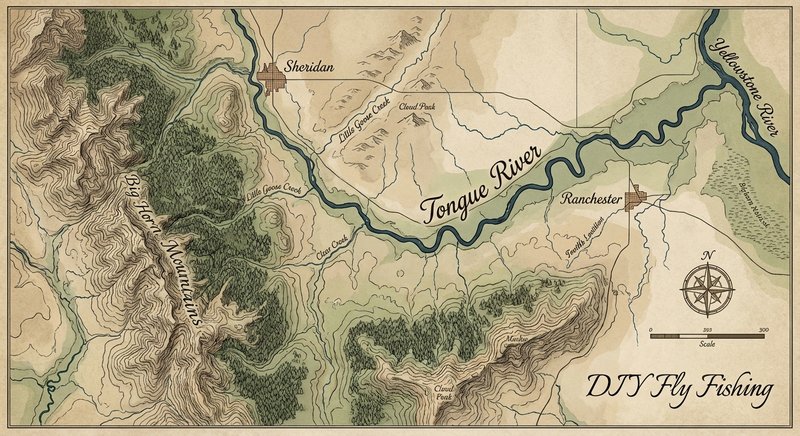
Tongue River
Fly fishing in Wyoming · Beginner · Best seasons: Summer, Fall
Target Species
Brown Trout, Rainbow Trout
About This Water
Northern Wyoming stream with brown trout. Less crowded alternative to famous waters.
Fishing Recommendations
The Tongue River in northern Wyoming is one of the state's true "hidden gems." Tucked into the eastern flank of the Bighorn Mountains, it offers a dramatic transition from high-alpine pocket water to a limestone-carved canyon, eventually spilling out into the high plains.
As a guide, I consider the Tongue one of the most rewarding technical freestone rivers in the Rocky Mountains. Here is your comprehensive guide to fishing the Tongue River.
🎣 Location Overview
The Tongue River is characterized by its diversity. The most sought-after section is the Tongue River Canyon, located just outside Dayton, Wyoming. Here, the river has carved deep through limestone cliffs, creating a spectacular backdrop of vertical walls and turquoise pools.
What makes it special is the "limestone influence." Unlike many granite-based mountain streams, the limestone buffers the water pH and provides a rich mineral base that supports high insect populations. The water is crystal clear, cold, and features everything from thundering plunges and deep holes to technical "slick" water where the fish are as wary as any on the Henry’s Fork.
🐟 Target Species & Behavior
- Brown Trout: The kings of the canyon. In the lower canyon and the valley stretches, Browns dominate. They are notoriously spooky. During the day, they tuck under limestone ledges and undercut banks. In the fall, they become aggressive and territorial.
- Rainbow Trout: Found throughout the system but more prevalent in the faster riffles and oxygenated "bubble curtains." They are known for their aerial acrobatics and willingness to rise to a well-placed dry fly.
- Behavior: These fish are highly visual. Because the water is so clear, they can see a poorly cast line or a silhouette on the bank from a long distance. "Low and slow" is the mantra for the angler’s approach here.
📅 Best Times to Fish
- Summer (July – August): This is the prime window for dry fly enthusiasts. Once the spring runoff subsides (usually late June), the river settles into a rhythmic hatch cycle.
- Morning: Trico and PMD hatches.
- Afternoon: "Hopper time." The winds off the Bighorns blow terrestrials into the water.
- Fall (September – October): This is my favorite time for "trophy" hunting. As the cottonwoods turn gold, the Brown Trout prepare for the spawn.
- Conditions: Look for overcast days for the best Blue Winged Olive (BWO) hatches.
- Streamer Window: Low light (dawn/dusk) is when the big Browns come out to hunt.
- Best Time of Day: In the heat of summer, 7:00 AM to 11:00 AM offers the best hatch action. In the Fall, the "golden hour" (the last two hours of light) is unparalleled.
🪰 Recommended Flies & Techniques
Top Fly Patterns
- Dry Flies:
- Chubby Chernobyl (Size 10-14): Gold, Tan, or Purple. Great as a hopper or a high-visibility indicator for a dropper.
- Parachute Adams (Size 16-20): The ultimate "match everything" fly for the Tongue.
- Elk Hair Caddis (Size 14-16): Tan or Olive, especially in the evening.
- Morrish Hopper (Size 10-12): For those windy August afternoons.
- Nymphs:
- Pat’s Rubber Legs (Size 8-12): Vital for the deeper canyon pools.
- Pheasant Tail (Size 16-20): Standard or soft-hackled.
- Copper John (Size 14-18): Red or Chartreuse to get down fast in the current.
- Streamers:
- Gold Beadhead Wooly Bugger (Black or Olive).
- Sex Dungeon or Sparkle Minnow: For targeting the larger Browns in the fall.
Techniques
- Dry-Dropper: This is the most effective way to cover the Tongue. Use a buoyant hopper pattern and hang a small Beadhead Pheasant Tail about 24-30 inches below it.
- High-Sticking: In the pocket water of the upper canyon, use a short line to keep your fly line off the conflicting currents.
- The "Twitch": When fishing hoppers near the banks, give the fly a very subtle "wiggle" to mimic a drowning insect. Often, this is the trigger a big Brown needs.
💡 Pro Tips & Local Knowledge
- Hike for Quality: Most people fish within 100 yards of the parking lots. If you hike two miles into the Tongue River Canyon Trail, the fishing pressure drops significantly, and the fish become much less selective.
- Watch the Shadows: Because of the high canyon walls, parts of the river go into shadow earlier than others. Fish will often move from the deep holes into the shallower "tails" of pools as soon as the sun leaves the water.
- Stealth is Mandatory: Wear natural colors (greens/browns) to blend in with the vegetation. Avoid "lining" the fish (casting the heavy fly line directly over their heads). Reach casts and slack-line mends are your best friends here.
- The "Dayton Stretch": Below the canyon, the river flows through the town of Dayton. There are several public fishing access points here that hold surprisingly large fish, though they are often more "educated" than the canyon fish.
⚠️ Important Information
- Access: Much of the upper river is within the Bighorn National Forest (Public). However, once the river hits the valley floor, it is a patchwork of private and public land. Always look for the Wyoming Game & Fish "Public Fishing Area" signs.
- Safety: The Tongue River Canyon is Rattlesnake country. Be extremely careful when stepping over logs or reaching for rocks near the canyon walls during the summer.
- Wading: The rocks in the Tongue are notoriously slick due to the limestone and algae. I highly recommend felt-soled boots (where legal) or studs, along with a wading staff.
- Regulations: A valid Wyoming fishing license and a Conservation Stamp are required. Always check the current Wyoming Game & Fish Department regulations for any seasonal closures or lure restrictions (some sections are "Artificial Flies and Lures Only").
Guide’s Final Word: The Tongue River isn't just about the fish; it's about the environment. Take a moment to look up at those 1,000-foot limestone walls—but keep your eye on your fly, because a 19-inch Brown Trout can rise at any moment.
Bug Hatches & Matching Flies
| Hatch | Type | Peak months | Time of day | Hook sizes | Matching flies |
|---|---|---|---|---|---|
| Blue Winged Olive Baetis spp. | mayfly | April, May, September, October | Midday | #18-22 | Parachute Adams #18-22, RS2 #20-22, Pheasant Tail #18-20 |
| Salmonfly Pteronarcys californica | stonefly | June | All Day | #4-8 | Rogue River Stone #4-8, Pat's Rubber Leg #6-10, Chubby Chernobyl #6-10 |
| Golden Stonefly Hesperoperla pacifica | stonefly | June, July | Morning/Evening | #8-12 | Golden Chubby #8-12, 20-Incher #8-12 |
| Pale Morning Dun Ephemerella excrucians | mayfly | June, July, August | Late Morning/Afternoon | #14-18 | PMD Sparkle Dun #16-18, Split Case PMD #16-18, Trigger Finger PMD #16-18 |
| Spotted Sedge Hydropsyche spp. | caddis | June, July, August | Evening | #14-18 | Elk Hair Caddis #14-18, LaFontaine's Deep Sparkle Pupa #14-16, Goddard Caddis #14-16 |
| Yellow Sally Isoperla spp. | stonefly | July, August | Afternoon/Evening | #14-16 | Yellow Sally Stimulator #14-16, Little Yellow Sloan #14-16 |
| Trico Tricorythodes spp. | mayfly | July, August, September | Early Morning | #20-24 | Trico Spinner #20-24, Sunken Trico Spinner #20-22 |
| Grasshoppers Orthoptera | terrestrial | August, September | Midday/Afternoon | #8-12 | Morrish Hopper #8-12, Dave's Hopper #10-12, Thunder Thighs Hopper #10-12 |
| Midges Chironomidae | midge | January, February, March, December | Midday | #18-24 | Zebra Midge #18-22, Griffith's Gnat #18-22, Palomino Midge #20-22 |