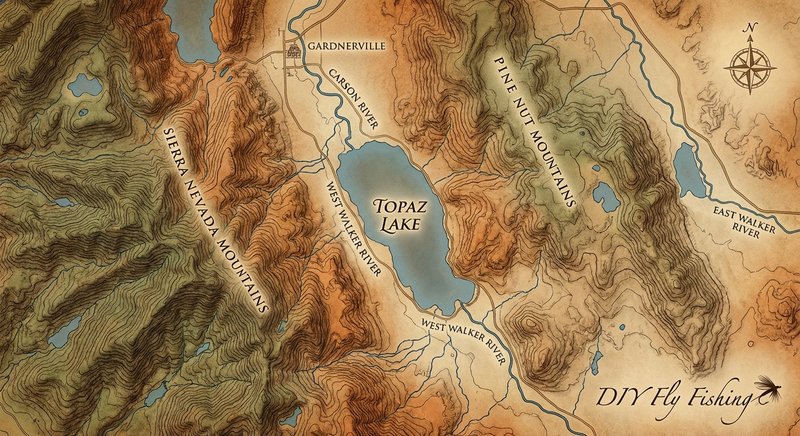
Topaz Lake
Fly fishing in Nevada · intermediate · Best seasons: spring, fall, winter
Target Species
Rainbow Trout, Brown Trout
About This Water
Border lake shared with California. Excellent rainbow and brown trout fishing.
Fishing Recommendations
Welcome to Topaz Lake, often referred to as the "Queen of the High Desert." Straddling the Nevada-California border about 75 miles south of Reno, this reservoir is a unique fishery that offers a classic Eastern Sierra experience with a high-desert twist.
As a guide, I look at Topaz as the premier "shoulder season" destination. When the high-elevation creek loops are frozen solid, Topaz is often where the action is.
🎣 Location Overview
Topaz Lake is a man-made reservoir sitting at approximately 5,000 feet of elevation. What makes it special is its role as the "early season" destination. While most Sierra waters are under snow, Topaz traditionally kicks off the fishing year on January 1st.
The lake is characterized by a mix of steep rocky shorelines on the west side and flatter, sandy beaches on the east and north. Because it is a terminal reservoir for the West Walker River, the water levels can fluctuate, but the fishing remains remarkably consistent due to a robust stocking program and a healthy population of wild holdover fish.
🐟 Target Species & Behavior
Rainbow Trout
The bread and butter of Topaz. You’ll find a mix of "catchable" stockers and "holdovers" that have spent a year or more in the lake, growing silver and strong.
- Behavior: They tend to cruise the shoreline in 5–15 feet of water. In the winter and spring, they are looking for warmer water near the surface and along the rocky points where midges hatch.
Brown Trout
Topaz holds some truly "trophy" caliber Browns that can reach upwards of 5–8 pounds.
- Behavior: Browns here are predatory and elusive. They hold deeper during the day, often near the dam or the steep rocky ledges on the California side. They move into the shallows during low-light conditions (dawn/dusk) to hunt small perch and trout.
📅 Best Times to Fish
Optimal Seasons
- Winter (January – February): This is the legendary "opening" window. Despite the cold, the fish are hungry. This is the best time for shore anglers to reach fish that haven't been pressured yet.
- Spring (March – May): Prime Time. The water warms, midge hatches become prolific, and the trout become extremely active before the summer heat sets in.
- Fall (October – November): As the water cools, the large Browns become aggressive as they prepare for their spawning cycle.
Prime Windows
- The "Topaz Chop": Experienced guides pray for a light breeze. A glass-calm surface makes the fish spooky in the clear water; a light ripple (the "chop") masks your presence and triggers feeding.
- First Light: Essential if you are hunting trophy Browns.
🪰 Recommended Flies & Techniques
1. Indicator Nymphing (The "Steady" Method)
Because of the massive midge populations, hanging flies under an indicator is incredibly effective.
- Flies: Zebra Midges (#16–20) in black/silver, red/gold, or olive. Chromies and Ice Buddies also work well.
- Technique: Set your indicator 8 to 12 feet deep. Fish the edges of the drop-offs.
2. Stripping Streamers (The "Aggressive" Method)
Perfect for float tubers or those fishing the rocky points.
- Flies: Wooly Buggers (#8–12) in olive, black, or "Seal Bugger" brown. Pro Tip: Use a Perch-colored streamer (orange/green) to mimic the local forage.
- Technique: Use an intermediate sinking line. Vary your retrieve: two quick strips followed by a long pause. Most hits happen on the pause.
3. Balanced Leeches
- Flies: Balanced Leech in black, bruiser (black/blue), or blood red.
- Technique: Fished under an indicator, these stay horizontal in the water column, mimicking a swimming leech perfectly even in wave action.
💡 Pro Tips & Local Knowledge
- Focus on "The Wall": The rocky west shore (near the dam) has deep ledges. This is where the big Browns live. If you’re in a float tube, work this area carefully with a sinking line.
- The South End Inlet: When the West Walker River is flowing into the lake, the south end can be a hotspot for Rainbows congregating near the fresh, oxygenated water.
- Watch the Wind: Topaz is notorious for the "Washoe Zephyr"—high winds that kick up in the afternoon. If you are in a float tube or small boat, keep a close eye on the horizon. If the whitecaps start, get off the water immediately.
- The Perch Factor: Topaz has a large population of Sacramento Perch fry. In the late spring, trout will gorge on these. A small, sparkly "Hornberg" or a white/olive streamer will produce when nothing else does.
⚠️ Important Information
Access
- Douglas County Park (NV side): Offers the best access with boat ramps, camping, and easy shore access.
- The "Hedge": Small pull-outs along Hwy 395 provide access to the steeper California side.
Regulations & Permits
- Reciprocal Agreement: You can fish Topaz Lake with either a Nevada or California fishing license. However, if you have a CA license, you must have the appropriate stamps, and vice versa for NV.
- Season: Historically a seasonal lake, but always check current NDOW (Nevada Department of Wildlife) or CDFW regulations as season dates and bag limits can change annually.
Safety
- Cold Water: In winter and spring, the water is dangerously cold. If you are using a float tube, wear high-quality neoprene waders and a life jacket. Hypothermia is a real risk here.
Bug Hatches & Matching Flies
| Hatch | Type | Peak months | Time of day | Hook sizes | Matching flies |
|---|---|---|---|---|---|
| Chironomids Chironomidae | midge | January, February, March, April, October, November | All Day | #12-20 | Zebra Midge #16-20, Ice Cream Cone #12-16, Griffith's Gnat #18-22 |
| Callibaetis Callibaetis | mayfly | May, June, September | Morning/Afternoon | #12-16 | Hare's Ear Nymph #14-16, Callibaetis Spinner #14-16, Parachute Adams #14-18 |
| Damselfly Enallagma | other | June, July | Morning/Afternoon | #10-14 | Marabou Damsel #10-14, Adult Damsel #12-14 |
| Dragonfly Anisoptera | other | July, August | Afternoon | #4-10 | Dragonfly Nymph #6-10, Moorish Dirty Bird #8-12 |
| Scuds Gammarus | other | Year-round | All Day | #14-18 | Flashback Scud #14-18, Ray Charles #14-16 |
| Water Boatman Corixidae | other | September, October | Afternoon | #14-16 | Water Boatman #14-16, Prince Nymph #14-16 |
| Grasshoppers Acrididae | terrestrial | July, August, September | Afternoon | #8-12 | Dave's Hopper #8-12, Morrish Hopper #10-12 |
| Caddis Hydropsychidae | caddis | May, June, July | Evening | #14-18 | Elk Hair Caddis #14-18, LaFontaine's Deep Sparkle Pupa #14-16 |