Toutle River
Fly fishing in Washington · Intermediate · Best seasons: Winter, Spring
Target Species
Steelhead
About This Water
Recovering post-Mt. St. Helens with returning steelhead. Unique geological fishing experience.
Fishing Recommendations
The Toutle River, flowing from the volcanic slopes of Mt. St. Helens in Southwest Washington, offers one of the most unique and resilient fly fishing experiences in the Pacific Northwest. Forever changed by the 1980 eruption, the Toutle has spent decades reclaiming its identity. Today, it stands as a rugged, high-gradient fishery that rewards the persistent angler with hard-fighting, chrome-bright steelhead.
🎣 Location Overview
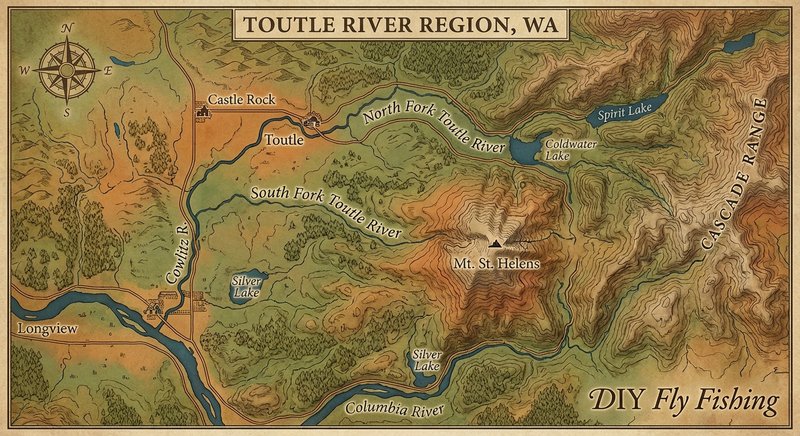
The Toutle is divided into two primary systems: the North Fork and the South Fork.
- The North Fork: Historically the most impacted by volcanic sediment, it is now home to the Sediment Retention Structure (SRS). While it can be fickle due to silt, it holds significant runs of hatchery and wild winter steelhead.
- The South Fork: This is the "crown jewel" for fly anglers. It is a classic freestone river with boulder-strewn runs, deep emerald pools, and pocket water. It is one of the few rivers in the region that has managed to maintain a healthy run of wild winter steelhead in a "wild" setting.
Anglers love the Toutle because it feels raw. Unlike the crowded banks of the nearby Cowlitz, the Toutle requires hiking, bushwhacking, and a high level of physical fitness to access its best water.
🐟 Target Species & Behavior
Winter & Spring Steelhead
The primary target is the Winter Steelhead (both wild and hatchery). These fish are known for their aggression and size.
- Behavior: Toutle steelhead are "movers." Because the river can rise and fall rapidly with rain or snowmelt, these fish utilize the higher flows to push deep into the system.
- Holding Water: In the South Fork, look for "inside seams" and the heads of pools where the water transitions from fast riffles to walking-speed depths. In the colder months (Jan-Feb), they hold in the tailouts and the soft water behind large boulders.
- Feeding: While they aren't "feeding" in the traditional sense, they are highly territorial. They react to movement, color, and the "swing" of a fly.
📅 Best Times to Fish
- Winter Season (January – March): This is the peak for hatchery-bound fish on the North Fork and early wild fish on the South Fork.
- Spring Season (March – May): This is the prime window for the larger, wild "Spring" steelhead. The water temperatures begin to rise slightly, making the fish more active and willing to chase a swung fly.
- Conditions: The Toutle is highly sensitive to rain.
- The "Green Drop": The best fishing occurs as the river is dropping and clearing after a rain event. You want "steelhead green" water with 3–5 feet of visibility.
- Time of Day: Early morning is standard, but on the South Fork, the "afternoon warm-up" in March can often trigger a midday bite.
🪰 Recommended Flies & Techniques
The Swing (Spey or Single-Hand)
The Toutle is a premier "swing" river. Use a 7 or 8-weight Spey rod with a Skagit head and various T-series sink tips (T-8 to T-14 depending on flow).
- Top Fly Patterns:
- Intruders: Pink/Orange, Black/Blue, or Chartreuse/White.
- Prom Dress / Hobo Spey: Large profiles for murky water; smaller, darker profiles for clear water.
- The "Green Butt Skunk": A classic for when the water is low and clear in late spring.
Nymphing (Indicator)
Highly effective in the pocket water of the South Fork.
- Patterns: Large rubber-leg stoneflies (black/brown), Glo-bugs (egg patterns) in peach or Oregon cheese, and Bead-head Prince Nymphs.
Presentation Tips
- The "Hang": At the end of your swing, let the fly dangle in the current for 10 seconds. Steelhead often follow the fly across the river and strike just as it straightens out.
- Depth Control: If you aren't ticking the bottom occasionally, you aren't deep enough. However, the Toutle is "grabby"—bring plenty of extra tips and flies.
💡 Pro Tips & Local Knowledge
- The South Fork "Hike-In": Much of the South Fork is accessed through Weyerhaeuser timberlands. Be prepared to hike several miles. Bringing a mountain bike can be a game-changer for covering the gated logging roads to reach untouched holes.
- Watch the SRS: On the North Fork, the Sediment Retention Structure can discharge silt even when it hasn't rained. Check local social media groups or fly shops in Longview for "clarity reports" before driving out.
- Cover Water: Don't spend two hours in one hole. Give a run 15–20 casts, move down a step each time, and if nothing happens, move to the next access point. The Toutle rewards those who travel.
- Short Leash: In the South Fork’s boulder gardens, use a shorter leader (3–4 feet) when swinging. This gives you better control over the fly's depth in turbulent water.
⚠️ Important Information
- Regulations: The Toutle has complex regulations. Barbless hooks are mandatory. Some sections are "Catch and Release" only for wild fish (look for the clipped adipose fin to keep a hatchery fish). Always check the WDFW Sport Fishing Rules before heading out.
- Permits: If you are accessing the river through timberlands (specifically Weyerhaeuser), you may need a recreational access permit. These are sold annually and can be expensive, so check which gates are open to the public.
- Safety: The Toutle is a powerful river. The rocks are notoriously slippery (volcanic basalt). Felt-soled boots with studs are highly recommended. Always fish with a wading belt.
- Environment: You are in the Mt. St. Helens blast zone. Cell service is spotty to non-existent. Carry a satellite messenger (like a Garmin InReach) if you are heading deep into the South Fork canyons.
Bug Hatches & Matching Flies
| Hatch | Type | Peak months | Time of day | Hook sizes | Matching flies |
|---|---|---|---|---|---|
| March Brown Rhithrogena morrisoni | mayfly | March, April | Afternoon | #12-14 | Western March Brown #12-14, Hare's Ear Nymph #12-14, March Brown Emerger #14 |
| Blue Winged Olive (BWO) Baetis | mayfly | March, April, October, November | Late Morning/Afternoon | #16-20 | Parachute Adams #16-20, RS2 #18-20, Pheasant Tail Nymph #16-20 |
| Golden Stonefly Hesperoperla pacifica | stonefly | June, July | Morning/Evening | #8-12 | Chubby Chernobyl (Gold) #8-12, Pat's Rubber Leg #8-12, Golden Stone Nymph #10 |
| Green Drake Drunella doddsii | mayfly | June | Afternoon | #10-12 | Green Drake Cripple #10-12, Hairwing Green Drake #10-12 |
| Spotted Sedge Hydropsyche | caddis | July, August, September | Evening | #14-18 | Elk Hair Caddis (Tan) #14-16, Soft Hackle Hare's Ear #14-16, LaFontaine's Deep Sparkle Pupa #14-16 |
| Yellow Sally Isoperla | stonefly | June, July, August | Afternoon/Evening | #14-16 | Yellow Sally Stimulator #14-16, Little Yellow Sloan #14-16 |
| Pale Morning Dun (PMD) Ephemerella excrucians | mayfly | June, July, August | Late Morning | #16-18 | PMD Sparkle Dun #16-18, Split Case PMD #16-18 |
| Salmonfly Pteronarcys californica | stonefly | May, June | All Day | #4-8 | Rogue Foam Stone #4-8, Pteronarcys Nymph #6-8 |
| Terrestrials Formicidae / Coleoptera | terrestrial | August, September | All Day | #12-18 | Cinnamon Ant #16-18, Black Foam Beetle #12-14 |