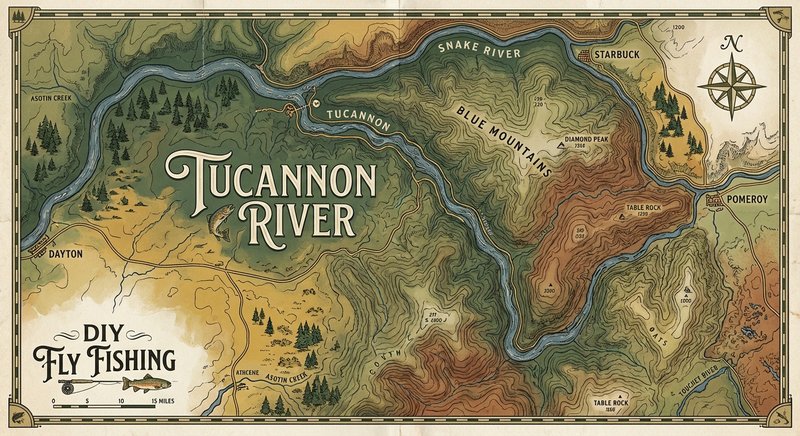
Tucannon River
Fly fishing in Washington · Intermediate · Best seasons: Summer, Fall
Target Species
Rainbow Trout, Steelhead
About This Water
Blue Mountains stream with wild rainbow trout and steelhead. Remote southeast Washington fishing.
Fishing Recommendations
The Tucannon River is one of Southeast Washington’s most cherished hidden gems. Tucked away in the rugged Blue Mountains, it offers a classic "small water" experience that punches well above its weight class. Whether you are stalking wild rainbows in pocket water or swinging for "A-run" Steelhead in the lower reaches, the Tucannon provides a technical but rewarding challenge for the fly angler.
🎨 Location Overview
The Tucannon River is a tributary of the Snake River, carving a scenic valley through basalt cliffs and timbered ridges. What makes it special is the diversity of its water: the upper sections flow through the Umatilla National Forest and the W.T. Wooten Wildlife Area, offering pristine, cold-water habitat for trout. As the river descends, it transitions into a classic desert canyon stream.
Anglers love the Tucannon because it feels intimate. You don’t need a drift boat here; this is a wade-fisherman’s paradise. The water is characterized by quick riffles, deep basalt-lined pools, and "tight-quarter" casting opportunities where accuracy is more important than distance.
🐟 Target Species & Behavior
Rainbow Trout
The river holds a mix of wild "redband" rainbows and some hatchery escapees from the various impoundments (lakes) along the valley.
- Behavior: These are opportunistic feeders. In the fast-moving water, they have a split second to decide to eat. They hold in the "cushion" in front of boulders, the seams between fast and slow water, and the bubbly "heads" of pools.
- Diet: Heavy focus on Stoneflies (Salmonflies and Golden Stones), Caddis, and terrestrial insects (hoppers/ants) in the summer.
Steelhead
The Tucannon hosts a run of "A-run" summer-run Steelhead. These fish are typically smaller (4–8 lbs) than the B-run fish of the Clearwater, but they are incredibly acrobatic.
- Behavior: They enter the river in late summer and fall. They are "travelers" and tend to hold in the tailouts of larger pools or in the "walking pace" water of the mid-river.
- Diet: They aren't actively feeding, but they strike out of aggression or instinct.
📅 Best Times to Fish
Summer (July – August)
- Focus: Rainbow Trout.
- Conditions: Water is low and clear. This is the prime window for dry fly fishing.
- Time of Day: Early morning and "golden hour" before dusk. Mid-day can be slow due to high sun and heat.
Fall (September – November)
- Focus: Steelhead and large resident Rainbows.
- Conditions: The first cooling rains of September trigger the Steelhead to move up from the Snake River.
- Prime Window: October is arguably the best month on the river, as you can catch trout on dries in the afternoon and swing for steelhead in the morning.
🪰 Recommended Flies & Techniques
For Rainbow Trout (Summer/Fall)
- Technique: Hopper-Dropper. Use a high-visibility dry fly with a small nymph suspended 18–24 inches below it.
- Top Dry Flies: Chubby Chernobyl (Size 8-12), Elk Hair Caddis (Size 14-16), Stimulators (Orange/Yellow).
- Top Nymphs: Copper John (Red/Silver), Prince Nymph, and the "Tucannon Special"—a Beadhead Pheasant Tail.
For Steelhead (Fall)
- Technique: Swinging flies with a light Spey rod (3-5 weight) or a single-hand 7-weight. Nymphing with beads under an indicator is also highly effective in the deeper holes.
- Swing Flies: Green Butt Skunk, Blue Charm, or small Purple Intruders.
- Nymphing: 8mm or 10mm soft beads (Natural Roe or Mottled Orange), Jimmy Legs (Stonefly patterns).
💡 Pro Tips & Local Knowledge
- Focus on the Wooten Wildlife Area: This stretch offers the best public access and has been subject to significant habitat restoration. Look for the "man-made" log jams; these are magnets for the biggest trout in the river.
- The "Stealth" Factor: Because the water is often crystal clear, Tucannon fish are spooky. Wear earthy tones, stay low, and try not to wade through the middle of the hole before you fish it.
- Don't Overlook the Lower River: While the upper river is prettier, the lower river (closer to the mouth at the Snake) can hold massive Steelhead in October that most people drive right past.
- The "Hatchery Bridge" Rule: Local guides often focus on areas around the Tucannon Fish Hatchery, as Steelhead naturally congregate there.
⚠️ Important Information
- Access: Much of the river is paralleled by Tucannon Road. Public access is excellent within the Wooten Wildlife Area, but be respectful of private property fences in the lower canyon.
- Regulations: The Tucannon has very specific rules.
- Selective Gear Rules are usually in effect (no bait, barbless hooks).
- Bull Trout: The river is home to endangered Bull Trout. If you hook one, keep it in the water and release it immediately. It is illegal to target them.
- Steelhead: Check the WDFW (Washington Dept. of Fish and Wildlife) emergency rules before heading out, as Steelhead seasons can close on short notice based on return numbers.
- Discovery Pass: You will need a Washington State Discovery Pass to park in the Wooten Wildlife Area and most access points.
Guide’s Final Word: The Tucannon isn't a "numbers" river like some of the bigger Montana streams, but it offers a soulful, quiet fishing experience. Bring a 4-weight for the trout, a 7-weight for the steelhead, and a camera for the basalt cliffs. Tight lines!
Bug Hatches & Matching Flies
| Hatch | Type | Peak months | Time of day | Hook sizes | Matching flies |
|---|---|---|---|---|---|
| Blue-Winged Olive Baetis spp. | mayfly | March, April, September, October | Late Morning/Afternoon | #16-22 | Parachute Adams #18-20, Pheasant Tail #16-20, RS2 #18-22 |
| Salmonfly Pteronarcys californica | stonefly | May, June | All Day | #4-8 | Chubby Chernobyl #6-8, Pats Rubber Legs #4-8, Rogue River Stone #6-8 |
| Golden Stonefly Hesperoperla pacifica | stonefly | June, July | Morning/Evening | #8-12 | Golden Chubby #8-12, Kaufmanns Stone #8-10, Norm Wood Special #10-12 |
| Pale Morning Dun Ephemerella inermis | mayfly | June, July | Late Morning/Early Afternoon | #14-18 | PMD Sparkle Dun #16-18, Split Case PMD #14-16, Quigley Cripple #16 |
| Spotted Sedge Hydropsyche spp. | caddis | June, July, August | Evening | #14-18 | Elk Hair Caddis #14-16, Soft Hackle Hare's Ear #14-18, Peeking Caddis #14-16 |
| Yellow Sally Isoperla spp. | stonefly | June, July, August | Afternoon/Evening | #14-16 | Yellow Stimulator #14-16, Iron Sally #14-16 |
| October Caddis Dicosmoecus atripes | caddis | September, October | Afternoon | #8-12 | Orange Stimulator #8-10, October Caddis Pupa #10-12 |
| Terrestrials Formicidae / Acrididae | terrestrial | July, August, September | All Day | #10-16 | Dave's Hopper #10-12, Black Foam Ant #14-16, Chernobyl Ant #10-14 |