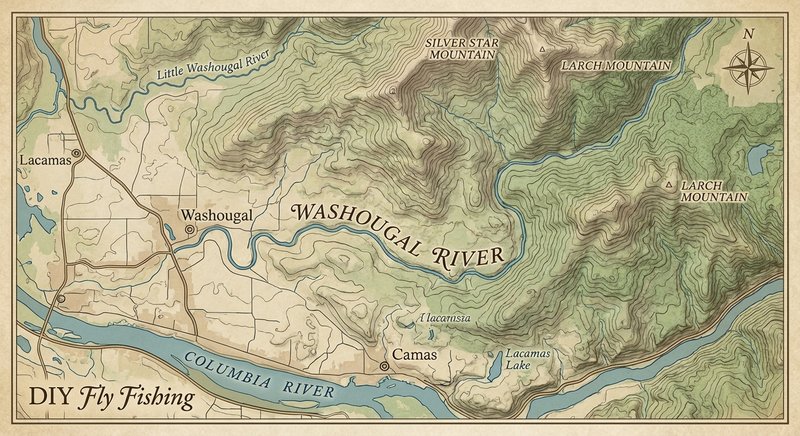
Washougal River
Fly fishing in Washington · Beginner · Best seasons: Summer, Fall
Target Species
Steelhead, Cutthroat Trout
About This Water
Columbia Gorge tributary with summer steelhead. Accessible fishing near Portland/Vancouver metro.
Fishing Recommendations
The Washougal River is one of Southwest Washington’s most scenic and beloved "backyard" rivers. Flowing out of the Cascade foothills and emptying into the Columbia River near the town of Camas, it offers a classic Pacific Northwest experience: crystalline water, volcanic rock formations, and deep emerald pools.
As an expert guide, I can tell you that the Washougal is both rewarding and challenging. It is a "flashy" river, meaning it rises and clears quickly after rain, and its fish are known for being particularly wary due to the exceptional water clarity.
🎣 Location Overview
The Washougal is characterized by its extreme clarity and its varied structure. The upper river is a playground of pocket water, boulders, and deep canyons, while the lower river features broader runs and classic tailouts.
What makes it special is its accessibility paired with its beauty. While it's close to the Portland/Vancouver metro area, the upper reaches feel remarkably wild. Anglers love it because it is a "technical" river; the gin-clear water requires stealth, light tippets, and precise presentations, making a landed fish feel like a true achievement.
🐟 Target Species & Behavior
Steelhead (Summer & Winter)
- Behavior: Summer-run Steelhead are the stars here. They enter the system as early as May and linger through October. They are aggressive and known for holding in fast, highly oxygenated water (riffles and the heads of pools).
- Holding Water: Look for "structure." These fish love to tuck behind large boulders or sit in the "seams" where fast and slow water meet. In low water, they retreat to the deepest, darkest parts of the pools.
Coastal Cutthroat Trout
- Behavior: These are the "jewels" of the Washougal. You’ll find both resident fish and "searun" Cutthroat (locally called Bluebacks).
- Feeding: They are opportunistic predators. They feed on aquatic insects (caddis, mayflies), but larger fish are highly piscivorous, chasing down sculpins and salmon fry.
📅 Best Times to Fish
- Summer (June – August): This is the prime window for Summer Steelhead. The water is warm, and the fish are active. Focus on the low-light hours of dawn and dusk. Once the sun hits the water, the fish go deep and become very difficult to trick.
- Fall (September – October): This is the best time for Cutthroat and the tail-end of the Summer Steelhead run. As the first rains of autumn arrive, the "Blueback" Cutthroat move up from the Columbia.
- Optimal Conditions: Look for a "dropping and clearing" trend after a light rain. On the Washougal, if the visibility is 4–6 feet, you are in the "golden zone." If it's too clear (10+ feet), you must fish very fine leaders and stay low to the bank.
🪰 Recommended Flies & Techniques
For Steelhead
- Technique: Swinging Flies is the traditional method here. Use a Spey or switch rod. In the summer, "skating" a dry fly on the surface can produce heart-stopping rises.
- Flies:
- Surface: Waller Walker, Mudder Minnows.
- Subsurface (Low Water): Green Butt Skunk, Street Maid, or Blue Charms (Size 6-10).
- Subsurface (High/Cold Water): Small Intruders in purple, black, or blue.
For Cutthroat Trout
- Technique: Dry-Dropper rigs are incredibly effective. Fish a buoyant dry fly with a small nymph suspended 18 inches below it.
- Flies:
- Dries: Royal Wulff, Elk Hair Caddis, Stimulators (Size 12-16).
- Nymphs: Prince Nymphs, Pheasant Tails, or Gold Ribbed Hare’s Ear.
- Streamers: Small olive or black Woolly Buggers (Size 8-10) stripped through deep slots.
💡 Pro Tips & Local Knowledge
- The "Stealth" Factor: Because the water is so clear, the fish can see you long before you see them. Wear earthy tones (no bright white or orange hats) and avoid wading deeply if you don't have to. Sometimes the fish are right at your feet in the shadows of the bank.
- Focus on the Upper River: For the fly angler, the water above Dougan Falls offers spectacular pocket water for trout. However, check regulations, as Steelhead access is limited by natural barriers.
- The "Washougal Swing": When swinging for Steelhead, use a longer leader than you would on the Deschutes or the Sandy. A 12-foot leader helps prevent the fly line from spooking fish in the clear pools.
- Skate the Riffles: Don't ignore the fast, shallow water that looks too thin to hold a fish. In the summer, Steelhead will sit in 18 inches of bubbly water for the oxygen.
⚠️ Important Information
- Access: Much of the lower river passes through private property. Use designated access points like Hatfield Park, The Big Eddy, and various pull-outs along Washougal River Road. Above Dougan Falls is largely DNR (Department of Natural Resources) land and offers great public access.
- Regulations: Check the WDFW (Washington Department of Fish and Wildlife) pamphlet before you go. The Washougal has specific rules regarding:
- Selective Gear Rules (often barbless hooks only).
- Mandatory release of all wild (unclipped) Steelhead.
- Night closures (no fishing after dark).
- Permits: You need a Washington State Freshwater Fishing License and a Columbia River Salmon/Steelhead Endorsement.
- Safety: The rocks on the Washougal are notoriously slippery (volcanic basalt). Studded wading boots are highly recommended to avoid a dunking.
The Washougal is a "moody" river, but for the angler who prizes finesse and scenery, there is no place better in Southwest Washington. Tight lines!
Bug Hatches & Matching Flies
| Hatch | Type | Peak months | Time of day | Hook sizes | Matching flies |
|---|---|---|---|---|---|
| Blue Winged Olive Baetis spp. | mayfly | March, April, October, November | Mid-day | #18-22 | RS2 #18-20, Parachute Adams #18-22, Pheasant Tail #18-20 |
| March Brown Rhithrogena morrisoni | mayfly | March, April | Afternoon | #12-14 | March Brown Western Red #12-14, Gold Ribbed Hare's Ear #12-14, Soft Hackle March Brown #14 |
| Grannom Caddis Brachycentrus | caddis | April, May | Morning/Evening | #14-16 | Peacock Caddis #14-16, Holy Grail Caddis #14-16, Deep Sparkle Pupa #14-16 |
| Golden Stonefly Hesperoperla pacifica | stonefly | June, July | Morning/Evening | #6-10 | Kaufmann's Stone #6-10, Chubby Chernobyl #8-10, Pat's Rubber Legs #8-12 |
| Yellow Sally Isoperla spp. | stonefly | June, July, August | Late Afternoon/Evening | #14-16 | Yellow Sally Dry #14-16, Little Yellow Sloan #14-16 |
| Pale Morning Dun Ephemerella spp. | mayfly | June, July, August | Morning/Afternoon | #16-18 | PMD Sparkle Dun #16-18, Split Case PMD #16-18, Pheasant Tail #16-18 |
| October Caddis Dicosmoecus gilvipes | caddis | September, October | Afternoon/Evening | #8-10 | Orange Stimulator #8-10, October Caddis Pupa #8-10 |
| Carpenter Ants and Beetles | terrestrial | July, August, September | Mid-day/Afternoon | #12-16 | Black Foam Ant #14-16, Cinnamon Ant #14-16, Fat Albert #12-14 |