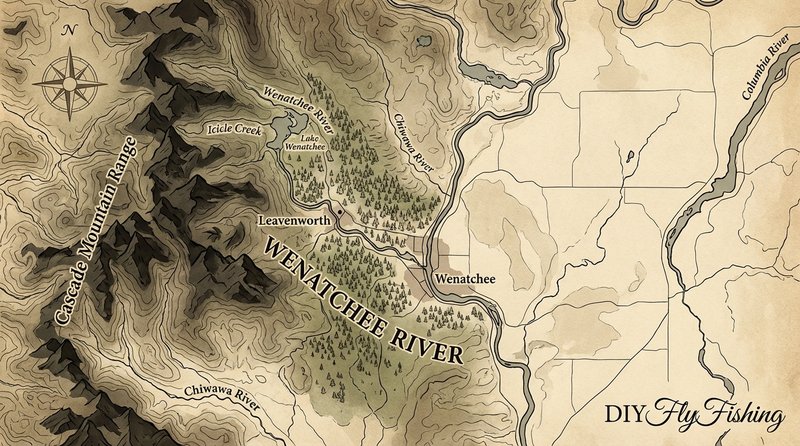
Wenatchee River
Fly fishing in Washington · Intermediate · Best seasons: Summer, Fall
Target Species
Steelhead, Rainbow Trout
About This Water
Cascade mountain river with salmon, steelhead, and trout. Beautiful Bavarian scenery near Leavenworth.
Fishing Recommendations
The Wenatchee River is one of the most iconic and powerful drainages in Central Washington. Flowing from the high Cascades at Lake Wenatchee down to its confluence with the Columbia River, it offers a dramatic transition from alpine forests to desert canyons. For the fly fisher, it is a river of "big water" character—broad riffles, deep basalt canyons, and classic "swing" water.
Here is your comprehensive guide to fly fishing the Wenatchee River.
🎣 Location Overview
The Wenatchee is a classic freestone river known for its crystal-clear water and large, polished granite boulders. What makes it special is the sheer diversity of water types: the upper river near Leavenworth is lush and mountainous, while the lower river near Cashmere and Monitor flows through arid, golden hills and orchards.
Anglers love the Wenatchee because it is a "big stick" river. It rewards long casts, powerful mending, and an athletic approach to wading. The scenery—especially in the fall when the larch trees and orchards turn gold—is among the best in the Pacific Northwest.
🐟 Target Species & Behavior
Steelhead (Summer-Run)
The Wenatchee hosts a significant run of summer steelhead (which arrive in the river in late summer/fall). These fish are aggressive and known for their willingness to rise to a swung fly.
- Behavior: They are migratory and hold in "classic" steelhead water—walking-speed runs, the heads of pools, and behind large submerged boulders.
- Feeding: While they don't feed actively like trout, they strike out of predatory instinct or territorial aggression.
Rainbow Trout
The river has a healthy population of wild "redband" rainbow trout.
- Behavior: They are opportunistic feeders. During the summer, they hold in the fast "oxygenated" water—riffles and pocket water. As the water cools in the fall, they move toward the tailouts and deeper slots.
- Feeding: They key in on caddis, stoneflies, and terrestrial insects (hoppers/ants) in the summer, shifting to Blue Winged Olives (BWOs) and salmon eggs in the late fall.
📅 Best Times to Fish
Optimal Seasons
- Summer (July – August): Prime time for Rainbow Trout. The water has dropped after the spring freshet, and the dry fly action is at its peak.
- Fall (September – November): The "Golden Window." This is when the steelhead arrive in numbers and the trout are feeding heavily to bulk up for winter.
Best Times of Day
- Summer: Early morning and "the magic hour" (last two hours of light) are essential to avoid the heat and the "recreational floater" traffic.
- Fall: Mid-day becomes more productive as the water warms slightly, triggering insect hatches.
Prime Conditions
- Water Flow: Look for flows between 1,500 and 3,000 CFS for the best wading.
- Clarity: The Wenatchee can handle some rain, but it’s best when the water has that "emerald green" tint.
🪰 Recommended Flies & Techniques
Steelhead Techniques
- The Swing: This is the soul of Wenatchee fishing. Using a Spey or switch rod, cast quartering downstream and let the fly swing through the current.
- Flies:
- Surface: Street Sweeper, Ska-pper, or any foam-backed hitched fly.
- Sub-surface: Green Butt Skunk, Blue Charm, or Hobo Spey (Black/Blue or Purple).
Trout Techniques
- Dry-Dropper: A high-visibility foam hopper or stonefly with a weighted nymph (like a Perdigon) 2-3 feet below it.
- Nymphing: European Nymphing is highly effective in the pocket water near Leavenworth.
- Flies:
- Dries: Chubby Chernobyl (Size 8-12), Stimulators, and Elk Hair Caddis.
- Nymphs: Pat’s Rubber Legs (Orange/Brown), Prince Nymphs, and Jigged Pheasant Tails.
💡 Pro Tips & Local Knowledge
- The "Shadow" Factor: In the deep canyons (like Tumwater Canyon), the sun disappears early. Fish the shady banks during the heat of the day; trout will move into shallower water once the direct sun leaves the surface.
- Swing the Riffles: Many anglers bypass the shallow, choppy riffles. On the Wenatchee, summer-run steelhead love to sit in water that is only 2-3 feet deep if it has good surface chop for cover.
- The "Leavenworth Hatch": During summer afternoons, the river through the town of Leavenworth is crowded with tubers. Don't fight it—either fish very early or head to the more secluded stretches below Cashmere where the crowds thin out.
- Boulder Gardens: When trout fishing, don't just fish the pools. The Wenatchee is full of "pocket water." High-sticking your nymphs behind every large rock can result in a fish every few minutes.
⚠️ Important Information
Regulations & Permits
- Selective Gear Rules: The Wenatchee is generally under selective gear rules (unscented artificial flies/lures, single barbless hooks).
- Steelhead Openings: Crucial: The Wenatchee is only open for Steelhead via "Emergency Opener" by the WDFW, depending on return numbers. Always check the WDFW Emergency Rules before targeting steelhead.
- Retention: Most trout are catch-and-release only. Check the current pamphlet for specific zone boundaries.
Access
- Upper River: Access is available via Highway 2 through Tumwater Canyon (rugged wading) and several parks in Leavenworth (Blackbird Island).
- Lower River: Good access at Peshastin, Dryden Dam (beware of hazards), and the Monitor boat ramp.
- Discover Pass: You will need a Washington State Discover Pass to park at most state-managed access sites.
Safety
- Wading: The Wenatchee is a powerful river with "greasy" rocks. Studded boots and a wading staff are non-negotiable if you plan on wading deep.
Bug Hatches & Matching Flies
| Hatch | Type | Peak months | Time of day | Hook sizes | Matching flies |
|---|---|---|---|---|---|
| Salmonfly Pteronarcys californica | stonefly | May, June | All Day | #4-8 | Rogue River Stone #4-6, Pat's Rubber Legs #4-8, Chubby Chernobyl #6-8 |
| Golden Stonefly Hesperoperla pacifica | stonefly | June, July | Morning/Evening | #8-12 | Norm Wood Special #8-10, Golden Twenty-Incher #10-12, Clark's Golden Stone #10-12 |
| Blue-Winged Olive (BWO) Baetis | mayfly | March, April, September, October, November | Mid-day | #18-22 | Sparkle Dun #18-22, RS2 #20-22, Parachute BWO #18-20 |
| Pale Morning Dun (PMD) Ephemerella excrucians | mayfly | June, July, August | Late Morning/Afternoon | #14-18 | Parachute PMD #16-18, Pheasant Tail #14-18, PMD Cripple #16 |
| October Caddis Dicosmoecus gilvipes | caddis | September, October | Afternoon/Evening | #8-10 | Orange Stimulator #8-10, October Caddis Pupa #8-10, Morrish's October Caddis #8-10 |
| Mother's Day Caddis Brachycentrus | caddis | April, May | All Day | #14-16 | Elk Hair Caddis (Olive) #14-16, Peacock Caddis Pupa #14-16, Z-Wing Caddis #14 |
| Yellow Sally Isoperla | stonefly | June, July, August | Evening | #14-16 | Yellow Sally Stimulator #14-16, Little Yellow Sloan #14-16, Missing Link Caddis (Yellow) #14-16 |
| Western Green Drake Drunella grandis | mayfly | June, July | Afternoon | #10-12 | Hair Wing Green Drake #10-12, Green Drake Cripple #10-12, Hares Ear (Nymph) #10-12 |
| Grasshoppers Orthoptera | terrestrial | August, September | Late Morning/Afternoon | #8-12 | Morrish Hopper #10-12, Dave's Hopper #8-12, Rainy's Grand Hopper #10 |