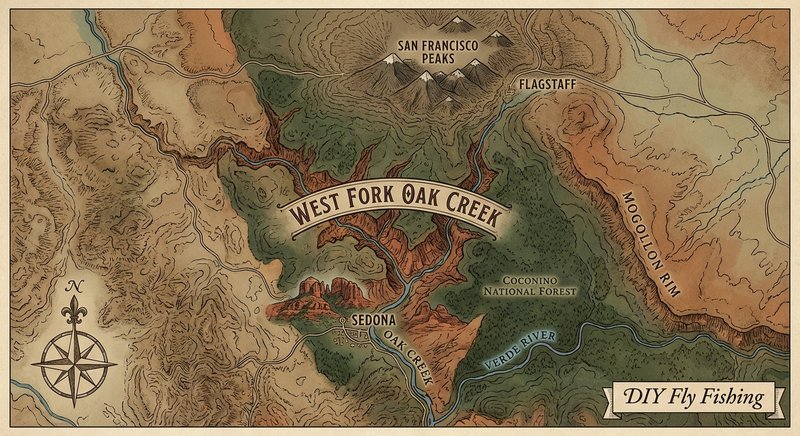
West Fork Oak Creek
Fly fishing in Arizona · beginner · Best seasons: spring, fall
Target Species
Rainbow Trout
About This Water
Popular Sedona area stream in scenic red rock canyon. Stocked rainbow trout with beautiful scenery.
Fishing Recommendations
As an expert guide who has spent many seasons navigating the red rock canyons of the Southwest, I can tell you that West Fork Oak Creek is a "bucket list" destination—not just for the fishing, but for the sheer visual majesty. It is often cited as one of the most beautiful hikes in the United States, and for the fly angler, it offers a technical, intimate, and highly rewarding small-stream experience.
🎣 Location Overview
The West Fork of Oak Creek is a spring-fed tributary located inside a massive, sheer-walled sandstone canyon within the Coconino National Forest, just north of Sedona, Arizona.
What makes this water special is the microclimate. While the surrounding Sedona desert swelters, the West Fork stays cool under a thick canopy of maples, oaks, and towering canyon walls. The water is gin-clear, characterized by shallow runs, deep "sand-bottom" pools, and complex pocket water created by fallen timber and boulders. This is "canyon fishing" at its finest—tight quarters, overhead obstacles, and incredibly wary fish.
🐟 Target Species & Behavior
The primary target here is the Rainbow Trout. While the main stem of Oak Creek is heavily stocked, the West Fork contains a mix of wild-spawned fish and "holdover" rainbows that have migrated upstream. You may also encounter occasional small Brown Trout.
- Behavior: These fish are extremely "spooky." Because the water is exceptionally clear and the stream is small, they have a high sensitivity to shadows and vibrations on the bank.
- Holding Patterns: They tucked into the "dark water"—the shadows cast by canyon walls or overhanging trees. They also hold at the very head of pools where the riffle enters, and under submerged logs.
- Feeding: They are opportunistic but size-conscious. They feed heavily on midges, small mayflies, and—crucially for this area—terrestrials that fall from the dense riparian foliage.
📅 Best Times to Fish
- Spring (April – Early June): This is the prime window. The snowmelt from the Mogollon Rim has stabilized, insect activity is high, and the water temperatures are perfect.
- Fall (Late September – November): This is arguably the most beautiful time. The canyon turns shades of brilliant orange and red. The water is lower and more technical, but the fish are hungry ahead of winter.
- Time of Day: Early morning (at first light) is best to beat the crowds of hikers. Late afternoon, as the shadows deepen in the canyon, provides a "power hour" of dry fly activity.
- Avoid: Mid-summer (July/August) due to the monsoon season (flash flood risk) and high hiker traffic.
🪰 Recommended Flies & Techniques
Because of the tight overhead cover, you’ll want a shorter rod—a 7.5ft to 8.5ft 3-weight or 4-weight is ideal.
Top Fly Patterns
- Dry Flies: Parachute Adams (#16-20), Elk Hair Caddis (#16-18), Royal Wulff (#16), and Stimulators (#14) for high-floating visibility.
- Nymphs: Zebra Midge (Black or Red, #18-22), Bead-head Pheasant Tail (#18), and Gold-ribbed Hare’s Ear (#16-18).
- Terrestrials: Small foam ants (#16-18) and beetles are deadly in late spring and fall.
Techniques
- Stealth Nymphing: Use a "Dry-Dropper" rig. A buoyant dry fly with a tiny midge or pheasant tail hanging 12-18 inches below it. This prevents the "splash" of a heavy strike indicator which will spook every fish in the pool.
- The "Dapping" Technique: In many spots, the brush is too thick for a backcast. Creep up to the bank and simply drop your fly onto the water surface using only the length of your rod.
- Short Casts: Most of your shots will be under 15 feet. Focus on accuracy and delicate presentations rather than distance.
💡 Pro Tips & Local Knowledge
- The Three-Mile Rule: The first two miles of the West Fork are heavily trafficked by tourists and hikers. The fishing improves exponentially once you hike past the third mile. The further you go, the more "wild" the fish behave.
- Manage Your Shadow: The sun moves across the narrow canyon quickly. Always keep the sun in front of you if possible so your shadow doesn't fall across the pool you are fishing.
- Dress in Earth Tones: Leave the bright white shirts and hats at home. Wear greens, browns, and grays to blend into the canyon walls and foliage.
- Tenkara: This is one of the best streams in Arizona for Tenkara fishing. The fixed-line approach allows for incredible fly control in the tight pocket water.
⚠️ Important Information
- Access: Park at the Call of the Canyon day-use area (located between Sedona and Flagstaff on Highway 89A). There is a parking fee (approx. $12 per vehicle). Note: The parking lot fills up very early (often by 8:00 AM) on weekends.
- Regulations: The West Fork is located within a Wilderness Area. It is generally Catch and Release only with barbless hooks, but always check the current Arizona Game and Fish Department (AZGFD) regulations for "Special Catch and Release" waters before heading out.
- Wading: Wet wading is comfortable in late spring and fall, but the rocks are incredibly slippery (covered in fine silt and algae). Felt soles (where legal) or studded rubber soles are highly recommended.
- Safety: This is a narrow canyon. Check the weather for rain anywhere in the watershed. Flash floods are a real and lethal danger in the West Fork; if the water starts to turn muddy or rises suddenly, climb to high ground immediately.
Guide’s Final Word: Treat the West Fork like a cathedral. It is a fragile ecosystem. Barbless hooks and minimal handling of the fish will ensure this gem remains a world-class destination for the next generation of anglers.
Bug Hatches & Matching Flies
| Hatch | Type | Peak months | Time of day | Hook sizes | Matching flies |
|---|---|---|---|---|---|
| Blue Winged Olive (BWO) Baetis spp. | mayfly | March, April, October, November | Late Morning/Afternoon | #18-22 | RS2 #18-22, Parachute Adams #18-22, Pheasant Tail Nymph #18-20 |
| Pale Morning Dun (PMD) Ephemerella invaria | mayfly | June, July | Late Morning | #16-18 | PMD Sparkle Dun #16-18, Hare's Ear Nymph #16-18, Barr's PMD Emerger #16-18 |
| Cinnamon Caddis Hydropsyche spp. | caddis | June, July, August | Evening | #14-18 | Elk Hair Caddis (Tan) #14-18, LaFontaine's Deep Sparkle Pupa #16, Z-Wing Caddis #14-16 |
| Midges Chironomidae | midge | January, February, March, December | All Day | #20-26 | Zebra Midge #20-24, Griffith's Gnat #20-22, Top Secret Midge #22-24 |
| Yellow Sally Isoperla spp. | stonefly | June, July | Afternoon/Evening | #14-16 | Yellow Sally Dry #14-16, Iron Lotus #16, Kaufmann's Mini Stone #14-16 |
| Terrestrial Ants and Beetles Formicidae / Coleoptera | terrestrial | July, August, September | Afternoon | #12-18 | Black Foam Ant #16-18, Chernobyl Ant #12-14, Hi-Vis Beetle #14-16 |
| Trico Tricorythodes spp. | mayfly | August, September | Early Morning | #22-24 | Trico Spinner #22-24, Sunken Trico Spinner #22, WD-40 #22-24 |
| Golden Stonefly Hesperoperla pacifica | stonefly | May, June | Morning/Evening | #8-12 | Pats Rubber Legs #8-12, Golden Stimulator #10-12, 20 Incher #10-12 |