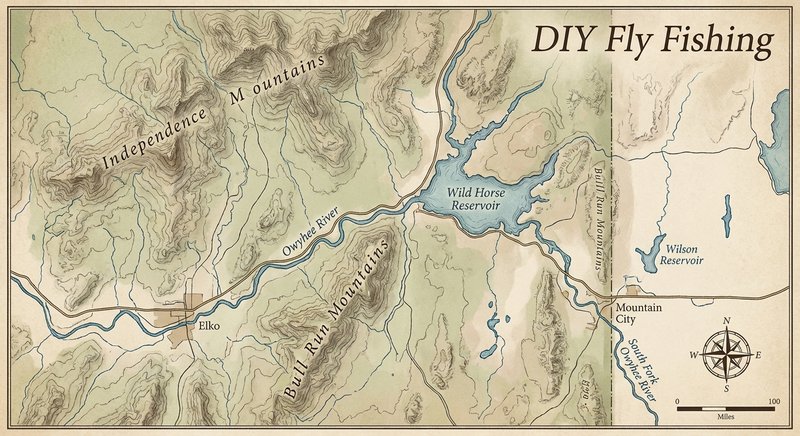
Wild Horse Reservoir
Fly fishing in Nevada · intermediate · Best seasons: spring, summer, fall
Target Species
Rainbow Trout, Brown Trout, Tiger Trout
About This Water
Large Elko County reservoir with excellent trout fishing. Popular northeast Nevada destination.
Fishing Recommendations
Wild Horse Reservoir is often called the "gem of the high desert." Located in a remote corner of northeastern Nevada, this 2,800-acre reservoir sits at an elevation of roughly 6,200 feet, surrounded by vast sagebrush seas and volcanic rimrock. It is widely considered one of the most productive stillwater trout fisheries in the Great Basin.
Here is your guide to mastering the waters of Wild Horse.
🎣 Location Overview
Wild Horse Reservoir is a high-altitude impoundment of the Owyhee River. What makes it special is its incredible productivity. Because the water is rich in nutrients, the growth rates for trout are explosive. It is not uncommon to hook Rainbows and Browns that look like footballs—thick-bodied and full of fight.
The shoreline is a mix of rocky points, shallow silt flats, and extensive weed beds. While it is a popular spot for gear anglers, fly fishers who understand stillwater tactics—especially those using float tubes or pontoon boats—can have 30-fish days when the conditions align.
🐟 Target Species & Behavior
- Rainbow Trout: The most abundant species. They are highly opportunistic and can be found cruising the shallow flats in the spring and moving to the cooler, deeper channels near the dam as summer heats up.
- Brown Trout: The "ghosts" of Wild Horse. They prefer the rocky ledges and submerged structures. They become highly aggressive in the fall as they prepare for their (attempted) spawn.
- Tiger Trout: A sterile hybrid of a Brook and Brown trout. They are exceptionally aggressive and are often found patrolling the edges of weed beds where they hunt small tui chubs and yellow perch.
- The Forage Base: These fish are fat for a reason. They gorge on Scuds (freshwater shrimp), Damselfly larvae, Chironomids (midges), and Tui Chubs.
📅 Best Times to Fish
Optimal Seasons
- Spring (Ice-out through June): This is the prime window. As soon as the ice recedes, fish move into the shallows to warm up and feed. The "Callibaetis" and "Damselfly" hatches in June are legendary.
- Fall (September - October): As water temperatures drop, fish return to the shallows. This is the best time for trophy Brown and Tiger trout, which become very territorial.
- Summer (July - August): Fishing can be tough during the heat of the day. Focus on the "thermal refuge" areas—deeper water or spots where underwater springs may enter.
Best Times of Day
- Early Morning: The first three hours of light offer the best calm-water sight fishing.
- Evening "Power Hour": The wind usually dies down, and a massive midge or caddis hatch often occurs just before dark.
🪰 Recommended Flies & Techniques
1. The "Stillwater Nymphing" Rig (Indicator)
The most effective way to fish Wild Horse is hanging flies under a slip-indicator.
- Flies: Balanced Leeches (Black, Olive, or "Bruised" Purple/Red), Zebra Midges (Size 12-16), and Scud patterns (Olive/Pink).
- Technique: Set your indicator so your bottom fly is 12–18 inches off the bottom. Let the wind move the indicator; the "chop" on the water gives the balanced leech a deadly jigging motion.
2. Stripping Streamers & Damselflies
- Flies: Pine Squirrel Leeches, Woolly Buggers (Size 6-10), and Marabou Damsel Nymphs.
- Technique: Use an intermediate (slow-sink) line. Cast toward the edges of weed beds and use a "stop-and-go" retrieve to mimic a swimming damselfly or a panicked baitfish.
3. Dry Fly Action
- Flies: Callibaetis Spinners (Size 14-16), Parachute Adams, or Foam Damsels.
- Technique: Look for rising fish in the glassy water of protected coves during the morning. Be stealthy; these fish are spookier than you’d think in clear water.
💡 Pro Tips & Local Knowledge
- Focus on "The Cliffs": The rocky western shore near the cliffs offers deep drop-offs close to the bank. This is prime territory for big Browns and Tigers.
- Follow the Wind: In many lakes, wind is an enemy. At Wild Horse, a "lunchtime breeze" pushes zooplankton and insects toward the windward shore. Don't be afraid to fish the choppy side of the lake.
- The "Chub" Factor: If you want the biggest fish in the lake, throw large articulated streamers (4-5 inches) in perch or olive/white colors. You are mimicking the Tui Chub, which is the primary protein source for trophy-sized trout.
- The State Park Area: The area around the State Park boat ramp and the "North Shore" flats are excellent for float tubers due to easy access and consistent weed-line development.
⚠️ Important Information
- Access: Wild Horse is about 65 miles north of Elko, NV, on Highway 225. The road is paved, but the area is remote. Ensure you have a full tank of gas and supplies.
- Regulations: A valid Nevada fishing license is required. Always check the NDOW (Nevada Department of Wildlife) website for current limits and seasonal closures.
- Weather Warning: This is high-desert country. Thunderstorms can roll in rapidly with high winds. If you see whitecaps forming, get off the water immediately—especially if you are in a float tube.
- Services: There is a small resort (Wild Horse District) and a State Park with camping, but cell service is spotty to non-existent. Plan accordingly.
Guide’s Final Word: “If the indicator goes down and doesn't come back up, don't just 'set' the hook—strike hard. These fish have thick jaw pads, and you’re often fighting the wind. Give 'em the wood!”
Bug Hatches & Matching Flies
| Hatch | Type | Peak months | Time of day | Hook sizes | Matching flies |
|---|---|---|---|---|---|
| Chironomids Chironomidae | midge | April, May, June, September | All Day | #12-22 | Ice Cream Cone #14-18, Chironobead #12-16, Griffith's Gnat #18-22 |
| Callibaetis Callibaetis ferrugineus | mayfly | June, July, August | Morning/Afternoon | #12-16 | Parachute Adams #14-16, Callibaetis Spinner #14-16, Pheasant Tail Nymph #12-16 |
| Damselfly Enallagma spp. | other | June, July | Morning/Afternoon | #10-14 | Marabou Damsel Nymph #10-12, Adult Damsel #12-14, Braided Butt Damsel #10-14 |
| Scuds Gammarus | other | April, May, October, November | All Day | #12-16 | Ray Charles #14-16, Flashback Scud #12-16, Olive Scud #14-16 |
| Dragonfly Anisoptera | other | July, August | Afternoon | #4-10 | Dragon Slayer #6-10, Girdle Bug #6-8, Wooly Bugger (Olive) #4-10 |
| Grasshoppers Melanoplus spp. | terrestrial | August, September | Afternoon | #8-12 | Morrish Hopper #8-12, Dave's Hopper #10-12, Charlie Boy Hopper #8-10 |
| Leeches Hirudinea | other | May, June, September | Low Light (Morning/Evening) | #6-12 | Balanced Leech #8-12, Mohair Leech #8-10, Bunny Leech #6-10 |
| Trico Tricorythodes spp. | mayfly | August, September | Early Morning | #20-24 | Trico Spinner #20-24, Sunken Trico Spinner #20-22, RS2 #20-22 |