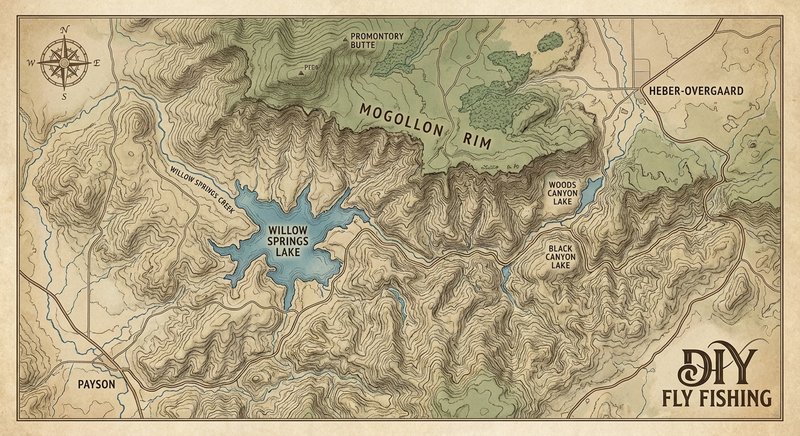
Willow Springs Lake
Fly fishing in Arizona · beginner · Best seasons: spring, summer, fall
Target Species
Rainbow Trout, Brown Trout
About This Water
Rim country lake with good trout population. Forest Service campground provides access.
Fishing Recommendations
Greetings, angler. It’s a pleasure to guide you through one of Arizona’s most scenic high-country fisheries. Perched atop the Mogollon Rim at approximately 7,500 feet, Willow Springs Lake is a premier destination for fly anglers looking to escape the desert heat and find cold-water trout in a stunning alpine setting.
Here is your comprehensive guide to fly fishing Willow Springs Lake.
🎣 Location Overview
Willow Springs Lake is a 158-acre reservoir nestled in the Ponderosa pine forest of the Apache-Sitgreaves National Forest. What makes this water special is its accessibility paired with its rugged beauty. The lake features several long "fingers" or arms, created by flooded canyons, which provide ample shoreline for the walk-and-wade angler and protected coves for those in float tubes or kayaks.
The water is generally clear to stained, depending on recent monsoon activity. Because it is a deep-water canyon lake, it stays cooler longer than other Arizona lakes, making it a reliable trout fishery even when the valley temperatures are soaring.
🐟 Target Species & Behavior
The Arizona Game and Fish Department manages this as a "put-and-take" and "put-and-grow" fishery.
- Rainbow Trout: These are the primary residents. You’ll find plenty of "stockies" (10-12 inches), but the lake also holds "holdovers" that have survived several seasons and grown into the 16-20 inch range. They tend to cruise the shorelines in the morning and retreat to the deeper thermoclines near the dam as the sun rises.
- Brown Trout: While less numerous than Rainbows, the Browns in Willow Springs are the "trophy" prizes. They are predatory and elusive. They hold tight to the submerged timber and the rocky ledges of the canyon walls. They are most active during low-light conditions (dawn/dusk) and in the fall.
- Note: You may also encounter Tiger Trout, which are frequently stocked here and behave much like aggressive Browns.
📅 Best Times to Fish
Seasons
- Spring (Late April – June): This is prime time. As the ice melts and the water warms, trout become hyper-active. They congregate in the shallows to feed after a long winter.
- Summer (July – August): Fishing remains good, but you must adapt to the "Monsoon Pattern." Early mornings are best. Once the sun is high, the fish go deep.
- Fall (September – early November): This is the best window for Brown Trout. As temperatures drop, Browns move into the shallows to prepare for their spawning run, becoming highly aggressive toward streamers.
Time of Day
- Dawn & Dusk: The "Magic Hour" is real here. The surface often turns into glass, and you will see "ring-buoys"—rising fish taking midges or terrestrials.
- Overcast Days: If a storm is brewing (be safe regarding lightning!), the dropping barometric pressure often triggers a feeding frenzy.
🪰 Recommended Flies & Techniques
Top Fly Patterns
- Streamers:
- Simi Seal Leech (Blood Red, Black/Red, or Peacock): The absolute "gold standard" for Arizona rim lakes.
- Woolly Bugger (Size 8-12, Olive or Black): Classic for a reason.
- Nymphs:
- Zebra Midge (Size 18-22, Red or Black): Essential for fishing under an indicator.
- Hare’s Ear or Pheasant Tail (Size 14-16): Great for mimicking the general insect life in the weeds.
- Dry Flies:
- Parachute Adams (Size 16-18): For the evening midge hatches.
- Chernobyl Ant or Foam Hoppers (Size 10-12): Effective in late summer when terrestrials blow off the pines into the water.
Effective Techniques
- The "Slow Strip" (Intermediate Sinking Line): Use a slow, rhythmic 3-inch strip with a Simi Seal Leech. This is the most productive method at Willow Springs. Focus on the transition zones where the shallow flats drop into deep water.
- Indicator Rigging: If the fish are lethargic, hang a Zebra Midge 4–6 feet under a small indicator. Cast near the submerged "islands" or points and let the ripple move the fly.
- Float Tubing: While shore fishing is possible, a float tube or kayak allows you to reach the steep canyon walls and timber-filled coves that shore anglers can't touch.
💡 Pro Tips & Local Knowledge
- Work the Wood: Willow Springs has a lot of submerged timber. Large Brown Trout love to hide in the "sticks." If you aren't losing a fly occasionally, you aren't fishing deep enough into the structure.
- The "Dam" Secret: The deepest water is near the dam. During the heat of the summer, use a Type 3 or Type 5 sinking line to get your flies down 15-20 feet.
- Mid-Day Lull: If the bite dies, head to the narrow northern "arms" of the lake. The shade provided by the canyon walls keeps the water slightly cooler and the fish slightly more active.
- Stealth Matters: On calm mornings, the water is crystal clear. Use long leaders (9-12 feet) and fluorocarbon tippet (5X or 6X) to avoid spooking the larger, more educated holdover trout.
⚠️ Important Information
- Access: Located off Hwy 260, about 23 miles east of Payson. There is a paved road leading to a large parking lot and a boat ramp.
- Regulations: Arizona fishing regulations apply. You must have a valid Arizona Fishing License. There are no "special gear" restrictions (e.g., barbless/artificial only) unless posted, but catch-and-release is encouraged for the Brown Trout population to maintain the trophy quality.
- Boating: Gas motors are restricted to 10 horsepower or less. Most anglers use electric trolling motors or paddle power.
- Safety: The Mogollon Rim is famous for sudden, violent afternoon thunderstorms in the summer. If you hear thunder, get off the water immediately—graphite fly rods are lightning magnets.
Tight lines, and enjoy the beauty of the Rim!
Bug Hatches & Matching Flies
| Hatch | Type | Peak months | Time of day | Hook sizes | Matching flies |
|---|---|---|---|---|---|
| Chironomids (Midges) Chironomidae | midge | April, May, June, September, October | All day (Peak morning) | #12-22 | Zebra Midge #16-20, Ice Cream Cone #12-16, Griffith's Gnat #18-22 |
| Callibaetis (Speckled Duns) Callibaetis pictiventris | mayfly | May, June, July, August | Late Morning to Early Afternoon | #12-16 | Adams #14-16, Hare's Ear Nymph #14-16, Callibaetis Spinner #14-16 |
| Damselfly Enallagma | terrestrial | June, July | Morning to Afternoon | #10-14 | Marabou Damsel Nymph #10-12, Adult Damsel #12-14 |
| Traveling Sedge (Caddis) Hesperophylax | caddis | July, August, September | Late Evening/Dusk | #8-12 | Elk Hair Caddis #10-14, Goddard Caddis #8-12 |
| Carpenter Ants & Beetles Formicidae / Coleoptera | terrestrial | July, August, September | Afternoon | #10-16 | Black Foam Ant #12-16, Peacock Lady Beetle #14-16 |
| Cinnamon Caddis Hydropsyche | caddis | June, July | Evening | #14-18 | Cinnamon Elk Hair Caddis #14-16, LaFontaine's Emerger #16 |
| Dragonfly Nymphs Anisoptera | terrestrial | May, June, July | All day | #6-10 | Dragonfly Nymph (Olive) #6-10, Woolly Bugger (Olive) #8-10 |
| Water Boatmen Corixidae | midge | September, October | Afternoon | #14-18 | Water Boatman #14-16, Prince Nymph #14-18 |