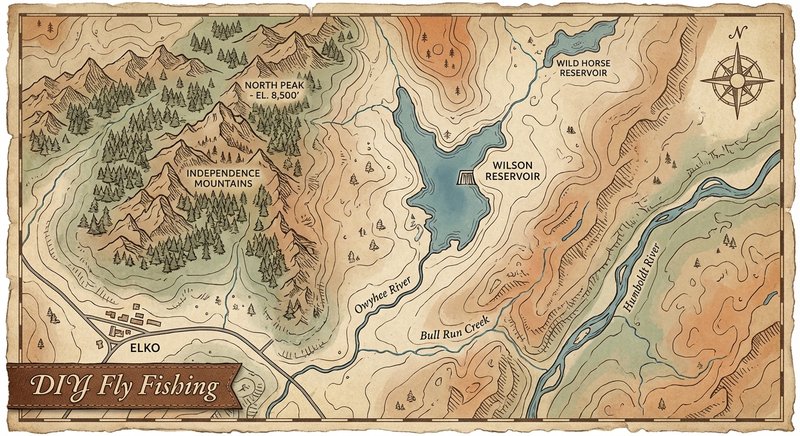
Wilson Reservoir
Fly fishing in Nevada · intermediate · Best seasons: spring, summer, fall
Target Species
Rainbow Trout, Brown Trout
About This Water
Elko County impoundment with trout. Remote northeastern Nevada.
Fishing Recommendations
Welcome to one of the high desert’s best-kept secrets. As a guide who has spent years navigating the interior West, I can tell you that Wilson Reservoir in Elko County, Nevada, is a quintessential "stillwater" gem. Located in the Independence Valley, this reservoir is a nutrient-rich environment that produces hard-fighting, healthy trout.
Here is your comprehensive guide to fly fishing Wilson Reservoir.
🎣 Location Overview
Wilson Reservoir is a high-desert impoundment of the Owyhee River drainage. What makes it special is its productivity. Because it sits in a fertile basin, the water is rich in alkalinity and nutrients, which translates to a massive biomass of insects and scuds.
The reservoir is characterized by its sagebrush-lined shores, occasional rocky outcrops near the dam, and extensive weed beds. It is a classic "stillwater" fishery where the fish grow fast and stay thick. Anglers love it because it offers a "big sky" Nevada experience—remote, quiet, and capable of producing Rainbows in the 18–22 inch range and elusive, trophy-sized Browns.
🐟 Target Species & Behavior
- Rainbow Trout: These are the primary residents. They are active cruisers, often found patrolling the weed edges and drop-offs. In the spring, they move into the shallows to feed; as the water warms, they retreat to the cooler, deeper channels near the old river bed.
- Brown Trout: The "wolves" of Wilson. The Browns here tend to be more light-sensitive and structure-oriented. They hold near the dam’s rip-rap or deep submerged ledges. They are highly piscivorous (fish-eating) once they reach a certain size.
- Feeding Habits: The diet here is dominated by Chironomids (midges), Scuds (freshwater shrimp), Damselflies, and Callibaetis. In the fall, they switch heavily to leeches and smaller baitfish (like young-of-the-year perch or dace).
📅 Best Times to Fish
Optimal Seasons
- Spring (Late April – June): This is the "Prime Time." As the ice clears and the water hits the 50°F mark, the Chironomid hatches are world-class.
- Summer (July – August): Fishing is best in the early morning and late evening. Look for the "Damsel migration" in July—it's some of the most exciting sight-fishing of the year.
- Fall (September – October): My personal favorite time for big Browns. As water temperatures drop, fish move back into the shallows to bulk up for winter.
Prime Windows
- The "Golden Hour": The 60 minutes before sunset is legendary here for surface activity.
- Overcast Days: High desert sun can be intense. On cloudy days, the fish feel more secure and will cruise the top three feet of the water column all day long.
🪰 Recommended Flies & Techniques
Top Fly Patterns
- Chironomids: Ice Candy, Zebra Midges, or Chromies (Sizes 12–18). Use red, black, or silver.
- Scuds: UV Scud in olive or pink (Sizes 14–16).
- Streamers: Balanced Leeches (olive or black), Woolly Buggers, and the "Seal Bugger."
- Dry Flies: Parachute Adams or Callibaetis Cripples (Sizes 14–16) for late morning hatches.
Effective Techniques
- The "Indicator Rig": This is the most effective way to fish Wilson. Suspend a two-fly midge rig (a larger "attractor" midge followed by a smaller "natural") under a slip-indicator. Position your bottom fly about 12–18 inches off the bottom.
- Stripping Streamers: Use an intermediate sinking line. Cast toward the shore or weed edges and use a "strip-strip-pause" retrieve. The pause is usually when the strike happens.
- Damsel Tactics: During mid-summer, fish a floating line with a long leader and an unweighted Damsel nymph. Retrieve with short, erratic pulses to mimic the swimming motion of the natural insect.
💡 Pro Tips & Local Knowledge
- Bring a Watercraft: While you can catch fish from the bank near the dam, Wilson is best fished from a float tube, pontoon, or small boat. The shoreline can be muddy and choked with cattails, making backcasting difficult.
- The "Bubble Line": On windy days (which is most days in Nevada), look for "foam lines" or "bubble lines" created by the wind. These lines concentrate plankton and insects. Trout will cruise directly underneath these lines like a conveyor belt of food.
- Focus on the Old River Channel: Use a fish finder or a topographic map to locate the submerged Owyhee River channel. In the heat of summer, the fish stack up in this slightly deeper, cooler water.
- Watch the Wind: The wind can kick up violently in the afternoon. Always keep an eye on the horizon; if you see whitecaps, head for the ramp immediately.
⚠️ Important Information
- Access: Wilson Reservoir is remote. The access roads are dirt/gravel and can become impassable gumbo mud after heavy rain or snowmelt. A high-clearance vehicle is recommended.
- Regulations: A valid Nevada Fishing License is required. Check the Nevada Department of Wildlife (NDOW) for current bag limits, as they can change based on water levels and stocking schedules.
- Facilities: There is a primitive campground with a vault toilet, but no running water or electricity. Pack in what you need and Pack Out Everything.
- Cell Service: Virtually non-existent. Let someone know your plan before you head out into the Independence Valley.
Guide’s Final Word: Wilson Reservoir rewards the patient angler who masters the "slow" game. Don't be afraid to let your flies sit still under an indicator for minutes at a time. When that indicator twitches, hang on—these high-desert trout have some serious shoulders!
Bug Hatches & Matching Flies
| Hatch | Type | Peak months | Time of day | Hook sizes | Matching flies |
|---|---|---|---|---|---|
| Chironomids Chironomidae | midge | April, May, October | All Day | #12-22 | Zebra Midge #16-20, Ice Cream Cone #14-18, Griffith's Gnat #18-22 |
| Callibaetis Callibaetis nigritus | mayfly | June, July | Late Morning/Afternoon | #12-16 | Hare's Ear Nymph #14-16, Parachute Adams #14-16, Callibaetis Spinner #16 |
| Damselflies Enallagma | other | June, July | Late Morning/Afternoon | #10-14 | Marabou Damsel Nymph #10-12, Adult Damsel #12-14 |
| Traveling Sedge Hesperophylax | caddis | July, August | Evening | #8-12 | Goddard Caddis #10-12, Elk Hair Caddis #12-14 |
| Scuds Gammarus | other | May, September | All Day | #12-16 | Ray Charles #14-16, Flashback Scud #12-16 |
| Grasshoppers Acrididae | terrestrial | August, September | Afternoon | #8-12 | Morrish Hopper #10-12, Joe's Hopper #8-12 |
| Water Boatmen Corixidae | other | September, October | Afternoon | #14-18 | Boatman Pattern #14-16, Prince Nymph #14-18 |
| Dragonflies Anisoptera | other | July, August | Morning/Afternoon | #6-10 | Dragon Mylar #6-10, Woolly Bugger (Olive) #8-10 |