Wind River
Fly fishing in Washington · Intermediate · Best seasons: Summer, Fall
Target Species
Steelhead
About This Water
Columbia Gorge stream with summer steelhead. Clear water in scenic canyon setting.
Fishing Recommendations
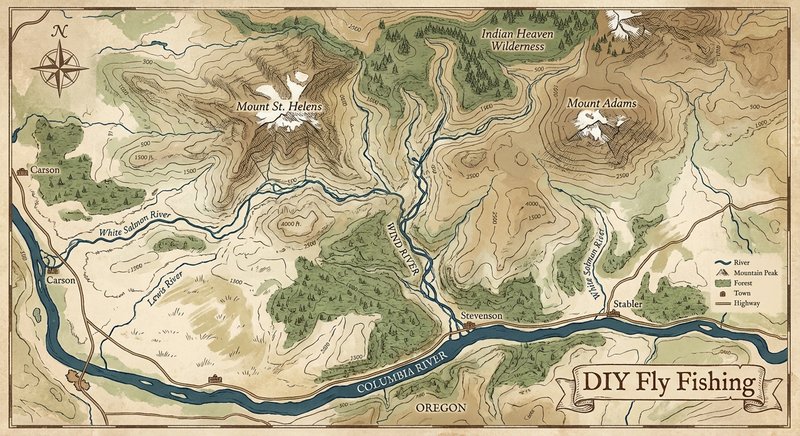
The Wind River is one of the crown jewels of the Columbia River Gorge. Flowing through a dramatic, forested canyon near Carson, Washington, it is a high-gradient, boulder-choked system that offers some of the most challenging and rewarding steelhead fishing in the Pacific Northwest.
As your guide, here is everything you need to know to tackle the "Wind."
🎣 Location Overview
The Wind River is legendary for its Skamania-strain Summer Steelhead. Unlike many coastal rivers that are wide and gravelly, the Wind is a rugged, mountain-style stream. It is characterized by deep basalt canyons, turbulent whitewater, and classic "pocket water."
Anglers love the Wind because it is a "proving ground." The fish are notoriously strong, and the terrain is demanding. Because the river is cooled by mountain springs and shaded by deep canyons, it remains fishable even when other Columbia tributaries become too warm in the mid-summer heat.
🐟 Target Species & Behavior
The primary draw here is the Summer Steelhead. These fish enter the system starting in May, but the bulk of the run settles in during the summer months.
- Aggression: Skamania steelhead are famous for their aggression. They are more likely to chase a swung fly or rise to a dry line than almost any other strain of steelhead.
- Holding Patterns: Because the Wind is high-gradient, fish hold in places that provide relief from the current. Look for the "cushion" in front of large boulders, the tail-outs of deep pools, and the seams where fast water meets slow water.
- The "Thermal Refuge": During the hottest parts of the summer, steelhead from the Columbia River will often duck into the mouth of the Wind River to seek cooler water, even if they aren't spawning there. This creates high concentrations of fish in the lower river.
📅 Best Times to Fish
- Optimal Months: July through September is the prime window. While fish enter in June, the water levels are often too high and dangerous for wading. By July, the flows drop, exposing the boulder gardens where fly anglers excel.
- Best Time of Day: "First light or bust." Steelhead in the Wind are very light-sensitive. The best fishing usually occurs from 30 minutes before sunrise until the sun hits the water. Once the sun is high, these fish retreat into the deepest shadows or under large boulders.
- Conditions: Look for a stable or slightly dropping river flow. If a summer rainstorm "blows out" the river, wait 24 hours—the Wind clears quickly due to its rocky bottom.
🪰 Recommended Flies & Techniques
The Wind River is a "swing" fisher's paradise, but you must be versatile.
1. The Swung Fly (Spey or Single Hand)
This is the traditional way to fish the Wind. Use a floating line or a light sink tip (MOW tips in T-8 or T-11).
- Top Patterns: Green Butt Skunk, Street Cleaner, Purple Peril, and any variation of a "Max Canyon."
- Pro Secret: Use skating dry flies (like a Foam Waller Walker) in the early morning. Seeing a summer steelhead explode on the surface in a canyon is the pinnacle of the sport.
2. Nymphing (Indicator or Euro)
In the deep, turbulent slots where a swung fly can't reach, an indicator rig is deadly.
- Top Patterns: Life-like stonefly nymphs (Size 6-10), Jigged Beads, and "The Standard" (Red or Black Copper John).
- Technique: Use plenty of weight to get down fast in the heavy current.
3. Presentation Tips
- Shorten your casts: You don't need to cast 80 feet. Most fish are held in the "buckets" right at your feet or just past the first break.
- Mend Deep: If swinging, ensure you have a good belly in the line to keep the fly deep through the middle of the run.
💡 Pro Tips & Local Knowledge
- The "Creep": Because the water is incredibly clear, steelhead can see you from a distance. Move slowly and avoid wearing bright colors. Stealth is mandatory.
- Focus on the Lower River: The area near the "High Bridge" and the mouth are popular, but don't be afraid to hike. The further you get from the easy access points, the less pressured the fish are.
- Wading Safety: Warning: The rocks in the Wind are notoriously slick and unstable. Felt soles (where legal) or high-quality rubber with aluminum studs are non-negotiable. A wading staff is highly recommended.
- The "Columbia Influence": Pay attention to the Columbia River pool levels. If the Columbia is high, it can "back up" the lower mile of the Wind, changing the flow dynamics.
⚠️ Important Information
- Regulations: The Wind River has very specific regulations that can change yearly. It is typically barbless hooks only.
- Wild Fish: You must release all wild (unclipped) steelhead. Only hatchery fish (clipped adipose fin) may be retained.
- Access: Much of the river is accessed via the Gifford Pinchot National Forest roads. Be prepared for steep descents into the canyon. Some areas near the mouth are private or tribal land—always check signage.
- Thermal Closures: Occasionally, Washington Department of Fish and Wildlife (WDFW) will close the river if water temperatures exceed 70°F to protect the fish. Always check the WDFW Emergency Rules before heading out.
Guide’s Final Word: The Wind River isn't about high numbers; it's about the quality of the environment and the sheer power of the fish. Bring a 7-weight rod, a sturdy pair of boots, and your "A-game." Tight lines!
Bug Hatches & Matching Flies
| Hatch | Type | Peak months | Time of day | Hook sizes | Matching flies |
|---|---|---|---|---|---|
| March Brown Rhithrogena morrisoni | mayfly | March, April | Afternoon | #12-14 | March Brown Parachute #12-14, Hare's Ear Nymph #12-14, March Brown Emerger #14 |
| Blue Winged Olive (BWO) Baetis | mayfly | March, April, September, October | Afternoon | #18-22 | Parachute Adams #18-22, RS2 #20, Pheasant Tail Nymph #18-20 |
| Golden Stonefly Hesperoperla pacifica | stonefly | June, July | All Day | #8-12 | Chubby Chernobyl (Gold) #8-12, Pat's Rubber Legs #8-12, Golden Stone Nymph #10 |
| Grannom Caddis Brachycentrus | caddis | April, May | Late Afternoon/Evening | #14-16 | Peacock Caddis #14-16, Deep Sparkle Pupa #14-16, Elk Hair Caddis (Dark) #14-16 |
| Pale Morning Dun (PMD) Ephemerella excrucians | mayfly | June, July, August | Morning/Afternoon | #16-18 | PMD Parachute #16-18, Split Case PMD #16-18, Trigger Finger PMD #16-18 |
| Salmonfly Pteronarcys californica | stonefly | May, June | All Day | #4-8 | Clark's Stone #6-8, Kaufmann's Stone Nymph #4-8, Morning Wood Stone #6 |
| October Caddis Dicosmoecus atripes | caddis | September, October | Late Afternoon | #8-12 | Orange Stimulator #8-10, October Caddis Pupa #10-12, Morrish October Caddis #8-10 |
| Spotted Sedge Hydropsyche | caddis | July, August, September | Evening | #14-16 | Elk Hair Caddis (Tan) #14-16, LaFontaine's Emergent Sparkle Pupa #14-16, Z-Wing Caddis #14-16 |