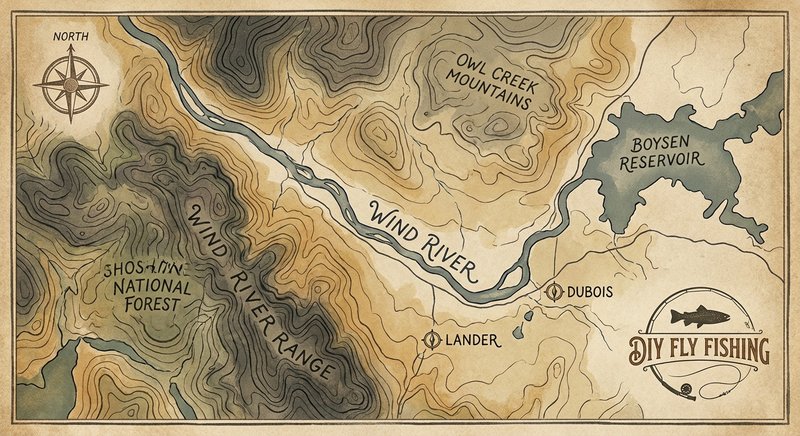
Wind River
Fly fishing in Wyoming · Intermediate · Best seasons: Summer, Fall
Target Species
Rainbow Trout, Brown Trout, Cutthroat Trout
About This Water
Central Wyoming river with diverse trout fishing. Flows through Wind River Canyon.
Fishing Recommendations
The Wind River in Wyoming is one of the most diverse and rugged fly fishing destinations in the American West. Flowing from the high peaks of the Absaroka and Wind River Ranges down through the high desert and into the deep, red-walled Wind River Canyon, it offers a dramatic variety of water types. Whether you are fishing the freestone stretches near Dubois or the legendary tailwater section in the Canyon, the Wind River is a "bucket list" destination for anglers seeking solitude and hard-fighting trout.
🎣 Location Overview
The Wind River is unique because it essentially changes names. It flows as the Wind River until it reaches the "Wedding of the Waters" near Thermopolis, where it becomes the Bighorn River.
The fishing is generally divided into three distinct sections:
- The Upper Wind (Dubois area): A classic high-country freestone river. It’s characterized by cobble bottoms, riffles, and deep undercut banks.
- The Middle Wind (Reservation land): Large, meandering water flowing through the Wind River Indian Reservation.
- The Wind River Canyon: A world-class tailwater fishery below Boysen Reservoir. This section is famous for its massive trout and stunning 2,000-foot limestone walls.
Anglers love this water because it remains less pressured than the nearby Snake or Madison rivers, offering a true "Wild West" fishing experience with high fish counts and impressive average sizes.
🐟 Target Species & Behavior
- Brown Trout: The "kings" of the Wind River Canyon. They are predatory and territorial. In the fall, they become aggressive and move toward gravel bars for the spawn. Look for them in deep pools and near structure.
- Rainbow Trout: Known for their aerial acrobatics, the rainbows here are thick-bodied and powerful. In the Upper Wind, they hold in faster oxygenated water; in the Canyon, they hang in the seams and foam lines.
- Cutthroat Trout (Yellowstone & Snake River varieties): Primarily found in the Upper Wind and its tributaries. They are opportunistic feeders and are often the first to rise to a dry fly.
- Feeding Behavior: These fish are keyed into heavy hatches of Baetis, Caddis, and Pale Morning Duns (PMDs). In the late summer, they become highly focused on terrestrials (grasshoppers) along the grassy banks of the Upper Wind.
📅 Best Times to Fish
Summer (July - August)
- Window: This is prime time for the Upper Wind once the spring runoff subsides (usually by early July).
- Time of Day: Early morning and late evening are best for dry fly action. Mid-day is great for hopper-dropper rigs.
- Conditions: Clear water and stable flows.
Fall (September - October)
- Window: Perhaps the best time for trophy hunters. The crowds disappear, and the Brown Trout start their pre-spawn aggressive phase.
- Time of Day: 10:00 AM to 4:00 PM. The warmer part of the day triggers BWO hatches.
- Conditions: Low, clear water. The Canyon section is particularly productive in the fall as water temperatures stabilize.
🪰 Recommended Flies & Techniques
Top Fly Patterns
- Dry Flies: Chubby Chernobyl (Size 8-12, Gold or Tan), Parachute Adams (14-18), Elk Hair Caddis (14-16), and Amy's Ant.
- Nymphs: Pat’s Rubber Legs (Size 8-12, Coffee/Black), Prince Nymph (12-14), Pheasant Tail (16-18), and San Juan Worms (Red).
- Streamers: Gold Beadheaded Woolly Buggers, Sex Dungeon (Olive or White for the Canyon), and the Sparkle Minnow.
Effective Techniques
- The "Hopper-Dropper": In August and September, use a large foam grasshopper as your indicator with a 2-foot dropper to a Pheasant Tail or Copper John.
- Streamer Stripping: In the Canyon, use a sink-tip line and "pound the banks." Use an erratic strip-set to entice big Browns.
- Dead-Drift Nymphing: In the deeper runs of the Canyon, use a standard two-nymph rig under an indicator. Ensure you have enough weight (split shot) to get to the "zone" quickly—the current in the Canyon is deceptively heavy.
💡 Pro Tips & Local Knowledge
- The Wind is Real: The river isn't named "Wind" by accident. Be prepared to cast into 20mph gusts. Use a 6-weight rod for the Canyon to punch through the wind and handle larger streamers.
- Upper Wind Secret: Focus on the "pocket water" around the town of Dubois. Many anglers overlook the town stretches, but the undercut banks there hold surprisingly large Browns.
- The "Canyon Crawl": In the Wind River Canyon, trout often hold much closer to the bank than you think. Before wading deep, fish the "first seam" only a few feet from the shore.
- Watch the Flows: Always check the USGS gauge for "Wind River near Dubois" or "Below Boysen Reservoir." If the Canyon flows are above 2,000 cfs, wading becomes dangerous; 700-1,200 cfs is the "sweet spot" for wading.
⚠️ Important Information
Access & Permits
- Upper Wind: Much of the water near Dubois is public (National Forest) or has BLM access points.
- Wind River Reservation: Large portions of the river flow through the Wind River Indian Reservation. A Wyoming state fishing license is NOT valid here. You must purchase a specific Tribal Fishing Permit from local vendors in Dubois, Thermopolis, or Lander.
- Wind River Canyon: This is entirely on Tribal Land. You must have a Tribal Permit. Furthermore, if you wish to fish the Canyon, you are legally required to be accompanied by a permitted Tribal Guide if you are not a tribal member, though some highway pull-offs allow for limited shore access with just the permit (check current tribal bylaws as these can change).
Regulations
- Always check the current Wyoming Game & Fish Department regulations for the Upper Wind.
- Many sections are "Artificial Lures and Flies Only."
- Practice Catch and Release to preserve these wild genetics, especially for the native Cutthroat.
Safety
- Grizzly Bear Country: The Upper Wind is grizzly territory. Always carry bear spray and know how to use it.
- Rattlesnakes: Common in the dry, rocky areas of the Wind River Canyon during summer. Watch your step when hiking to the water.
Bug Hatches & Matching Flies
| Hatch | Type | Peak months | Time of day | Hook sizes | Matching flies |
|---|---|---|---|---|---|
| Salmonfly Pteronarcys californica | stonefly | June, July | All Day | #4-8 | Rogue River Stone #4-6, Pat's Rubber Legs #6-8, Cat Puke #4-8 |
| Blue Winged Olive Baetis | mayfly | April, May, September, October | Midday | #18-22 | RS2 #20-22, Parachute Adams #18-22, Pheasant Tail #18-20 |
| Pale Morning Dun Ephemerella | mayfly | July, August | Late Morning/Afternoon | #14-18 | PMD Sparkle Dun #16-18, Split Case PMD #16-18, Mercury PMD #16-18 |
| Golden Stonefly Hesperoperla pacifica | stonefly | July | All Day | #8-12 | Chubby Chernobyl (Gold) #8-12, Golden 20-Incher #10-12, Halfback #8-12 |
| Mother's Day Caddis Brachycentrus | caddis | May | Afternoon/Evening | #14-16 | Peacock Caddis #14-16, Z-Wing Caddis #14-16, LaFontaine's Deep Sparkle Pupa #14-16 |
| Trico Tricorythodes | mayfly | August, September | Early Morning | #20-24 | Trico Spinner #22-24, Drowned Trico #22-24 |
| Grasshoppers Orthoptera | terrestrial | August, September | Late Morning/Afternoon | #6-12 | Morrish Hopper #8-12, Amy's Ant #10-12, Rainy's Grand Hopper #6-10 |
| Midges Chironomidae | midge | February, March, April | Late Morning | #18-24 | Zebra Midge #18-22, Griffith's Gnat #20-22, Top Secret Midge #20-22 |