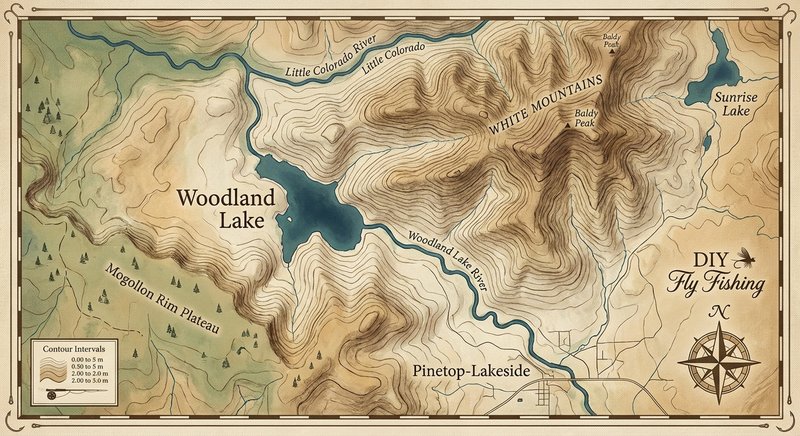
Woodland Lake
Fly fishing in Arizona · beginner · Best seasons: spring, summer, fall
Target Species
Rainbow Trout
About This Water
Pinetop-Lakeside town lake. Easy access with stocked trout.
Fishing Recommendations
As an expert guide with years of experience navigating the high-country waters of the Mogollon Rim, I can tell you that Woodland Lake in Pinetop-Lakeside is one of the most accessible and productive "urban-adjacent" trout fisheries in Arizona. While it sits right in the heart of town, its elevation (approx. 7,000 ft) and heavy stocking program make it a staple for fly anglers looking for a consistent bite.
🎣 Location Overview
Woodland Lake is the centerpiece of Woodland Lake Park. It is a relatively shallow, fertile impoundment characterized by heavy weed growth in the warmer months and a shoreline lined with ponderosa pines and reeds.
What makes this water special is its accessibility. Unlike some of the more remote lakes in the White Mountains, you can pull up, hike a short distance, and be on the water. It is a "social" fishery, but for the fly angler, it offers excellent opportunities for sight-fishing in the shallows and high-volume catching during the spring and fall stocking cycles. The water is generally stained to murky, which influences fly selection toward darker profiles and flashier attractors.
🐟 Target Species & Behavior
The primary draw here is the Rainbow Trout.
- Behavior: These are primarily hatchery-raised fish, meaning they are often gregarious and move in "pods." They cruise the shoreline edges, particularly near the dam and the fishing piers.
- Holding Areas: Look for trout near the "drop-offs" where the shallow shelf meets the deeper channel. In the heat of summer, they retreat to the center of the lake near the aerators or the dam where the water is deepest and coolest.
- Feeding: They feed heavily on midges (chronomids), small damselfly nymphs, and the occasional terrestrial (ants/beetles) blown off the pines. Because it’s a park lake, they are also accustomed to "unnatural" food sources, making flashy attractor patterns very effective.
📅 Best Times to Fish
- Spring (April – June): Prime Time. This is the peak stocking window. The water is cool, and the fish are aggressive. This is when you'll see the best dry fly action.
- Summer (July – August): Fishing slows down during the heat of the day. Stick to the "Golden Hours" (dawn and dusk). Expect heavy monsoon rains in the afternoons—this can actually trigger a feeding frenzy as insects are washed into the lake.
- Fall (September – November): Another fantastic window. As water temperatures drop, the trout become more active in the shallows again to bulk up for winter.
- Best Time of Day: First light is king here. The wind is usually calm, allowing for delicate dry fly presentations before the afternoon breezes kick up.
🪰 Recommended Flies & Techniques
Top Fly Patterns
- Nymphs:
- Zebra Midge (Size 18-22) in Black/Silver or Red/Silver.
- Bead-head Prince Nymph (Size 14-16) – the flash attracts hatchery fish.
- Hare’s Ear Nymph (Size 14-16) – mimics the natural scuds and nymphs in the weeds.
- Streamers:
- Woolly Bugger (Size 10-12) in Olive, Black, or White.
- Simi Seal Leech (Blood Leech or Peacock colors) – an Arizona staple.
- Dry Flies:
- Parachute Adams (Size 16-18).
- Ant/Beetle patterns (Size 14) during summer afternoons.
Techniques & Presentation
- The "Indy" Rig: Suspend a Zebra Midge or a small Pheasant Tail 3–5 feet under a yarn indicator. Twitch it slightly to give it life.
- The Slow Strip: Using a clear intermediate sinking line, cast a Woolly Bugger or Simi Seal Leech toward the weed edges and use a slow, 2-inch "trout strip" retrieval.
- Dry-Dropper: In the spring, run a Parachute Adams with a small midge dropper 18 inches below it.
💡 Pro Tips & Local Knowledge
- The "Wall" and the Dam: The deepest water is near the dam. If the sun is high and the fish aren't in the shallows, head to the dam and use a sinking line to get your flies down 8–10 feet.
- Identify the "Lanes": The lake has significant weed growth. Don't fight the weeds; look for the "lanes" or openings in the vegetation. Trout use these as highways to patrol for food.
- Float Tubes: While you can fish from the bank, a float tube or kayak is a massive advantage at Woodland. It allows you to fish the "back" side of the weed beds where the fish feel less pressure from the shore anglers.
- The "Bread" Factor: Because it's a public park, fish are sometimes conditioned to white/light-colored objects. A white Woolly Bugger or a "Mop Fly" can be surprisingly deadly here.
⚠️ Important Information
- Access: Located off Woodland Lake Road in Pinetop-Lakeside. There is ample parking, restrooms, and a developed trail system around the lake.
- Regulations: An Arizona Fishing License is required for those 10 years and older. You can purchase these online via the Arizona Game and Fish Department (AZGFD).
- Vessel Rules: Non-motorized boats or boats with electric motors are allowed. No gas engines.
- Keep it Clean: This is a high-traffic community park. Please practice "Leave No Trace" and pack out any discarded tippet or trash.
Guide’s Final Take: Woodland Lake won't usually yield a "trophy of a lifetime," but for a fun day of high-volume catching in a beautiful mountain setting, it’s hard to beat. It’s the perfect place to introduce a beginner to the sport or to squeeze in a few hours of therapy before dinner.
Bug Hatches & Matching Flies
| Hatch | Type | Peak months | Time of day | Hook sizes | Matching flies |
|---|---|---|---|---|---|
| Chironomids (Midges) Family Chironomidae | midge | April, May, June, September, October | All Day | #12-22 | Zebra Midge #16-20, Chironobead #12-16, Griffith's Gnat #18-22 |
| Callibaetis (Speckled Duns) Callibaetis ferrugineus | mayfly | June, July, August | Late Morning/Afternoon | #12-16 | Callibaetis Spinner #14-16, Hare's Ear Nymph #12-16, Mercer's Poxyback Callibaetis #14-16 |
| Damselflies Suborder Zygoptera | terrestrial | June, July | Morning/Afternoon | #10-14 | Marabou Damsel #10-14, Adult Damsel #12-14, Braided Butt Damsel #12-14 |
| Dragonflies Suborder Anisoptera | terrestrial | July, August | All Day | #4-10 | Dragonfly Nymph #6-10, Woolly Bugger (Olive/Brown) #4-10, Gumdrop Dragonfly #8-10 |
| Water Boatmen & Backswimmers Families Corixidae & Notonectidae | terrestrial | September, October | Afternoon | #14-18 | Water Boatman #14-16, Prince Nymph #14-18, Backswimmer #12-14 |
| Cinnamon Caddis Family Leptoceridae | caddis | July, August, September | Evening | #14-18 | Elk Hair Caddis #14-18, LaFontaine's Emerger #16-18, Cinnamon Sedge #14-16 |
| Terrestrial Ants and Beetles Formicidae & Coleoptera | terrestrial | July, August | Afternoon | #12-18 | Black Foam Ant #14-18, Cinnamon Ant #14-16, Foam Beetle #12-16 |
| Scuds (Freshwater Shrimp) Order Amphipoda | terrestrial | March, April, October, November | All Day | #12-18 | Ray Charles #14-18, Olive Scud #12-16, Orange Scud #14-16 |