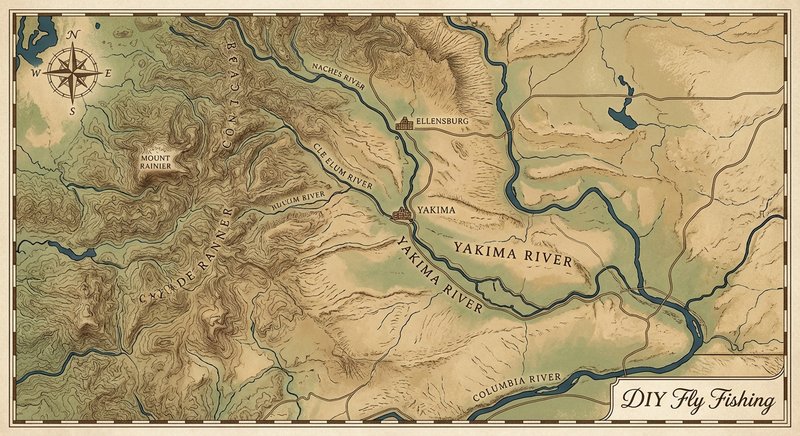
Yakima River
Fly fishing in Washington · Intermediate · Best seasons: Spring, Summer, Fall
Target Species
Rainbow Trout, Cutthroat Trout
About This Water
Blue-ribbon trout water in central Washington. Excellent dry fly fishing with prolific hatches throughout the season.
Fishing Recommendations
Welcome to the "Yak," Washington’s premier blue-ribbon trout stream. As the only river in the state designated as a Blue Ribbon fishery, the Yakima offers a unique high-desert fly fishing experience that rivals the famous tailwaters of Montana and Idaho.
🎣 Location Overview
The Yakima River flows from the snowmelt of the Cascade Mountains through a diverse landscape of alpine forests, lush farmlands, and dramatic basalt canyons. For fly anglers, the "Upper Yakima" (from Cle Elum to Ellensburg) and the "Yakima Canyon" (from Ellensburg to Roza Dam) are the crown jewels.
What makes it special is its tailwater nature. Controlled by several dams, the river’s flow is managed for irrigation, creating a "reverse cycle" known as the "Flip-Flop." It is a large, powerful river, best fished from a drift boat or raft, though wading is possible in certain sections during lower flows. The scenery in the Yakima Canyon, with its 1,000-foot towering basalt cliffs and bighorn sheep, is as much a draw as the fishing.
🐟 Target Species & Behavior
- Rainbow Trout: These are the stars of the show. Yakima Bows are wild, athletic, and famous for their "hot" runs. They thrive in the heavy oxygenated riffles and deep seams.
- Westslope Cutthroat: Found more frequently in the upper reaches and near cold-water tributaries. They are opportunistic feeders and often the first to rise to a dry fly.
- Behavior: Due to the river's heavy current, Yakima trout are "structure oriented." They hold tight to the banks, behind submerged basalt boulders, and in the "walking speed" water of the seams. During the summer high flows, the fish move right against the grass lines to escape the heavy mid-channel current.
📅 Best Times to Fish
- Spring (March – May): This is the window for the legendary Skwala Stonefly hatch. It’s the first big bug of the year. You’ll also see Blue Winged Olives (BWO) and March Browns.
- Summer (June – August): The "Big Water" season. Flows are high for irrigation, pushing fish to the banks. This is prime Terrestrial time (grasshoppers, ants, beetles) and Caddis season.
- Fall (September – November): My personal favorite. The "Flip-Flop" occurs in early September—water levels drop significantly, making the river very wadeable. You get the October Caddis hatch and the return of BWOs.
- Prime Window: On the Yakima, the "Golden Hour" in the summer is spectacular, but during the Spring and Fall, the best fishing is usually from 11:00 AM to 4:00 PM when the water warms.
🪰 Recommended Flies & Techniques
Top Fly Patterns
- Nymphs: Pat’s Rubber Legs (Black/Tan or Olive/Brown) is the undisputed king here. Also, Lightning Bugs, Copper Johns, and San Juan Worms.
- Dry Flies:
- Spring: Skwala Stonefly patterns (size 8-10), Parachute Adams (size 14-18).
- Summer: Chubby Chernobyls (Gold, Royal, or Purple), Morrish Hopper, Elk Hair Caddis.
- Fall: October Caddis (size 8-10), Blue Winged Olive patterns (size 18-20).
- Streamers: Sculpzilla or Sparkle Minnows in olive or white.
Techniques
- The Hopper-Dropper: This is the standard Yakima rig. Fish a large, buoyant dry fly (like a Chubby) with a Pat’s Rubber Legs hanging 2–4 feet below it.
- Indicator Nymphing: In the deep canyon runs, use a heavy tungsten bead nymph to get down fast in the swirling basalt pockets.
- Bank Banging: When drifting in the summer, you must land your fly within inches of the grassy bank. If you’re a foot off, you’re out of the strike zone.
💡 Pro Tips & Local Knowledge
- Respect the Wind: The Yakima Canyon is a natural wind tunnel. If you see whitecaps, don't fight it—switch to a 6-weight rod with a fast action to punch through the gusts.
- The "Walking Speed" Rule: If you aren't sure where to cast, look for water that is moving at the speed of a brisk walk. This is where the Yakima’s trout prefer to hold and feed.
- The Basalt Ledges: In the Canyon, the underwater topography is made of jagged basalt shelves. Fish will sit right on the drop-off of these ledges. If your fly transitions from shallow to deep, be ready for a strike.
- Wading Caution: The rocks in the Yakima are incredibly slick (the "Yakima Grease"). I highly recommend felt soles with studs and a wading staff.
⚠️ Important Information
- Regulations: The Yakima River is Catch and Release only for all trout from the Roza Dam up to the Keechelus Dam. It is Selective Gear Rules only (single point barbless hooks, no bait).
- Access:
- The Canyon: Hwy 821 (Canyon Road) has numerous access points like Umtanum, Ringer, and Roza.
- The Upper: Access is found near the towns of Cle Elum, South Cle Elum, and Thorp.
- Permits: You will need a standard Washington State Freshwater Fishing License. If parking at state-managed sites (WDFW), you will need a Discover Pass.
- Jet Boats: Be aware that you will occasionally see jet boats in the lower canyon sections; give them space, and they will generally stay in the deep channels.
The Yakima is a "thinking person's river." It challenges your casting and your reading of the water, but when you hook into a 18-inch wild Rainbow in the heart of the canyon, you'll understand why we call it home. Tight lines!
Bug Hatches & Matching Flies
| Hatch | Type | Peak months | Time of day | Hook sizes | Matching flies |
|---|---|---|---|---|---|
| Skwala Stonefly Skwala americana | stonefly | February, March, April | Afternoon | #8-12 | Skwala Stone #10-12, Pat's Rubber Legs #8-12, Bullet Head Skwala #10-12 |
| Blue Winged Olive Baetis tricaudatus | mayfly | March, April, September, October | Afternoon | #16-22 | Sparkle Dun #18-20, Pheasant Tail #16-20, RS2 #18-22 |
| March Brown Rhithrogena morrisoni | mayfly | April, May | Afternoon | #12-14 | Western March Brown #12-14, Hare's Ear Nymph #12-14 |
| Salmonfly Pteronarcys californica | stonefly | May, June | All Day | #4-8 | Chubby Chernobyl #6-8, Cat Puke #6-8, Jimmy Legs #4-8 |
| Golden Stonefly Hesperoperla pacifica | stonefly | June, July | Morning/Evening | #8-12 | Rogue Foam Stone #8-10, Golden Pat's Stone #8-12 |
| Pale Morning Dun Ephemerella excrucians | mayfly | June, July, August | Morning/Early Afternoon | #16-18 | Parachute PMD #16-18, Split Case PMD #16-18, PMD Cripple #16-18 |
| Yellow Sally Isoperla | stonefly | June, July, August | Evening | #14-16 | Yellow Sally Foam #14-16, Little Yellow Sloan #14-16 |
| Spotted Sedge (Caddis) Hydropsyche | caddis | June, July, August, September | Evening | #14-18 | Elk Hair Caddis #14-18, LaFontaine's Deep Sparkle Pupa #14-16, Iris Caddis #16-18 |