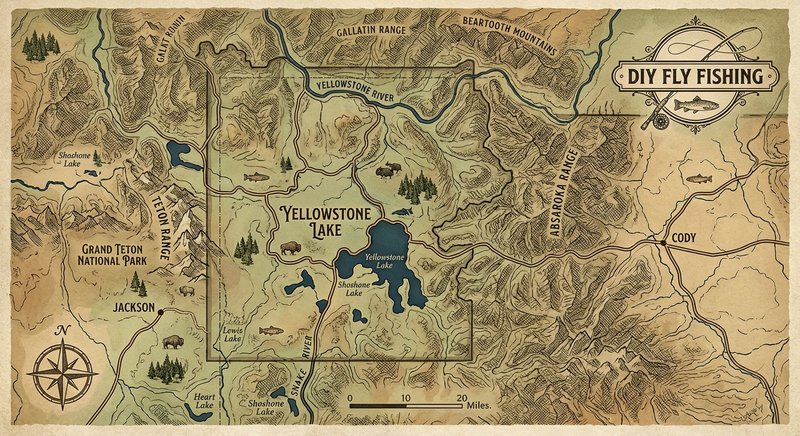
Yellowstone Lake
Fly fishing in Wyoming · Intermediate · Best seasons: Summer, Fall
Target Species
Cutthroat Trout, Lake Trout
About This Water
Largest high-altitude lake in North America. Native cutthroat trout fishery.
Fishing Recommendations
As your guide to the legendary waters of the West, it is a privilege to discuss Yellowstone Lake. Sitting at 7,733 feet above sea level, it is the largest high-elevation lake in North America. This isn't just a lake; it’s a volcanic caldera—an inland sea that serves as the ancestral home of the Yellowstone Cutthroat Trout.
Fishing here is a bucket-list experience, blending raw geothermal beauty with the chance to catch one of the most beautiful native salmonids in existence.
🎣 Location Overview
Yellowstone Lake is the "beating heart" of Yellowstone National Park. Covering 132 square miles with 110 miles of shoreline, it is a massive, cold, and often volatile body of water. What makes it special is the clarity of the water and the sight-fishing opportunities along its rocky points and sandy flats.
The water is crystal clear, allowing you to see cruising trout against the pale volcanic sand. However, it is also dangerous; the water temperature averages 41°F (5°C), and sudden winds can create 4-foot swells in minutes. Anglers love it for the solitude—if you are willing to hike a mile from the road, you can have miles of shoreline to yourself.
🐟 Target Species & Behavior
Yellowstone Cutthroat Trout (Native)
- Behavior: These are "cruisers." Unlike river trout that hold in one spot, lake cutthroats patrol the shoreline in search of food. They are often found in water less than 10 feet deep.
- Feeding: They focus on scuds, damselfly nymphs, callibaetis mayflies, and terrestrial insects (beetles/ants/hoppers) blown in from the forest.
Lake Trout (Invasive)
- Behavior: An invasive species that preyed heavily on the Cutthroat population. They prefer deep, cold water.
- Feeding: They are piscivorous (fish-eaters). During the heat of summer, they stay deep (60–100+ feet), but in the early season and late fall, they move into the shallows where they are accessible to fly anglers.
📅 Best Times to Fish
- The Season: The lake typically opens to fishing on June 15th and runs through October.
- Summer (July – August): This is the prime window for Cutthroat. The water has warmed enough to trigger insect hatches. Morning and late evening are best when the wind is calm.
- Fall (September – October): This is the trophy window. As water temperatures drop, larger Cutthroat return to the shallows. Crucially, this is when Lake Trout move into shallow water to spawn, making them catchable on streamers from the shore.
- Prime Window: 8:00 AM to 11:00 AM. Before the "afternoon wind" kicks up, the water is glass-calm, allowing for perfect sight-casting to cruising fish.
🪰 Recommended Flies & Techniques
Top Fly Patterns
- Dries: Chubby Chernobyl (Size 10-12) in gold or tan, Parachute Adams (Size 14-16), and Dave’s Hopper.
- Terrestrials: Black Foam Ants and Beetles are essential in August.
- Nymphs/Sub-surface: Gold Ribbed Hare’s Ear (Size 14), Flashback Pheasant Tail, and especially Scud patterns in olive or orange (Size 14-16).
- Streamers: Woolly Buggers (Black or Olive), Thin Mints, and white Zonkers (to mimic small fish for Lake Trout).
Effective Techniques
- Sight Casting (The "Stalk"): Walk the shoreline slowly. When you spot a cruising Cutthroat, lead the fish by 3–5 feet. If you land the fly on its head, it will spook.
- The "Duo" Rig: A high-visibility dry fly (like a Chubby) with a 24-inch dropper to a weighted scud. This covers both surface feeders and those rooting in the rocks.
- The Slow Strip: When using streamers for Lake Trout in the fall, use a sinking tip line and a "strip-strip-pause" retrieve near rocky drop-offs.
💡 Pro Tips & Local Knowledge
- Focus on Inlets: Focus your energy near the mouths of the many small tributary streams (check regulations, as some are closed to protect spawning). These areas bring in fresh oxygen and nutrients.
- The "West Thumb" Area: This area has high geothermal activity. The warmer water near hydrothermal vents can sometimes attract fish earlier in the season, but be careful—the ground can be unstable.
- Look for "The Drop": Yellowstone Lake has many shallow shelves that drop off into deep blue water. Fish the "edge" of these shelves. Cutthroats will cruise the shallow side, while Lake Trout will lurk just over the edge.
- Wind is your Friend (Sort of): A slight chop on the water breaks up your silhouette, making the fish less spooky. However, if the "whitecaps" appear, get off the water immediately.
⚠️ Important Information
Access Information
- Bridge Bay & Grant Village: Best spots for launching boats or float tubes.
- Nine Mile Post: Excellent shore access along the East Entrance Road.
- Backcountry: For the true experience, hire a boat shuttle to the South or Southeast Arms. These are remote, grizzly-heavy, and offer world-class fishing.
Regulations & Permits
- Park Permit Required: You need a specific Yellowstone National Park Fishing Permit (a state license from WY, MT, or ID is not valid).
- Catch & Release: All Cutthroat Trout must be released immediately.
- Mandatory Kill: All Lake Trout caught in Yellowstone Lake must be killed. It is illegal to release them. You can keep them to eat or dispose of them as per park guidelines.
- Tackle Restrictions: Lead tackle is strictly prohibited. Only barbless hooks are allowed.
Special Considerations
- Bear Safety: Yellowstone Lake is prime Grizzly territory. Always carry bear spray, make noise while walking through brush, and never fish alone in remote areas.
- Wading: Felt-soled boots are banned in the park to prevent the spread of invasive New Zealand Mud Snails.
Yellowstone Lake is a place of deep silence and sudden excitement. Treat the native Cutthroat with respect—they are the golden ghosts of the caldera. Tight lines!
Bug Hatches & Matching Flies
| Hatch | Type | Peak months | Time of day | Hook sizes | Matching flies |
|---|---|---|---|---|---|
| Chironomids (Midges) Chironomidae | midge | June, July | All Day | #12-22 | Ice Cream Cone #14-18, Zebra Midge #16-20, Griffith's Gnat #18-22 |
| Speckled Duns (Callibaetis) Callibaetis ferrugineus | mayfly | July, August | Late Morning/Afternoon | #12-16 | Callibaetis Spinner #14-16, Pheasant Tail Nymph #14-16, Hare's Ear Parachute #14-16 |
| Damselflies Enallagma spp. | terrestrial | July | Morning/Afternoon | #10-14 | Marabou Damsel Nymph #10-12, Adult Damsel #12-14 |
| Traveling Sedge Hesperophylax occidentalis | caddis | July, August | Evening | #8-12 | Goddard Caddis #8-12, Mikulak Sedge #10-12 |
| Gray Drakes Siphlonurus occidentalis | mayfly | June, July | Morning/Evening | #10-14 | Gray Drake Paradox #12, Siphlonurus Nymph #10-12 |
| Terrestrial Ants and Beetles Formicidae / Coleoptera | terrestrial | August, September | Afternoon | #12-18 | Black Foam Ant #14-16, Chernobyl Ant #10-12, Peacock Beetle #14-18 |
| Water Boatmen Corixidae | terrestrial | August, September | All Day | #14-18 | Prince Nymph #14-16, Water Boatman Pattern #14-18 |
| Scuds Gammarus lacustris | terrestrial | June, July, August | All Day | #12-16 | Ray Charles #14-16, Olive Scud #12-16 |