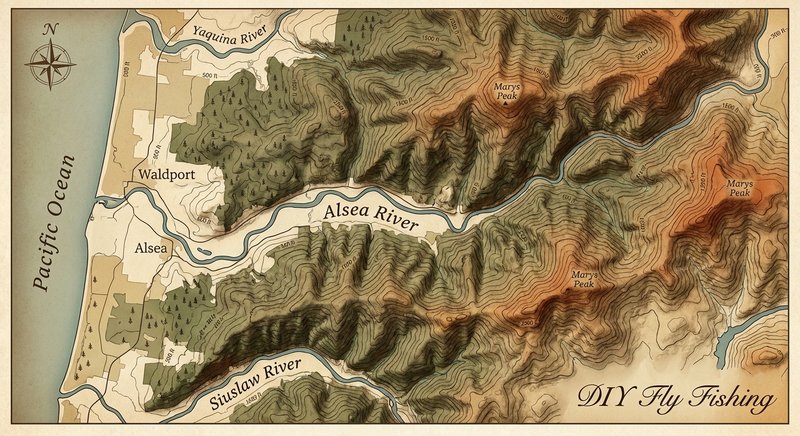
Alsea River
Fly fishing in Oregon · Beginner · Best seasons: Fall, Winter
Target Species
Steelhead, Chinook Salmon, Cutthroat Trout
About This Water
Mid-coast river with good steelhead and sea-run cutthroat. Beautiful rainforest setting.
Fishing Recommendations
The Alsea River is one of Oregon’s most iconic coastal streams. Tucked away in the Siuslaw National Forest and winding its way to the Pacific at Waldport, the Alsea is a quintessential "rain-fed" coastal river. It is legendary among fly anglers for its prolific winter steelhead runs and its rugged, moss-draped beauty.
🎣 Location Overview
The Alsea River is a medium-sized coastal system characterized by deep emerald pools, classic gravel riffles, and long, slow glides. What makes the Alsea special is its reliability and its "fishiness"—it is home to one of the most successful hatchery programs in the state (the Alsea Hatchery), which ensures a high density of returning winter steelhead.
The river is divided into two distinct personalities: the lower river (below Tidewater), which is influenced by the tides and is a staging ground for salmon; and the upper river (above the head of tide), which offers classic pocket water and swinging runs perfect for the fly rod. It is a temperamental river that responds quickly to rain; it can "blow out" (become muddy and unfishable) after a heavy storm but drops and clears into a beautiful "steelhead green" faster than many of its neighbors.
🐟 Target Species & Behavior
Winter Steelhead
The crown jewel of the Alsea. These are primarily hatchery-origin fish (Alsea stock), though wild fish are present.
- Behavior: They are aggressive when fresh from the ocean. They hold in "classic" water—the walking-speed currents at the heads and tails of pools.
- Feeding: They aren't actively feeding to grow, but they strike out of aggression or instinctual memory.
Chinook Salmon (Fall Run)
These are massive, powerful fish that enter the system in the fall.
- Behavior: In the lower river/tidewater, they "stage" while waiting for rain. Once the river rises, they move rapidly upstream to deep holes.
- Feeding: Like steelhead, they strike out of territorial aggression.
Coastal Cutthroat Trout
Often overlooked, the Alsea has a fantastic population of "Sea-run" Cutthroat (locally called Bluebacks) and resident fish.
- Behavior: They are opportunistic predators. They follow the salmon to eat displaced eggs or feast on fry and insects.
- Feeding: Very active surface and sub-surface feeders.
📅 Best Times to Fish
Fall (September – November)
- Primary Target: Chinook Salmon and Sea-run Cutthroat.
- Conditions: Look for the first "freshet" (significant rain) in late September or October to push fish out of the bay and into the river.
Winter (December – March)
- Primary Target: Winter Steelhead.
- Peak Window: January and February are the "prime time" months.
- Conditions: The best fishing occurs when the river level is dropping and clearing after a rain event. Look for a gauge height between 4.0 and 5.5 feet at the Tidewater gauge for optimal fly fishing visibility.
🪰 Recommended Flies & Techniques
For Steelhead (The Swing)
The Alsea is a great river for Spey casting.
- Technique: "Swinging" flies using a Skagit head and a sink tip (T-11 to T-14).
- Flies: Intruders in Pink/Orange, Purple/Black (for low light), and the classic Alsea Spey (a local variation of a General Practitioner).
- Nymphing: Using a 10ft 7wt or 8wt rod with an indicator is highly effective in the tighter pocket water near the hatchery. Use Beads (8mm-10mm) in "mottled orange" or Nightmares.
For Chinook
- Technique: Stripping large streamers in tidewater or swinging heavy flies in the upper river.
- Flies: Comet patterns, Bunny Leeches in Chartreuse or Pink/Black.
For Cutthroat
- Technique: Dry-fly fishing in late summer/early fall or swinging small streamers.
- Flies: Royal Wulff, Elk Hair Caddis, and small Borden Prawns.
💡 Pro Tips & Local Knowledge
- The "Hatchery Hole" vs. Solitude: The area around the Alsea Trout Hatchery (on the North Fork) and the Fall Creek confluence are the most crowded because fish congregate there. If you want solitude, focus on the stretches between Mill Creek and Blackberry Campground.
- Short Leash in Cold Water: In the dead of winter, steelhead won't move far for a fly. You need to get your fly down to their eye level. Don't be afraid to use a heavier sink tip than you think you need.
- The "Tidewater" Secret: In the fall, if the river is low, the Chinook and Cutthroat will be in the tidewater. Use an intermediate sinking line and strip a "Borden Prawn" or a "Micky Finn" near the edges of weed beds.
- Watch the Gauge: The Alsea River at Tidewater USGS gauge is your bible. If it's spiking vertically, stay home. If the graph shows a downward slope after a peak, grab your gear and go.
⚠️ Important Information
Access
- Drift Boats: The Alsea is a premier drift boat river. Popular drifts include Clemens Park to Blackberry or Blackberry to Campbell Park.
- Bank Access: There is good bank access along Highway 34, particularly at Blackberry Campground, Salmonberry Park, and various pull-outs along the river.
Regulations & Permits
- Licensing: You need an Oregon Angling License and a Combined Angling Tag (for Salmon/Steelhead).
- Barbless Hooks: While not always mandatory on all sections for all species, barbless hooks are highly recommended for easy release of wild fish.
- Wild Fish: Always check the current ODFW (Oregon Department of Fish and Wildlife) "Central Zone" regulations. Generally, wild steelhead must be released unharmed. Hatchery fish (identified by a clipped adipose fin) may be retained.
Special Considerations
- Safety: The Alsea has some technical water for rowers. If you are new to the river, scout "Deb’s Rock" and other hazards before launching.
- Etiquette: This is a popular river. If you see a boat backing down to a hole, give them space. If you are wading, don't "low-hole" (step in downstream of) another angler.
Bug Hatches & Matching Flies
| Hatch | Type | Peak months | Time of day | Hook sizes | Matching flies |
|---|---|---|---|---|---|
| Blue-Winged Olive (BWO) Baetis spp. | mayfly | March, April, October, November | Late Morning/Afternoon | #16-20 | Parachute Adams #16-20, RS2 #18-20, Pheasant Tail #16-20 |
| March Brown Rhithrogena morrisoni | mayfly | March, April | Afternoon | #12-14 | March Brown Western Red #12-14, Gold Ribbed Hare's Ear #12-14, March Brown Soft Hackle #14 |
| Golden Stonefly Calineuria californica | stonefly | June, July | Morning/Evening | #6-10 | Kaufmann's Stone #6-10, Chubby Chernobyl (Gold) #8-10, Pat's Rubber Legs #6-10 |
| Grannom Caddis Brachycentrus spp. | caddis | April, May | Afternoon/Evening | #14-16 | Elk Hair Caddis #14-16, Holy Grail (Green) #14-16, Peacock Caddis Larva #14-16 |
| October Caddis Dicosmoecus gilvipes | caddis | September, October | Late Afternoon | #8-12 | Orange Stimulator #8-10, Morrish's October Pupa #10-12, Large Peaked-Rib Hare's Ear #8-10 |
| Little Brown Stonefly Strophopteryx spp. | stonefly | February, March | Mid-day | #14-16 | Little Brown Stone #14-16, Copper John (Copper/Brown) #14-16, Soft Hackle Hare's Ear #14-16 |
| Yellow Sally Isoperla spp. | stonefly | June, August | Evening | #14-16 | Yellow Sally Dry #14-16, Jim's Yellow Sally Nymph #14-16, PMD Sparkle Dun #16 |
| Spotted Sedge Hydropsyche spp. | caddis | July, August, September | Evening | #14-18 | Tan Elk Hair Caddis #14-18, LaFontaine's Deep Sparkle Pupa #14-16, Green Weenie #14-16 |