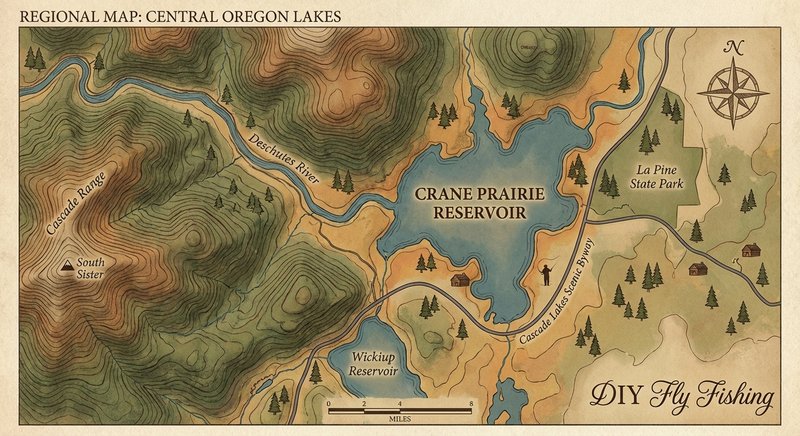
Crane Prairie Reservoir
Fly fishing in Oregon · Beginner · Best seasons: Spring, Summer, Fall
Target Species
Rainbow Trout, Brook Trout, Largemouth Bass
About This Water
Popular Cascade Lakes fishery with large rainbow trout. Excellent float tube fishing.
Fishing Recommendations
Welcome to Crane Prairie Reservoir, one of the crown jewels of Central Oregon’s "High Lakes." As a guide, I consider this one of the most productive stillwater fisheries in the United States. Known for its "Cranebows"—massive, fast-growing Rainbow Trout—and its haunting landscape of flooded timber, it offers a technical but highly rewarding experience.
Here is your comprehensive guide to fly fishing Crane Prairie.
🎣 Location Overview
Crane Prairie is a man-made reservoir located in the Deschutes National Forest. What makes it special is its history: when the Deschutes River was dammed, the forest wasn't cleared. Today, thousands of dead standing trees (snags) emerge from the water, creating a "drowned forest" that provides incredible cover and a massive biomass of insects.
The lake is shallow, nutrient-rich, and stays relatively cool due to several cold-water inlets (the Deschutes River, Cultus River, and Quinn River). It is a "fish factory" where trout grow at an astonishing rate, often gaining an inch a month during the summer.
🐟 Target Species & Behavior
- Rainbow Trout ("Cranebows"): These are the stars. Most are hatchery-reared triploids that don't spawn, meaning they spend all their energy eating and growing. They are heavy-bodied, hard-fighting, and often exceed 5–8 pounds.
- Brook Trout: Crane Prairie holds some of the largest Brookies in Oregon. They tend to congregate near the colder spring-fed inlets like Quinn River.
- Largemouth Bass: Found in the warmer, shallower weed beds and around the timber. They provide a fantastic alternative when the sun is high and trout fishing slows down.
- Behavior: These fish are "channel dwellers." They follow the submerged river channels of the Deschutes, Cultus, and Quinn rivers like highways to move between feeding grounds and thermal refuge (cool water).
📅 Best Times to Fish
- Spring (Mid-May to June): This is the prime window. As the ice melts and the water warms, the Chironomid (midge) hatches are legendary. Fish are in shallow water (4–10 feet) and are aggressively feeding.
- Summer (July to August): As the main lake warms, fish retreat to the "channels" and areas with spring influence. Look for oxygenated water. This is the peak for Damselfly and Dragonflies.
- Fall (September to October): The crowds thin out. Brook trout begin to color up, and Rainbows feed heavily on leeches and baitfish to bulk up for winter.
- Best Time of Day: Early morning (first light) until about 1:00 PM is usually the most productive window before the afternoon winds pick up.
🪰 Recommended Flies & Techniques
Chironomid Fishing (The #1 Method)
90% of the trout in Crane Prairie are caught on midges under an indicator.
- Patterns: Ice Buds, Chromies, Zebra Midges, and "The Standard" in sizes #12–16.
- Technique: Use a long leader (often 12–18 feet) and a slip-indicator. Suspend your fly 6–12 inches off the bottom in the river channels.
The Damselfly Hatch
During June and July, the damsel migration is spectacular.
- Patterns: Adult Damsels (blue) for dries; Olive Damsel Nymphs for subsurface.
- Technique: Use an intermediate sinking line and a "twitch-twitch-pause" retrieve near the weed beds.
Streamers & Leeches
- Patterns: Balanced Leeches (Black, Bruised, or Olive), Woolly Buggers, and Pine Squirrel Leech.
- Technique: Suspend Balanced Leeches under an indicator near timber, or slow-trolley streamers along the edges of the channels.
For Largemouth Bass
- Patterns: Poppers (morning/evening), Meat Whistles, and large Clouser Minnows.
- Technique: Cast directly into the "pockets" of the standing timber or over lily pad edges.
💡 Pro Tips & Local Knowledge
- Follow the Channels: If you aren't catching fish, find the submerged river channels on your depth finder. The fish use the 10–15 foot deep trenches to navigate the 4–6 foot flats.
- The "Crane Prairie Twitch": When fishing under an indicator, don't just let it sit. Every 30 seconds, give your line a tiny pull to make the midge dance. This often triggers the strike.
- Mind the Snags: You will lose flies. The bottom is littered with old logs and lava rocks. Bring plenty of extra leaders and tippet (3X and 4X are standard; don't go too light or a Cranebow will snap you off in the timber).
- Watch the Wind: The lake can get dangerous quickly. If you see whitecaps forming, head back to the boat ramp immediately.
⚠️ Important Information
- Boat Access: While some bank fishing is possible near the resort and Quinn River, a boat (or float tube/pontoon) is highly recommended to reach the channels and navigate the timber.
- Caution: Navigation can be treacherous. There are thousands of submerged stumps just inches below the surface. Move slowly!
- Regulations: Crane Prairie has specific bag limits and tackle restrictions. Generally, it is restricted to barbless hooks for many anglers by choice to preserve the trophy fishery. Always check the current ODFW Central Zone Regulations before heading out.
- Permits: An Oregon Angling License is required. If you are using a boat over 10 feet, you also need an Oregon Aquatic Invasive Species (AIS) permit.
Guide’s Final Word: "Bring your patience and a sturdy net. When a 6-pound Cranebow decides to head into the standing timber, you’re in for the fight of your life!"
Bug Hatches & Matching Flies
| Hatch | Type | Peak months | Time of day | Hook sizes | Matching flies |
|---|---|---|---|---|---|
| Chironomids Chironomidae | midge | April, May, June, September | All Day | #10-22 | Iceo-Chironomid #12-14, Zebra Midge #16-20, Griffith's Gnat #18-22 |
| Callibaetis Callibaetis ferrugineus | mayfly | June, July, August | Late Morning/Afternoon | #12-16 | Parachute Adams #14-16, Pheasant Tail Nymph #14-16, Quigley Cripple #14-16 |
| Damselflies Enallagma spp. | terrestrial | June, July | Late Morning/Afternoon | #10-14 | Braided Butt Damsel #12-14, Marabou Damsel Nymph #10-12, Adult Damsel #12 |
| Traveling Sedge Hesperophylax | caddis | July, August | Evening | #8-12 | Mikulak Sedge #8-10, Goddard Caddis #10-12, Deep Sparkle Pupa #10-12 |
| Dragonflies Anisoptera | terrestrial | July, August | Afternoon | #4-10 | Gomphus Nymph #6-10, Moorish Dragon #8, Carey Special #8-12 |
| Water Boatmen Corixidae | terrestrial | September, October | Afternoon | #14-18 | Prince Nymph (Small) #16-18, Water Boatman #14-16, Flashback Pheasant Tail #16 |
| Scuds Gammarus | terrestrial | April, May, October | All Day | #12-16 | Olive Scud #12-16, Ray Charles #14-16, Orange Scud #14 |
| Black Ants Formicidae | terrestrial | August, September | Afternoon | #12-16 | Carpenter Ant #12-14, Chernobyl Ant #10-12, Black Foam Ant #14-16 |