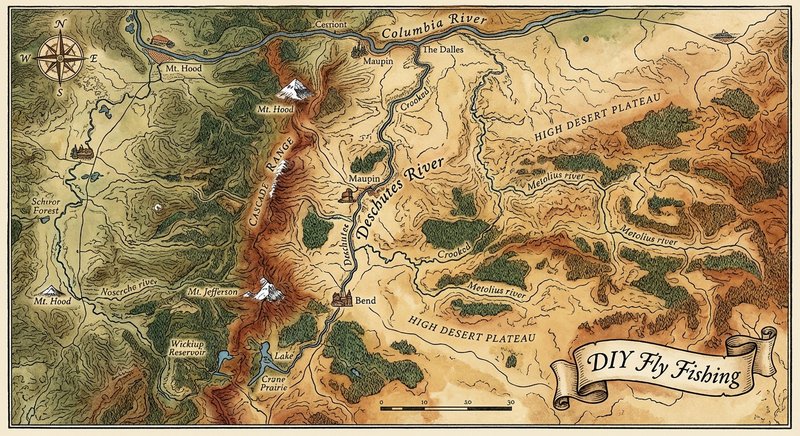
Deschutes River
Fly fishing in Oregon · Intermediate · Best seasons: Spring, Summer, Fall
Target Species
Rainbow Trout, Steelhead, Brown Trout
About This Water
World-renowned steelhead and trout fishery. Famous redsides and excellent dry fly fishing in canyon setting.
Fishing Recommendations
The Deschutes River is the crown jewel of Oregon fly fishing. Flowing north through rugged basalt canyons, it is a high-desert oasis that offers some of the most consistent and exciting fly fishing in the United States. Whether you are chasing the legendary "Redband" rainbow trout during a massive stonefly hatch or swinging flies for summer-run steelhead, the Deschutes is a "bucket list" destination.
🎣 Location Overview
The Deschutes is divided into three distinct sections, but the Lower Deschutes (the 100-mile stretch from Pelton Dam to the Columbia River) is the most famous.
What makes it special is its geology and biology. The river is fed by ground-water springs and controlled by a bottom-release dam, keeping water temperatures relatively stable. The result is a massive biomass of insects. The river is powerful, characterized by heavy riffles, deep basalt pockets, and "slick" tailouts. The scenery is breathtaking—towering canyon walls, sagebrush, and golden rimrock.
🐟 Target Species & Behavior
- Interior Redband Trout: These are the native stars of the river. A subspecies of Rainbow Trout, Redbands are incredibly powerful for their size. They live in highly oxygenated water and are notorious for deep, surging runs. They hold in the "heavy water"—fast riffles and the "seams" where fast and slow water meet.
- Summer Steelhead: Arriving in the lower river in July and peaking in September/October, these fish are aggressive and known for taking dry flies or traditional wet flies on a swing. They hold in "classic" steelhead water: walking-speed runs with "greased-line" characteristics.
- Brown Trout: Primarily found in the Upper Deschutes (above Bend) and parts of the Middle Deschutes. They are predatory and structure-oriented, often found under undercut banks or near downed timber.
📅 Best Times to Fish
- Spring (May - June): This is the "Main Event." The Salmonfly and Golden Stonefly hatch occurs from mid-May through early June. It is chaos—huge bugs, aggressive takes, and heavy crowds.
- Summer (July - August): Excellent evening caddis hatches. This is also when the first Summer Steelhead begin to enter the lower river.
- Fall (September - October): Perhaps the best time for a "multi-species" trip. The weather cools, the crowds thin, and the Steelhead fishing hits its peak. You also get the October Caddis hatch, which brings up the largest trout.
🪰 Recommended Flies & Techniques
For Redband Trout
- Dry Flies: Chubby Chernobyl (Size 4-8) in orange or gold; Clark’s Stone; Elk Hair Caddis (Size 14-16); X-Caddis.
- Nymphs: "Jimmy Legs" (Stonefly nymphs) in black or brown; Prince Nymphs; Copper Johns; Pheasant Tails (Size 14-18).
- Technique: High-stick nymphing is the most effective way to fish the heavy riffles. However, during a hatch, "pounding the banks" with a large dry-dropper rig from a drifting boat (to get to the spot) and then wading is the standard.
For Steelhead
- Surface/Dry: Steelhead Bee; Waller Walker; Purple Pom Skater.
- Traditional Swing: Green Butt Skunk; Max Canyon; Blue Charm.
- Spey/Skagit: Hoh Bo Spey; Dirty Ho; various intruder patterns in purple, black, or blue.
- Technique: The Down-and-Across Swing. Using a Spey rod is highly recommended due to the canyon walls limiting backcast room.
💡 Pro Tips & Local Knowledge
- The "Shade Line": In the deep canyon of the Deschutes, the sun is your enemy. Trout will move toward the "shade line" as it moves across the river. Follow the shadows; once the sun hits the water directly, the "big bug" bite often shuts down until evening.
- Wading Safety: The Deschutes is "slippery and pushy." The rocks are covered in slick algae (diatoms). Studded wading boots and a wading staff are mandatory. Do not underestimate the power of this river.
- The "Short Leash": When nymphing for Redbands, they often hold in water shallower than you’d expect. A shorter leader/tippet section can prevent you from snagging the bottom while keeping your fly in the strike zone of fish hugging the rocks.
- The "White Side": On the Lower Deschutes, the west bank is mostly Warm Springs Tribal Land. You need a specific Tribal Permit to fish that side, and regulations differ. Most anglers stick to the east bank (Bureau of Land Management land).
⚠️ Important Information
- NO FISHING FROM A BOAT: On the Lower Deschutes (from Pelton Dam to the mouth), it is illegal to fish from any floating device. Boats are used only for transportation. You must beach the boat and fish while standing in the water.
- Boater Passes: If you plan to float the river, you must purchase a Deschutes River Boater Pass in advance via Recreation.gov. They are limited and can sell out months in advance for peak weekends.
- Regulations:
- The Lower Deschutes is generally Barbless Hooks Only.
- Check ODFW (Oregon Dept. of Fish and Wildlife) for "Steelhead Sanctuaries"—certain areas near the mouths of tributaries are closed to fishing in late summer to protect migrating fish.
- Rattlesnakes & Ticks: This is high-desert country. Watch your step when walking through the sagebrush, especially in the heat of Summer.
Guide’s Final Thought: "Respect the Redband. These fish fight harder than any trout in the West. Treat them with care, keep them in the water, and they’ll give you a story to tell for years."
Bug Hatches & Matching Flies
| Hatch | Type | Peak months | Time of day | Hook sizes | Matching flies |
|---|---|---|---|---|---|
| Salmonfly Pteronarcys californica | stonefly | May, June | All Day | #4-8 | Chubby Chernobyl #6-8, Clark's Stone #6-10, Pat's Rubber Leg Stone #4-8 |
| Golden Stonefly Hesperoperla pacifica | stonefly | May, June | All Day | #8-12 | Norm Wood Special #8-10, Jimmy Legs #8-12, Golden Chubby Chernobyl #10-12 |
| Pale Morning Dun (PMD) Ephemerella excrucians | mayfly | June, July | Late Morning/Afternoon | #14-18 | Sparkle Dun #14-16, Pheasant Tail #14-18, PMD Emerger #16 |
| Blue Winged Olive (BWO) Baetis spp. | mayfly | March, April, September, October | Afternoon | #18-22 | RS2 #18-22, Parachute Adams #18-20, Blue Winged Olive Soft Hackle #18-20 |
| October Caddis Dicosmoecus gilvipes | caddis | September, October | All Day/Evening | #8-12 | Orange Stimulator #8-12, Peahead October Caddis #8-10, Morrish's October Adult #10 |
| Spotted Sedge Hydropsyche | caddis | June, July, August | Evening | #14-18 | Elk Hair Caddis #14-16, Iris Caddis #14-18, LaFontaine's Deep Sparkle Pupa #14-16 |
| Yellow Sally Isoperla spp. | stonefly | June, July | Afternoon/Evening | #14-16 | Yellow Sally Stimulator #14-16, Yellow Little Sloan #14-16 |
| March Brown Rhithrogena morrisoni | mayfly | March, April | Mid-day | #12-14 | March Brown Cripple #12-14, Western March Brown #12-14, Gold Ribbed Hare's Ear #12-14 |
| Midges Chironomidae | midge | January, February, March, December | Mid-day | #18-24 | Zebra Midge #18-22, Griffith's Gnat #18-22, Buzzer #20 |