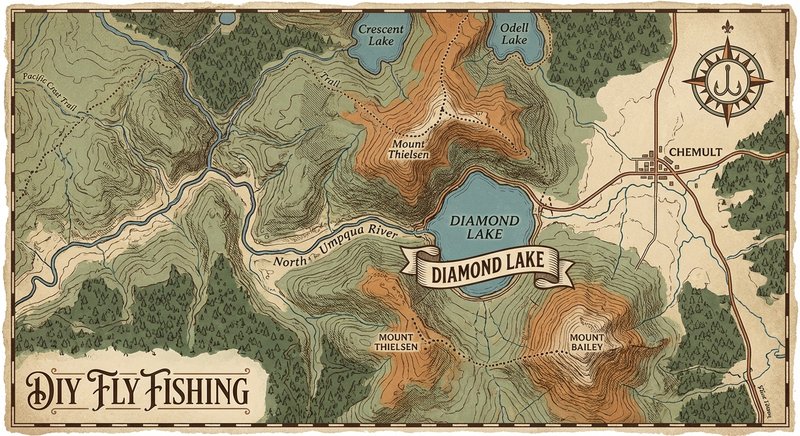
Diamond Lake
Fly fishing in Oregon · Beginner · Best seasons: Spring, Summer, Fall
Target Species
Rainbow Trout
About This Water
Popular southern Cascades lake with rainbow trout. Family-friendly fishing.
Fishing Recommendations
Welcome to one of the crown jewels of Oregon stillwater fishing. As a guide who has spent years decoding the High Cascades, I can tell you that Diamond Lake is a "trout factory." Nestled at 5,182 feet between the jagged spires of Mt. Thielsen and the rounded dome of Mt. Bailey, this lake offers some of the fastest growth rates for Rainbow Trout in the Pacific Northwest.
Here is your comprehensive guide to fly fishing Diamond Lake.
🎣 Location Overview
Diamond Lake is a natural, nutrient-rich lake covering roughly 3,000 acres. Unlike many deep, sterile alpine lakes, Diamond is relatively shallow, with an average depth of about 22 feet and a maximum of 50 feet.
What makes it special is its productivity. The lakebed is a massive weed bed teeming with aquatic insects. Following a massive restoration project in 2006 to remove invasive tui chub, the "Diamond Lake Rainbows" (primarily Eagle Lake and Kamloops strains) now thrive, often growing 1 to 2 inches per month during the summer. Anglers love it because it offers a legitimate chance at a 20-plus-inch trout on a fly rod in a stunning high-alpine setting.
🐟 Target Species & Behavior
The primary target is the Rainbow Trout. These fish are notorious for their girth and strength.
- Behavior: They are "cruisers." Because the lake is shallow, the fish move constantly along the edges of weed beds looking for hatches.
- Feeding: They are highly opportunistic. While they will eat small midges, they are also predatory, gorging on golden shiners (which have unfortunately returned but serve as forage) and large leeches.
- Holding Zones: Look for the "drop-offs" where the shallow shelf (6–10 feet) falls off into the 15–20 foot range. The trout use these edges like highways.
📅 Best Times to Fish
- Spring (Late May – June): This is "Ice-Out" season. As soon as the ice clears, the fish are hungry and shallow. This is the prime time for Chironomid (midge) fishing.
- Summer (July – August): The most consistent weather. This is the era of the Callibaetis and Damselfly hatches. Focus on the early morning (5:00 AM to 10:00 AM) and the "witching hour" before sunset to avoid the midday heat and wind.
- Fall (September – October): My personal favorite. As water temperatures drop, the trout move back into the shallows to bulk up for winter. The "October Caddis" and aggressive leech stripping are the tickets here.
🪰 Recommended Flies & Techniques
1. Indicator Nymphing (The Bread & Butter)
This is the most effective way to fish Diamond. Use a long leader (12–18 feet) under a slip-indicator.
- Flies: Chironomids (Size 12–16) in black/silver, red (Bloodworms), or "Ice Cream Cone" patterns.
- Technique: Suspend your fly 12 to 18 inches off the muddy bottom. The slight ripple of the water provides all the action you need.
2. Stripping Streamers & Leeches
When the wind picks up or the hatch is off, go sub-surface.
- Flies: Balanced Leeches (Black, Olive, or Wine), Woolly Buggers (Size 8–10), and Pine Squirrel leeches.
- Technique: Use an intermediate sinking line or a Type 3 sink tip. Use a "twitch-twitch-pause" retrieve.
3. Dry Fly Action
- Flies: Callibaetis Sparkle Duns (Size 14–16), Parachute Adams, and Adult Damselfly patterns (Blue).
- Technique: Look for rising fish in the glassy water of the South End. Precision is more important than distance.
💡 Pro Tips & Local Knowledge
- The "Bubble Line": On windy days, look for foam lines on the surface. These collect heat and trapped insects. Trout will cruise right under these lines; cast your flies along the edges of the foam.
- The South End Flats: The southern third of the lake is very shallow. It’s the first to warm up in the spring and holds the thickest weed beds. If you see birds diving, get over there—they’ve found the baitfish or a massive hatch.
- Double Anchoring: The wind can howl at Diamond Lake. To fish an indicator effectively, you must anchor both the bow and the stern of your boat to prevent swinging. If your boat swings, your fly lifts out of the "strike zone" near the bottom.
- Watch the Oxygen: In late August, the very bottom of the lake can become deoxygenated. If you aren't getting bites deep, move your fly up 3–5 feet in the water column.
⚠️ Important Information
- Access: There are excellent boat ramps at the South Shore, North Shore, and Thielsen View campgrounds.
- Regulations: Diamond Lake is open year-round, but snow usually closes road access from November to May. Oregon Department of Fish and Wildlife (ODFW) usually has a 5-fish limit, but check the current Oregon Sport Fishing Regulations as they can change to manage the population.
- Algal Blooms: In late summer, the lake can occasionally suffer from blue-green algae blooms. Check with the U.S. Forest Service (Umpqua National Forest) before heading out to ensure the water is safe for pets and humans.
- The Wind: "Diamond Lake whitecaps" are no joke. If you see a dark line approaching from the west, head for the docks. It can go from glassy to dangerous in 15 minutes.
Guide’s Final Word: Bring a heavy jacket even in July. At 5,000 feet, the mornings are crisp, but the fishing is red hot. Tight lines!
Bug Hatches & Matching Flies
| Hatch | Type | Peak months | Time of day | Hook sizes | Matching flies |
|---|---|---|---|---|---|
| Chironomids Chironomidae | midge | May, June, September | All Day | #10-18 | Ice Cream Cone #12-16, Chromie #12-18, Griffith's Gnat #16-20 |
| Callibaetis Callibaetis ferrugineus | mayfly | June, July, August | Late Morning/Afternoon | #12-16 | Callibaetis Spinner #14-16, Hare's Ear Nymph #12-16, Quigley’s Callibaetis Cripple #14-16 |
| Damselflies Enallagma | terrestrial | June, July | Late Morning/Afternoon | #10-12 | Marabou Damsel Nymph #10-12, Adult Damselfly #10-12 |
| Traveling Sedge Hesperophylax | caddis | July, August | Evening | #8-10 | Goddard Caddis #8-10, Mikulak Sedge #8-10 |
| Dragonflies Anisoptera | terrestrial | June, July | Daylight | #4-8 | Girdle Bug #6-8, Carey Special #4-8 |
| Scuds Gammarus | terrestrial | May, June, September, October | All Day | #12-16 | Ray Charles #14-16, Olive Scud #12-16 |
| Little Green Caddis Brachycentrus | caddis | June, July | Afternoon/Evening | #14-18 | Elk Hair Caddis (Olive) #14-16, Soft Hackle Peacock #14-18 |
| Flying Ants Formicidae | terrestrial | August, September | Afternoon | #12-16 | Black Foam Ant #14-16, Cinnamon Ant #14-16 |