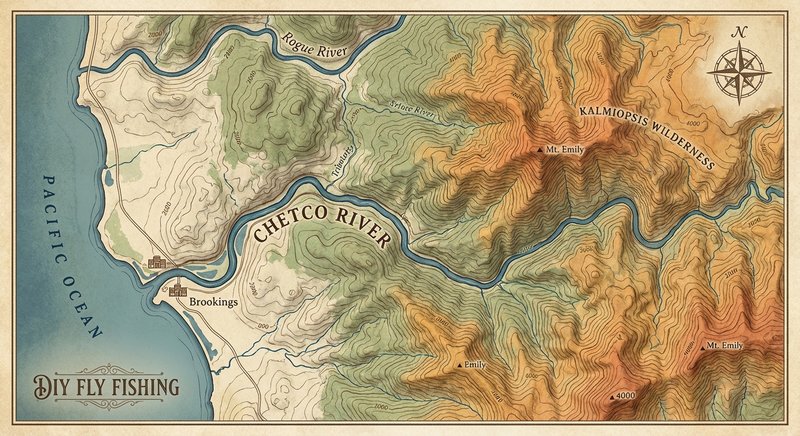
Chetco River
Fly fishing in Oregon · Intermediate · Best seasons: Fall, Winter
Target Species
Steelhead, Chinook Salmon
About This Water
Southern Oregon coastal river. Excellent winter steelhead and fall salmon.
Fishing Recommendations
As a guide who has spent years rowing the coastal rivers of the Pacific Northwest, I can tell you that the Chetco River is one of the crown jewels of Southern Oregon. Located just north of the California border near the town of Brookings, the Chetco is a "Wild and Scenic" designated river known for its startlingly clear, turquoise water and its run of massive, trophy-sized fish.
Here is your comprehensive guide to fly fishing the Chetco.
🎣 Location Overview
The Chetco is a relatively short, coastal river that flows out of the Kalmiopsis Wilderness. What makes it special is its clarity. Even after a heavy rain, the Chetco clears faster than almost any other river on the coast. It is often the "backup" river when the Smith or Rogue are blown out.
The river is characterized by large, rounded granite boulders, deep emerald pools, and classic gravel tailouts. Because the water is so clear, it offers a "sight fishing" quality rarely found in salmon and steelhead fisheries. Anglers love it because it produces some of the largest Chinook (King) salmon in the state, often exceeding 50 pounds, and a robust run of hard-fighting winter Steelhead.
🐟 Target Species & Behavior
Chinook Salmon (Kings)
- Behavior: These are "bright" fish fresh from the salt. They are aggressive but spook easily due to the water clarity. They hold in deep slots and the heads of pools.
- Feeding: While they don't "feed" in the traditional sense once in freshwater, they strike out of aggression or territorial instinct.
Winter Steelhead
- Behavior: The Chetco's steelhead are known for their size and strength. They move quickly through the lower river and hold in "walking speed" water—specifically in the transitions between rapids and deep pools.
- Feeding: They look for eggs (from the spawning salmon) and aquatic insects. In the lower river, they are highly reactive to swung flies.
📅 Best Times to Fish
Fall (October – December): Chinook Salmon
- Prime Window: Late October through November is the peak.
- Conditions: The first major rains of October (the "Big Flush") trigger the run. You want to fish as the river is dropping and clearing after a storm.
Winter (December – March): Steelhead
- Prime Window: January and February are the blue-ribbon months.
- Conditions: Look for "steelhead green" water. If the river is too low and clear, the fish become very shy and nocturnal. Overcast days are far superior to sunny days.
Time of Day
- Low Light is King: On the Chetco, the first two hours of light and the last hour of light are the most productive. Once the sun hits the water, the fish move into deep cover or the "bubbly" broken water where they feel safe.
🪰 Recommended Flies & Techniques
For Chinook (The "Low & Slow" Approach)
- Technique: Deep nymphing with heavy sink tips or "back-trolling" a fly from a drift boat.
- Flies:
- Comets: (Orange, Pink, or Chartreuse) with plenty of flash.
- Bunny Leeches: Large, weighted patterns in purple/black or pink/white.
- Intruders: Large profiles to trigger an aggression strike.
For Steelhead (The "Swing" and the "Indicator")
- Technique:
- Spey Casting: Swinging flies using Skagit heads and T-11 or T-14 sink tips is the most sporting way to cover water.
- Indicator Nymphing: Extremely effective in the pocket water and tighter slots.
- Flies:
- Egg Patterns: Glo-bugs or "Beads" (8mm to 10mm) in mottled orange or "Oregon Cheese."
- Swing Flies: Hobo Spey, Green Butt Skunk, or various Articulated Leeches in blue/black.
- Nymphs: Prince Nymphs and Rubber Leg Stoneflies (Size 4-8).
💡 Pro Tips & Local Knowledge
- The "Chetco Effect": Because the water is so clear, fluorocarbon leaders are mandatory. For Steelhead, drop down to 10lb or 12lb fluoro if the water is low. For Chinook, don't go lighter than 20lb, or you'll never stop a big fish in the current.
- Focus on the Lower River: The "Tidewater" and the stretch up to Social Security Bar are prime for fresh-from-the-ocean fish. If you have a drift boat, the float from Loeb Park to Social Security Bar is a classic.
- The "Walking Speed" Rule: When swinging for Steelhead, don't waste time in the deep, stagnant holes. Focus on water that is moving at the speed of a brisk walk—this is where the oxygen is highest and where Steelhead rest.
- Stealth Matters: Avoid wading deep into the "tailouts." Many anglers walk right past the fish. Stand back and fish the "near" water first.
⚠️ Important Information
Access
- Bank Access: Good bank access is available at Loeb State Park and various "bars" (gravel beaches) like Miller Bar, Nook Bar, and Social Security Bar. High-clearance vehicles are recommended for some gravel bar access points.
- Boating: A drift boat is the preferred method for the Chetco. It is a technical river in spots; if you aren't an experienced rower, hire a guide for your first trip.
Regulations & Permits
- Barbless Hooks: Oregon often requires barbless hooks on coastal streams—always check the current ODFW (Oregon Department of Fish and Wildlife) Southwest Zone regulations before heading out.
- Wild Fish: The Chetco has specific rules regarding the harvest of wild vs. hatchery fish. Most fly anglers practice 100% catch and release for wild Steelhead to preserve the genetics of this special river.
- Permits: You need an Oregon Angling License and a Combined Angling Tag (for Steelhead/Salmon).
Guide’s Parting Shot: If you see the water looks like "gin," go small and dark with your flies. If it looks like "pea soup," go big and bright. The Chetco will test your patience, but landing a 20lb winter Steelhead in that turquoise water is a memory you'll carry forever.
Bug Hatches & Matching Flies
| Hatch | Type | Peak months | Time of day | Hook sizes | Matching flies |
|---|---|---|---|---|---|
| Blue Winged Olive (BWO) Baetis spp. | mayfly | February, March, October, November | Late Morning/Afternoon | #18-22 | Parachute Adams #18-22, RS2 #20-22, Pheasant Tail #18-20 |
| March Brown Rhithrogena morrisoni | mayfly | March, April | Afternoon | #12-14 | March Brown Western Deceiver #12-14, Gold Ribbed Hare's Ear #12-14, March Brown Wet Fly #12-14 |
| Golden Stonefly Hesperoperla pacifica | stonefly | May, June, July | All Day | #8-12 | Kaufmann's Stone #8-12, Chubby Chernobyl (Gold) #8-10, Pat's Rubber Leg #8-12 |
| Pale Morning Dun (PMD) Ephemerella spp. | mayfly | June, July, August | Late Morning/Early Afternoon | #16-18 | PMD Sparkle Dun #16-18, Military May #16-18, Pale Morning Dun Quigley Hackle Stacker #16-18 |
| October Caddis Dicosmoecus atripes | caddis | September, October | All Day/Evening | #8-10 | Morrish October Caddis #8-10, Peeking Caddis #10-12, Orange Stimulator #8-10 |
| Little Black Stonefly Capniidae family | stonefly | January, February, March | Mid-day | #16-20 | Black Stimulator #16-18, Zebra Midge (Black) #18-20, Little Black Slow Water Stone #16-18 |
| Spotted Sedge Hydropsyche spp. | caddis | July, August, September | Evening | #14-16 | Elk Hair Caddis (Tan) #14-16, LaFontaine's Deep Sparkle Pupa #14-16, Hydropsyche Larva #14-16 |
| Green Caddis (Grannom) Brachycentrus spp. | caddis | April, May | Afternoon | #14-16 | Holy Grail (Green) #14-16, Cornfed Caddis #14-16, Caddis Larva (Bright Green) #14-16 |