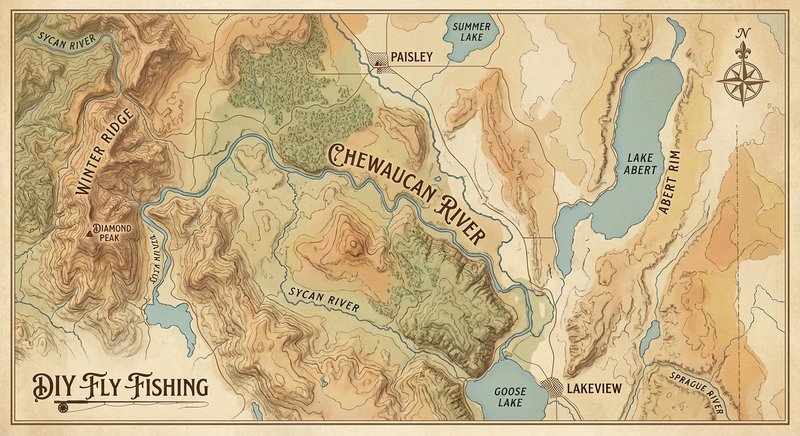
Chewaucan River
Fly fishing in Oregon · Intermediate · Best seasons: Spring, Summer, Fall
Target Species
Redband Trout
About This Water
Remote eastern Oregon stream with wild redband trout. Desert canyon setting.
Fishing Recommendations
The Chewaucan River is one of Oregon’s "hidden gems," tucked away in the high desert southeast of Paisley in Lake County. It is a rugged, beautiful, and relatively isolated fishery that offers a true wild trout experience. Unlike the crowded banks of the Deschutes or the Metolius, the Chewaucan provides solitude and the chance to catch a unique desert subspecies of trout in a dramatic canyon setting.
🎣 Location Overview
The Chewaucan is a terminal basin river, meaning it never reaches the ocean; it flows from the Fremont-Winema National Forest and eventually terminates in the Abert Lake basin.
What makes it special is the transition of scenery. The upper reaches flow through high-alpine meadows and dense coniferous forests, while the middle section carves through a spectacular, boulder-strewn canyon. The water is generally tea-colored due to natural tannins but remains cold enough to support a robust population of native fish. Anglers love it for its "pocket water" character—it is a playground for those who enjoy technical wading and short-range casting.
🐟 Target Species & Behavior
The star of the show here is the Great Basin Redband Trout.
- Characteristics: These are native, wild fish evolved to survive the harsh temperature fluctuations of the high desert. They are known for their brilliant crimson lateral stripes and heavy spotting.
- Behavior: Chewaucan Redbands are opportunistic but wary. In the fast-moving canyon water, they hold in the "cushion" in front of boulders, in deep plunge pools, and along the foamy seam lines (the "bubble line").
- Diet: They feed heavily on stoneflies (Golden Stones and Salmonflies), caddis, and terrestrial insects like grasshoppers and ants during the summer months.
📅 Best Times to Fish
- Spring (Late May – June): This is the window for the Salmonfly hatch. If you time it right after the spring runoff subsides, you can experience world-class dry fly fishing. However, water levels can be high and wading can be treacherous.
- Summer (July – August): The most consistent time. While the valley floor gets hot, the river canyon stays cooler. Focus on early mornings and late evenings. This is "Hopper-Dropper" season.
- Fall (September – October): My personal favorite. The water cools down, the crowds (which are already small) vanish, and the fish feed aggressively to bulk up for winter. October Caddis and Mahogany Duns are the primary hatches.
- Prime Window: Low-light periods (dawn and dusk) are always best, especially in the clear water of late summer.
🪰 Recommended Flies & Techniques
Top Fly Patterns
- Dry Flies:
- Chubby Chernobyl (Size 8-12) in Orange, Gold, or Tan.
- Elk Hair Caddis (Size 14-16) in Tan or Olive.
- Stimulators (Size 10-14) in Orange or Royal.
- Morrish Hopper or Parachute Hopper (Size 10-12).
- Nymphs:
- Pat’s Rubber Legs (Size 8-12) in Coffee/Black or Golden.
- Bead Head Prince Nymph (Size 14-16).
- Pheasant Tail Nymph (Size 14-18) – classic for a reason.
- Perdigons (Size 16) for fast-sinking in pocket water.
- Streamers:
- Woolly Buggers (Size 8-12) in Olive or Black for the deeper pools.
Techniques & Presentation
- The "Hopper-Dropper": In the pocket water, a high-floating dry fly with a weighted nymph tied 18-24 inches below it is lethal.
- Short Line Nymphing: Because the river is boulder-heavy, long casts result in complex drag. Keep your rod high, use a short line, and "guide" your flies through the slots between rocks.
- The "Dink and Link": Using a very small indicator or just a buoyant dry fly to detect subtle takes in the turbulent seams.
💡 Pro Tips & Local Knowledge
- Focus on the Canyon: The stretch between the Marster Spring Campground and the town of Paisley offers the best pocket water. The further you hike away from the road access points, the better the fishing gets.
- The "Shadow" Factor: In the deep canyon sections, the sun hits the water late and leaves early. Fish become much more active as soon as the sun dips behind the canyon walls.
- Wading Safety: The Chewaucan is notorious for "greasy" rocks. Even in low water, the boulders can be incredibly slick. Felt soles or studs, along with a wading staff, are highly recommended.
- Sneak Up: Because the water is often clear and shallow, these fish can be "spooky." Don't just march up to the bank. Approach from downstream and stay low.
⚠️ Important Information
- Access: Much of the upper river is within the Fremont-Winema National Forest with excellent public access. Highway 31 to Mill Street (which becomes Forest Service Road 33) follows the river for many miles.
- Regulations: The Chewaucan generally falls under the Southeast Zone regulations for Oregon ODFW.
- Check current seasons: Typically open year-round, but specific sections may have different rules.
- Gear: Usually restricted to artificial flies and lures only in the upper sections to protect the Redband population.
- Catch and Release: While some harvest is allowed, I strongly urge 100% catch and release for these native Redbands to preserve the genetics of this unique desert fishery.
- Environment: This is remote country. Cell service is non-existent in the canyon. Carry a spare tire, plenty of water, and watch out for rattlesnakes near the rocky banks during the heat of summer.
The Chewaucan isn't a river where you go to catch a 25-inch lunker; it’s a river where you go to catch 12-to-16-inch gems of pure desert gold in one of the most ruggedly beautiful settings in the Pacific Northwest. Tight lines!
Bug Hatches & Matching Flies
| Hatch | Type | Peak months | Time of day | Hook sizes | Matching flies |
|---|---|---|---|---|---|
| Salmonfly Pteronarcys californica | stonefly | June | All day | #4-8 | Chubby Chernobyl #6-8, Pats Rubber Legs #4-8 |
| Pale Morning Dun Ephemerella excrucians | mayfly | June, July | Late Morning/Afternoon | #14-18 | Sparkle Dun #16-18, Pheasant Tail #14-18 |
| Golden Stonefly Hesperoperla pacifica | stonefly | June, July | Late Afternoon/Evening | #8-12 | Norm Wood Special #8-10, Golden Stone Nymph #10-12 |
| Blue-Winged Olive Baetis spp. | mayfly | April, May, September, October | Mid-day | #18-22 | Parachute Adams #18-22, RS2 #20-22 |
| Spotted Sedge Hydropsyche | caddis | June, July, August | Evening | #12-16 | Elk Hair Caddis #14-16, LaFontaine's Deep Sparkle Pupa #14-16 |
| Grasshoppers Orthoptera | terrestrial | August, September | Late Morning/Afternoon | #8-12 | Morrish Hopper #10-12, Dave's Hopper #8-12 |
| Little Yellow Stonefly Isoperla spp. | stonefly | July | Evening | #14-16 | Yellow Sally #14-16, Iron Lotus #16 |
| Midges Chironomidae | midge | March, April, October | Morning | #18-24 | Zebra Midge #18-22, Griffith's Gnat #20-22 |