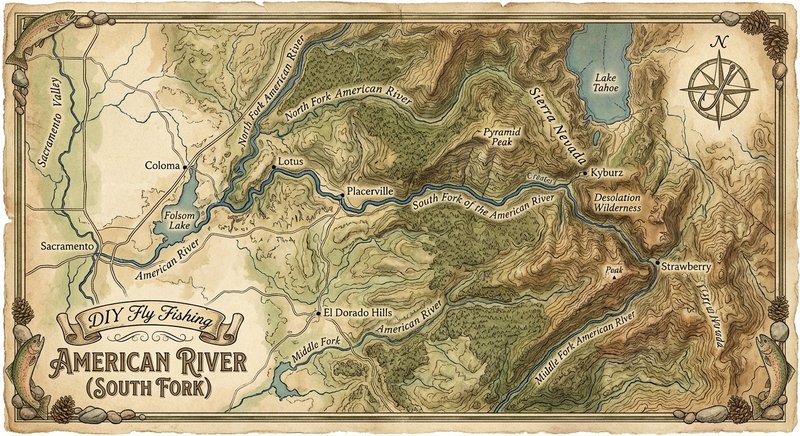
American River (South Fork)
Fly fishing in California · Beginner · Best seasons: Spring, Summer, Fall
Target Species
Rainbow Trout, Brown Trout
About This Water
Below Chili Bar with rainbow and brown trout. Popular rafting and fishing destination.
Fishing Recommendations
Welcome to the South Fork of the American River. As a guide who has spent years navigating the granite boulders and cold flows of the Sierra Nevada, I can tell you that the South Fork is one of the most versatile—yet often overlooked—fisheries in Northern California.
While it is world-famous for its Class III whitewater rafting, for a fly angler, it offers a diverse range of water, from high-gradient pocket water near the crest to broad, classic pools in the valley.
🎣 Location Overview
The South Fork of the American River originates near Echo Summit and tumbles down the Highway 50 corridor before eventually feeding into Folsom Lake. It is a river of two personalities:
- The Upper South Fork (Kyburz to Strawberry): This is classic "Blue Ribbon" style mountain water. High gradient, boulder-strewn, and chilled by snowmelt. It’s a freestone environment where trout are opportunistic and the scenery is quintessential Sierra.
- The Lower South Fork (Chili Bar to Lotus): This is a tailwater-influenced section (released from Chili Bar Dam). It is wider, deeper, and heavily utilized by rafters. However, for the angler who knows the "windows," it holds surprisingly large fish.
What makes it special is the accessibility. You can pull off Highway 50 and be in wild trout water within minutes, yet five miles away, you can find solitude in deep canyons.
🐟 Target Species & Behavior
- Rainbow Trout: These are the primary residents. In the upper reaches, they are smaller (8–12 inches) but incredibly vibrant and hard-fighting. They hold in "pocket water"—the soft spots behind boulders and in the bubbly oxygenated seams.
- Brown Trout: The South Fork's "ghosts." Browns are more prevalent in the deeper, slower pools and around submerged wood. In the fall, larger lake-run browns can occasionally move up from reservoirs, providing a chance at a trophy.
- Behavior: These fish are flow-dependent. During high releases for rafting, they tuck deep into the banks or behind the largest obstructions. During "fishable" flows, they move into the riffles to feed on heavy caddis and stonefly hatches.
📅 Best Times to Fish
- Spring (Late April – June): This is "Big Bug" season. As the snowmelt begins to stabilize, the Golden Stoneflies emerge. This is your best chance to fish large dries. Note: Watch out for high runoff; if the river is chocolate milk, stay home.
- Summer (July – August): Best for the upper reaches. While the valley swelters, the higher elevations (Kyburz area) stay cool. Pro Tip: In the lower section (Coloma), you must fish the "Rafter Window"—before 10:00 AM or after 5:00 PM—to avoid the flotillas.
- Fall (September – November): The "Golden Hour" of the river. Flows drop and stabilize, water temperatures are perfect, and the crowds vanish. This is the prime time for dry-dropper rigs and streamer fishing for aggressive browns.
🪰 Recommended Flies & Techniques
Top Fly Patterns
- Dries:
- Elk Hair Caddis (Size 14-18) – The bread and butter of this river.
- Golden Stimulator (Size 8-12) – Perfect for the Stonefly hatch.
- Parachute Adams (Size 16-20) – For those picky fish in the flat tail-outs.
- Nymphs:
- Pat’s Rubber Legs (Black/Brown) – The best "big" nymph for the South Fork.
- Perdigons/Spanish Bullets (Size 16-18) – For fast-sinking in heavy pocket water.
- Bead-head Prince Nymph – A classic that never fails here.
- Streamers:
- Woolly Bugger (Olive or Black) – Swinging these through deep pools is the best way to find a Brown.
Techniques
- European Nymphing: Because the South Fork is so boulder-heavy, a "tight-line" or Euro-nymphing setup is devastatingly effective. It allows you to get flies deep into the pockets where an indicator would get caught in conflicting currents.
- Dry-Dropper: A high-floating Stimulator with a 2-foot dropper to a Pheasant Tail nymph is the standard "searching" rig for the summer months.
- Pocket Picking: Don't spend too much time in one spot. Give a pocket 5–10 good drifts; if nobody’s home, move to the next boulder.
💡 Pro Tips & Local Knowledge
- The "Silver Creek" Secret: Where Silver Creek enters the South Fork (near Ice House Rd), the water stays significantly colder. This is a sanctuary for trout during hot August afternoons.
- Flow Management: Before you go, check Dreamflows.com. For the lower South Fork, you want flows below 1,500 cfs for safe wading. For the upper section, look for flows that are trending down after the spring peak.
- The Granite Slide: The rocks on the South Fork are notoriously slippery granite. Studded wading boots are not optional; they are a safety requirement. Felt soles (where legal) also help, but studs are better.
- Stealth in Low Water: In the fall, the water becomes crystal clear. Long leaders (9–12 feet) and 5x or 6x tippet become necessary to avoid spooking the larger, educated fish.
⚠️ Important Information
- Access:
- Upper: Most of the river along Hwy 50 is within the Eldorado National Forest, offering excellent public access.
- Lower: Use public parks like Henningsen Lotus Park or Marshall Gold Discovery State Historic Park. Respect private property signs in the residential stretches.
- Regulations: The South Fork has various regulations depending on the specific reach and the time of year. Generally, it falls under the "Sierra District" rules. Always check the California Department of Fish and Wildlife (CDFW) current handbook for barbless hook requirements or seasonal closures.
- Safety: This is a powerful river. Never wade deeper than your knees in moving water you aren't familiar with. Be mindful of mountain lions and rattlesnakes, which are common in the canyon stretches.
Tight lines, and enjoy the beauty of the American River! It’s a rugged piece of California history that still fishes as well as it did in the Gold Rush days if you know where to look.
Bug Hatches & Matching Flies
| Hatch | Type | Peak months | Time of day | Hook sizes | Matching flies |
|---|---|---|---|---|---|
| Blue Winged Olive Baetis | mayfly | March, April, October, November | Late Morning/Afternoon | #18-22 | RS2 #18-22, Parachute BWO #18-22, WD-40 #20-22 |
| Golden Stonefly Calineuria californica | stonefly | June, July | Morning/Evening | #8-12 | Pats Rubber Legs #8-12, Chubby Chernobyl #10-12, Golden Rogue Stone #10 |
| March Brown Rhithrogena morrisoni | mayfly | March, April | Midday | #12-14 | March Brown Parachute #12-14, Hare's Ear Nymph #12-14, March Brown Wet Fly #14 |
| Mother's Day Caddis Brachycentrus occidentalis | caddis | April, May | Afternoon/Evening | #14-16 | Peacock Caddis #14-16, Green Weenie #14-16, Elk Hair Caddis #14-16 |
| Little Yellow Stonefly Isoperla | stonefly | June, July | Late Afternoon/Evening | #14-16 | Yellow Sally Dry #14-16, Iron Lotus #16, Little Yellow Stone Nymph #14-16 |
| Spotted Sedge Hydropsyche | caddis | July, August, September | Evening | #14-18 | Hydrospsyche Larva #14-16, LaFontaine's Deep Sparkle Pupa #16, Godzilla Caddis #14-16 |
| Midges Chironomidae | midge | January, February, December | Throughout the day | #18-24 | Zebra Midge #18-22, Griffith's Gnat #20-22, Mercury Midge #20-24 |
| Terrestrials Formicidae/Orthoptera | terrestrial | August, September | Afternoon | #10-16 | Parachute Hopper #10-12, Cinnamon Ant #16, Morrish Hopper #10-12 |