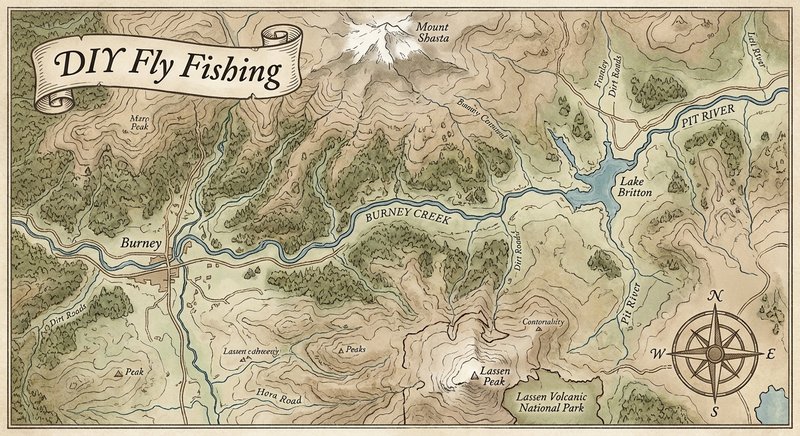
Burney Creek
Fly fishing in California · Intermediate · Best seasons: Spring, Summer, Fall
Target Species
Rainbow Trout, Brown Trout
About This Water
Near Burney Falls with wild rainbow trout. Spring-fed water in volcanic landscape.
Fishing Recommendations
Welcome to one of the most scenic fly fishing destinations in Northern California. As a guide in the Shasta-Cascade region, I can tell you that Burney Creek is a tale of two waters: the family-friendly stocked sections above the falls and the wild, technical, and breathtakingly beautiful canyon water below.
Here is the professional breakdown for fishing Burney Creek.
🎣 Location Overview
Burney Creek is a spring-fed tributary of Lake Britton located in Shasta County. It is world-famous for the 129-foot Burney Falls, which Teddy Roosevelt once called the "Eighth Wonder of the World."
What makes this water special is its consistency. Because it is largely spring-fed, the water remains cold and oxygenated year-round, even during the heat of a California July. The creek is divided into two distinct experiences:
- Above the Falls: Gentler gradients, easier access, and frequent stockings make this perfect for beginners and families.
- Below the Falls: A rugged, boulder-strewn canyon that leads down to Lake Britton. This is "blue ribbon" style water where wild fish thrive in deep pools and pocket water.
🐟 Target Species & Behavior
- Rainbow Trout: The primary residents. Above the falls, you’ll find eager hatchery fish. Below the falls, the rainbows are wild, vibrant, and incredibly strong for their size, often holding in the "bubble curtain" at the base of the falls or in the heavy pocket water.
- Brown Trout: Found primarily in the lower reaches near Lake Britton. They are elusive and tend to hug the undercut banks and large volcanic boulders. They become more active during the low-light hours of dawn and dusk.
Behavior: These fish are opportunistic but can be "micro-focused" on small insects. Because the water is crystal clear, they are easily spooked. Stealth and long leaders are your best friends here.
📅 Best Times to Fish
- Spring (Late April - June): The "prime" window. As the air warms, the insect life explodes. This is the best time for dry fly action.
- Summer (July - August): While other California rivers might get too warm, Burney Creek stays cold. It is a sanctuary for trout (and anglers) during the heat. Fish early morning or late evening to avoid the tourist crowds at the State Park.
- Fall (September - November): My personal favorite. The crowds vanish, and the Brown trout begin to move up from Lake Britton to spawn. The fall colors in the canyon are spectacular.
Prime Window: 10:00 AM to 2:00 PM for hatches in the spring; 6:00 PM to dark for the "caddis blizzard" in the summer.
🪰 Recommended Flies & Techniques
Top Fly Patterns
- Nymphs:
- Perdigons (Size 16-18) in olive or blue – they sink fast in the heavy pockets.
- Pats Stonefly (Size 8-12) in black/brown – the "meat and potatoes" for bigger fish.
- Zebra Midges (Size 18-20) in red or black.
- Dry Flies:
- Parachute Adams (Size 16-18) – the gold standard.
- Elk Hair Caddis (Size 14-16) – tan or olive.
- Stimulators (Size 10-12) – great for "hop and drop" rigs.
- Streamers:
- Woolly Buggers (Size 8-10) in olive or white (to mimic small minnows near the lake).
Effective Techniques
- Tight-Line (Euro) Nymphing: This is the most effective way to fish the pocket water below the falls. By eliminating the indicator, you can get flies deep into the small "buckets" behind boulders where the big fish hide.
- Dry-Dropper: Use a buoyant Stimulator as your indicator and hang a small beaded nymph 18-24 inches below it. This is deadly in the riffles above the falls.
- Stealth Approach: Kneel when approaching pools. If you can see the fish in this clear water, they have likely already seen you.
💡 Pro Tips & Local Knowledge
- The "Secret" Canyon: Most people stop at the base of the falls. If you are physically fit, hike a half-mile downstream toward Lake Britton. The terrain is difficult, but the fishing pressure drops to almost zero, and the size of the wild trout increases.
- The Mist Factor: The mist from the falls creates a unique micro-climate. It can be 10 degrees cooler at the base than at the parking lot. Dress in layers and be prepared for slippery rocks—felt soles or studs are highly recommended.
- Match the "Micro-Caddis": Burney Creek has a prolific hatch of very small, dark caddis. If fish are rising but ignoring your size 14 Elk Hair, drop down to a size 20 black gnat or midge.
⚠️ Important Information
- Access: Entry is through McArthur-Burney Falls Memorial State Park. There is a day-use fee (approx. $10).
- Regulations:
- The section within the State Park is generally open year-round, but check the current CDFW (California Department of Fish and Wildlife) regulations as specific sections have different bag limits and gear restrictions (Barbless hooks are always a good idea for conservation).
- Above the falls is often "put-and-take," while below the falls is managed more for wild trout.
- Wildlife: This is black bear and mountain lion country. While the park is busy, if you venture down-canyon, keep your wits about you and store any food in bear-proof containers.
- Permits: A valid California Fishing License is required for all anglers 16 and older.
Guide’s Final Word: Burney Creek isn't just a fishing trip; it's a visual experience. Bring a camera, fish the deep pockets with heavy nymphs, and take a moment to look up at the falls. You won't find a more beautiful office in the world.
Bug Hatches & Matching Flies
| Hatch | Type | Peak months | Time of day | Hook sizes | Matching flies |
|---|---|---|---|---|---|
| Blue Winged Olive Baetis | mayfly | March, April, October, November | Late Morning/Afternoon | #18-22 | RS2 #18-22, Parachute Adams #18-22, Pheasant Tail Nymph #18-20 |
| Pale Morning Dun Ephemerella | mayfly | May, June, July | Late Morning/Early Afternoon | #14-18 | PMD Sparkle Dun #16-18, Mercer's Trigger Micro Mayfly #16-18, Quigley's Hackle Stacker #14-16 |
| Spotted Sedge Hydropsyche | caddis | May, June, July, August | Evening | #14-18 | Elk Hair Caddis (Tan) #14-16, Pupa-Le-Anthro #16-18, Bird's Nest #14-16 |
| Golden Stonefly Calineuria californica | stonefly | June, July | Morning/Evening | #6-10 | Chubby Chernobyl #8-10, Pat's Rubber Leg #6-10, Picket Pin #8-12 |
| Little Black Caddis Brachycentrus | caddis | April, May | Afternoon | #16-18 | Z-Wing Caddis #16-18, Peacock Caddis #16-18, Holy Grail #16-18 |
| Midges Chironomidae | midge | January, February, March, December | All Day | #18-24 | Zebra Midge #18-22, Griffith's Gnat #20-22, Morgan's Midge #20-22 |
| Trico Tricorythodes | mayfly | August, September | Early Morning | #20-24 | Trico Spinner #20-24, Sunken Trico Spinner #22, WD-40 #20-22 |
| Terrestrials Formicidae / Coleoptera | terrestrial | July, August, September | Afternoon | #12-18 | Cinnamon Ant #14-18, Hopper Juan #10-14, Fat Albert #12-14 |