Deer Creek
Fly fishing in California · Intermediate · Best seasons: Spring, Summer, Fall
Target Species
Rainbow Trout
About This Water
Tehama County wild trout stream with native rainbow. Last unimpaired tributary to the Sacramento.
Fishing Recommendations
Deer Creek, located in Tehama County, is one of the crown jewels of Northern California’s "Lassen Foothills" fly fishing. It is one of the few remaining undammed tributaries to the Sacramento River, providing a rare glimpse into a truly wild, free-flowing ecosystem. For the fly angler, it offers a classic "blue ribbon" experience characterized by rugged canyons, crystal-clear pocket water, and wild, hard-fighting trout.
🎣 Location Overview
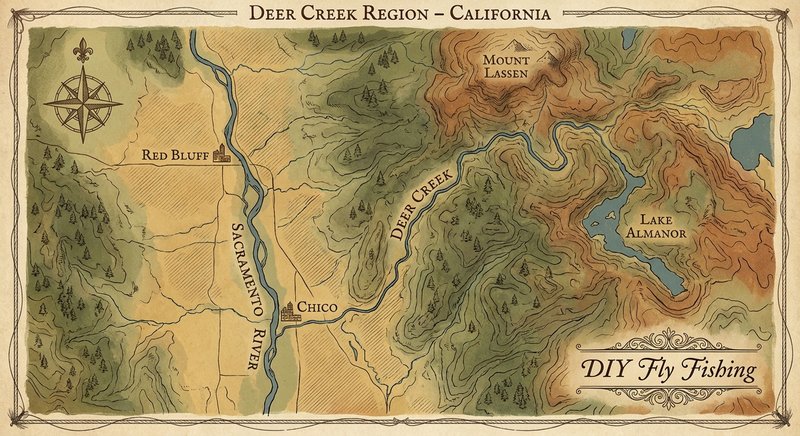
Deer Creek is a classic freestone stream that flows from the high volcanic slopes near Lassen Volcanic National Park down through deep, basalt-rimmed canyons before joining the Sacramento River.
What makes it special is its wildness. Because there are no dams, the water levels fluctuate naturally with snowmelt and rain. The upper reaches (near Highway 32) offer high-gradient meadow and forest fishing, while the middle sections flow through a remote, roadless wilderness canyon. The water is exceptionally clear, cold, and highly oxygenated—perfect habitat for wild trout. Anglers love it because it rewards stealth and precision rather than long-distance casting.
🐟 Target Species & Behavior
- Rainbow Trout: The primary target. These are wild fish, not stockers. They are known for being exceptionally vibrant with deep crimson stripes. They are "opportunistic" feeders due to the nutrient-poor nature of freestone streams.
- Behavior: In the fast water of Deer Creek, these fish hold in "soft" spots—behind boulders, in the seams between fast and slow water, and in the deep undercut banks. They don't have the luxury of inspecting a fly for long; they either hit it or let it pass.
- Other Species: Deer Creek is also a critical spawning ground for Spring-run Chinook Salmon and Steelhead. While these are protected and often not the target for trout anglers, their presence dictates the river's ecology.
📅 Best Times to Fish
Optimal Seasons
- Spring (Late May – June): This is the "Golden Window." Once the heavy snowmelt (runoff) begins to recede and the water clears to a "tea" color, the fishing is world-class.
- Summer (July – August): Great for "wet wading." The fish move into the fastest, most oxygenated riffles and pocket water. Morning and late evening are most productive as mid-day sun can make the fish lethargic.
- Fall (September – October): The water is low and clear. This is "stealth season." The arrival of October Caddies and cooler air temperatures triggers a feeding frenzy before winter.
Best Times of Day
- Early Morning: Best for nymphing the deeper pools.
- Late Afternoon/Dusk: The "Magic Hour" for dry fly action, especially during the caddis hatches.
🪰 Recommended Flies & Techniques
Top Fly Patterns
- Dry Flies:
- Elk Hair Caddis (Size 14-18) – The staple fly for Deer Creek.
- Humpty or Royal Wulff (Size 12-16) – High-visibility attractors for fast water.
- Parachute Adams (Size 14-18) – For slower pools and selective fish.
- Stimulators (Size 8-12) – Great for imitating golden stones or grasshoppers.
- Nymphs:
- Pheasant Tail (Size 14-18) – Classic Mayfly imitation.
- Prince Nymph (Size 12-16) – The "weighted" king of pocket water.
- Golden Stonefly Nymphs (Size 8-12) – For the deep canyon slots.
- Zebra Midge (Size 18-20) – Dropped off a dry fly.
Techniques & Presentation
- Dry-Dropper: This is the most effective way to fish Deer Creek. Use a buoyant dry fly (like a Stimulator) and hang a small nymph 18–24 inches below it. This covers both levels of the water column.
- Short Line Nymphing: You rarely need to cast more than 20 feet. High-sticking through pocket water is essential to avoid drag caused by the complex currents.
- Stealth: The water is clear. Wear earthy tones (camo/olive/brown) and stay low to the ground. If you can see the fish, they have likely already seen you.
💡 Pro Tips & Local Knowledge
- Focus on the "Pockets": Don't spend too much time on the long, flat pools unless you see rising fish. The highest concentration of active rainbows is in the "pocket water"—the small cushions of water created by rocks in the middle of rapids.
- The Highway 32 Stretch: For easy access, fish the segments near the Elam or Potato Patch campgrounds.
- The "Canyon" Hike: If you are physically fit, hike into the Deer Creek Trail below the Highway 32 bridge. The further you walk from the trailhead, the better the fishing gets, as pressure drops off significantly.
- Match the Speed: Ensure your fly is drifting at the exact same speed as the bubbles on the surface. Any "micro-drag" will cause a wild Deer Creek rainbow to refuse the fly.
⚠️ Important Information
- Access: Much of the upper creek is within the Lassen National Forest. Public access is excellent along Highway 32. Lower sections flow through private ranches and the Ishi Wilderness, requiring more planning and hiking.
- Regulations: Deer Creek has specific regulations to protect its salmon and steelhead runs.
- Always check the current CA Department of Fish & Wildlife (CDFW) regulations before heading out, as gear restrictions (barbless hooks) and seasonal closures are common.
- The section from the mouth to the Ponderosa Way bridge is often subject to different rules than the upper sections.
- Wading Safety: The rocks in Deer Creek are volcanic (basalt) and can be incredibly slick and sharp. Felt soles (where legal) or studded rubber boots and a wading staff are highly recommended.
- Wildlife: This is "Bear and Mountain Lion Country." Carry bear spray if you are heading into the remote canyon sections and always let someone know your itinerary.
Bug Hatches & Matching Flies
| Hatch | Type | Peak months | Time of day | Hook sizes | Matching flies |
|---|---|---|---|---|---|
| Salmonfly Pteronarcys californica | stonefly | May, June | All Day | #4-8 | Rogue Foam Salmonfly #4-6, Pats Rubber Legs (Orange/Black) #6-8, Clark's Stone #6-8 |
| Golden Stonefly Hesperoperla pacifica | stonefly | June, July | Morning/Evening | #8-12 | Golden Chubby Chernobyl #8-10, 20 Incher #10-12, Bird's Nest (Natural/Gold) #12 |
| Blue Winged Olive (BWO) Baetis | mayfly | March, April, October, November | Midday | #18-22 | RS2 (Olive) #20-22, Parachute Adams #18-22, Pheasant Tail #18-20 |
| Spotted Sedge Hydropsyche | caddis | June, July, August | Evening | #14-18 | Elk Hair Caddis (Tan) #14-16, LaFontaine's Deep Sparkle Pupa #14-16, Goddard Caddis #14-16 |
| Pale Morning Dun (PMD) Ephemerella excrucians | mayfly | June, July | Late Morning/Afternoon | #16-18 | PMD Sparkle Dun #16-18, Quigley's Hackle Stacker #16-18, Mercer's Poxy Back PMD #16-18 |
| October Caddis Dicosmoecus gilvipes | caddis | September, October | Afternoon | #8-10 | Stimulator (Orange) #8-10, Morrish's October Pupa #8-10, Peeking Caddis #10 |
| Yellow Sally Isoperla | stonefly | June, July | Afternoon/Evening | #14-16 | Little Yellow Sloan #14-16, Yellow Sally Nymph #14-16, Parachute Yellow Sally #14-16 |
| Little Black Caddis Brachycentrus | caddis | April, May | Morning/Midday | #16-18 | Z-Caddis (Black) #16-18, Deep Six Caddis Pupa #16-18, Peacock Caddis #16-18 |
| Terrestrials (Grasshoppers/Ants) Formicidae / Orthoptera | terrestrial | July, August, September | Midday | #10-16 | Morrish Hopper #10-12, Cinnamon Ant #14-16, Carpenter Ant #12-14 |