Battle Creek
Fly fishing in California · Intermediate · Best seasons: Spring, Summer, Fall
Target Species
Rainbow Trout, Steelhead
About This Water
Near Red Bluff with wild rainbow trout. Important salmon and steelhead restoration stream.
Fishing Recommendations
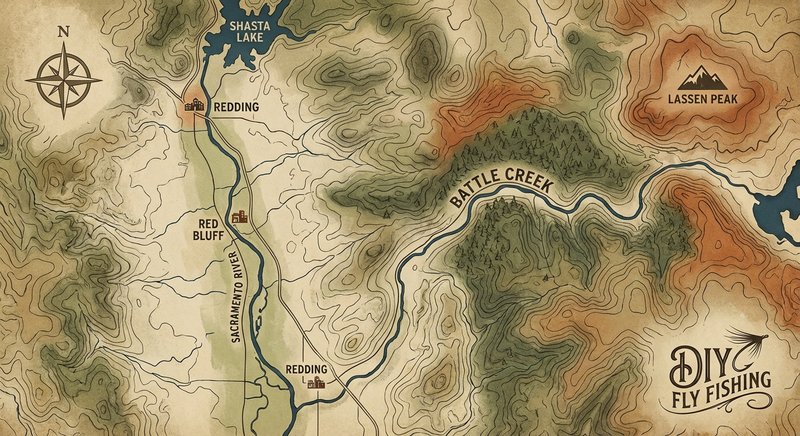
Battle Creek is one of the most vital and beautiful tributaries of the Sacramento River in Northern California. Flowing from the volcanic slopes of Mt. Lassen down to the valley floor near Cottonwood, it offers a dramatic split personality: a rugged, high-gradient trout stream in its upper reaches and a critical spawning corridor for steelhead in its lower section.
As a guide, I consider Battle Creek a "hidden gem" that requires effort to fish but rewards the persistent angler with wild, hard-fighting fish in a spectacular volcanic landscape.
🎣 Location Overview
Battle Creek is defined by its volcanic heritage. The water is cold, clear, and nutrient-rich, carving through deep basalt canyons. It is divided primarily into the North Fork, the South Fork, and the Main Stem.
What makes it special is the ongoing Battle Creek Salmon and Steelhead Restoration Project. Millions of dollars have been spent removing dams to reopen prime spawning habitat. The upper forks offer classic "pocket water" fishing among volcanic boulders, while the lower reaches provide a more intimate steelhead experience than the massive Sacramento River nearby.
🐟 Target Species & Behavior
Rainbow Trout (Resident)
- Behavior: Found predominantly in the North and South Forks. These are wild, opportunistic fish. In the fast-moving water, they don't have long to decide, making them aggressive hitters.
- Holding: Look for "pillows" in front of boulders, soft seams next to fast chutes, and the tail-outs of deep pools.
- Feed: Their diet consists heavily of caddis larvae, stoneflies (Golden and Pteronarcys), and opportunistic terrestrial drops in the summer.
Steelhead (Anadromous)
- Behavior: These are Central Valley Steelhead that enter from the Sacramento River. They are known for being exceptionally "hot" and acrobatic.
- Holding: They hold in the lower main stem, often in walking-speed water or deep slots near the Coleman National Fish Hatchery.
- Feed: Once they enter the creek, they are focused on the spawn. They will strike out of aggression or to feed on the eggs of spawning Chinook salmon in the fall.
📅 Best Times to Fish
- Spring (April - June): This is the prime window for the North and South Forks. As the snowmelt from Lassen recedes, the hatches go wild. You’ll see prolific Mother’s Day Caddis hatches and the beginning of the Stonefly activity.
- Summer (July - August): While the valley floor bakes, the upper forks stay cool due to spring-fed flows. This is "Short-Sleeve" fishing time—perfect for dry flies and hopper-dropper rigs in the higher elevations (Manton area).
- Fall (September - November): The Trophy Window. This is when the Steelhead arrive in the lower sections. It also coincides with the Salmon spawn; the resident rainbows move down to gorge on eggs, providing some of the fastest fishing of the year.
🪰 Recommended Flies & Techniques
Techniques
- High-Stick Nymphing: Because the creek is so bouldery, traditional indicator nymphing can be tough with complex currents. Using a Euro-style or high-stick method to keep your line off the water is lethal here.
- Dry Fly / Dropper: In the summer, a buoyant foam hopper with a small bead-head nymph (like a Perdigon) 2 feet below it is the standard "scouting" rig.
- Swinging (Lower Creek): For Steelhead, swinging small, dark leeches or traditional wet flies on a light sink-tip can be very effective during low light.
Top Fly Patterns
- Nymphs:
- Pats Rubber Legs (Black/Tan) #6-10 (The "steak and potatoes" of Battle Creek).
- Mercer’s Micro Mayfly (Olive/Brown) #16-18.
- Glo-Bugs or Bead Eggs (Fall only, for Steelhead/Resident Rainbows).
- Dries:
- Elk Hair Caddis (Tan) #14-16.
- Chubby Chernobyl (Golden/Pink) #8-12.
- Adams Parachute #14-18.
- Streamers:
- Zonkers or Small Wooly Buggers (Olive/Black) to mimic sculpins.
💡 Pro Tips & Local Knowledge
- Mind the Rocks: The volcanic basalt in Battle Creek is incredibly slick and often sharp. Studded wading boots are a must. I also highly recommend a wading staff; the "bowling ball" bottom of the creek has claimed many cell phones and fly rods.
- The "Manton" Access: For the North and South Forks, head toward the town of Manton. There are public access points near the powerhouses.
- The Egg Bite: In October, find a pod of spawning salmon in the lower creek. Fish an egg pattern 10-15 feet behind them. The resident rainbows will be stacked there like cordwood, waiting for a stray egg to drift by.
- Stealth is Key: Because the water is often crystal clear, your shadow will spook fish 20 feet away. Approach pools from downstream and keep a low profile.
⚠️ Important Information
Access
Large portions of Battle Creek flow through private ranch land. Respect "No Trespassing" signs. The best public access is near the Coleman National Fish Hatchery (lower) and the Wilderness Woods/Manton area (upper). Always use a mapping app (like OnX) to ensure you are on public land.
Regulations
Battle Creek has very specific regulations that can change based on the section of the creek and the time of year.
- Check the CDFW (California Department of Fish and Wildlife) "Special Regs" before you go.
- Typically, the creek is Catch and Release only with Barbless Hooks in many sections to protect the dwindling steelhead and salmon populations.
- Certain sections are closed during specific months to protect spawning fish.
Conservation
You are fishing in a sensitive restoration area. Handle all fish with wet hands, keep them in the water, and if you see a salmon on a redd (a gravel nest), do not walk through it or fish for it. Let them spawn in peace so we have fish for the next generation!
Bug Hatches & Matching Flies
| Hatch | Type | Peak months | Time of day | Hook sizes | Matching flies |
|---|---|---|---|---|---|
| Salmonfly Pteronarcys californica | stonefly | May, June | All day | #4-8 | Chubby Chernobyl #6-8, Pats Rubber Legs #4-8 |
| Blue Winged Olive Baetis | mayfly | February, March, April, October, November | Late Morning/Afternoon | #18-22 | RS2 #20-22, Parachute Adams #18-22 |
| Golden Stonefly Hesperoperla pacifica | stonefly | June, July | Morning/Evening | #8-12 | Golden Rogue Stone #8-10, Iron Lotus #12-14 |
| Pale Morning Dun Ephemerella | mayfly | June, July | Late Morning/Early Afternoon | #14-18 | Sparkle Dun #16-18, Military Mayfly #16-18 |
| Spotted Sedge Hydropsyche | caddis | May, June, July, August | Evening | #14-18 | Elk Hair Caddis #14-16, LaFontaine's Deep Sparkle Pupa #14-16 |
| October Caddis Dicosmoecus | caddis | September, October, November | Afternoon/Evening | #8-12 | Orange Stimulator #8-10, Pecka's October Pupa #10-12 |
| Little Yellow Stonefly Isoperla | stonefly | June, July, August | Evening | #14-16 | Yellow Sally Dry #14-16, Little Yellow Sloan #14-16 |
| Midges Chironomidae | midge | December, January, February | Late Morning | #20-24 | Zebra Midge #20-22, Griffith's Gnat #20-22 |
| Grasshoppers Acrididae | terrestrial | August, September | Afternoon | #8-12 | Morrish Hopper #10-12, Dave's Hopper #8-12 |